 Himal Press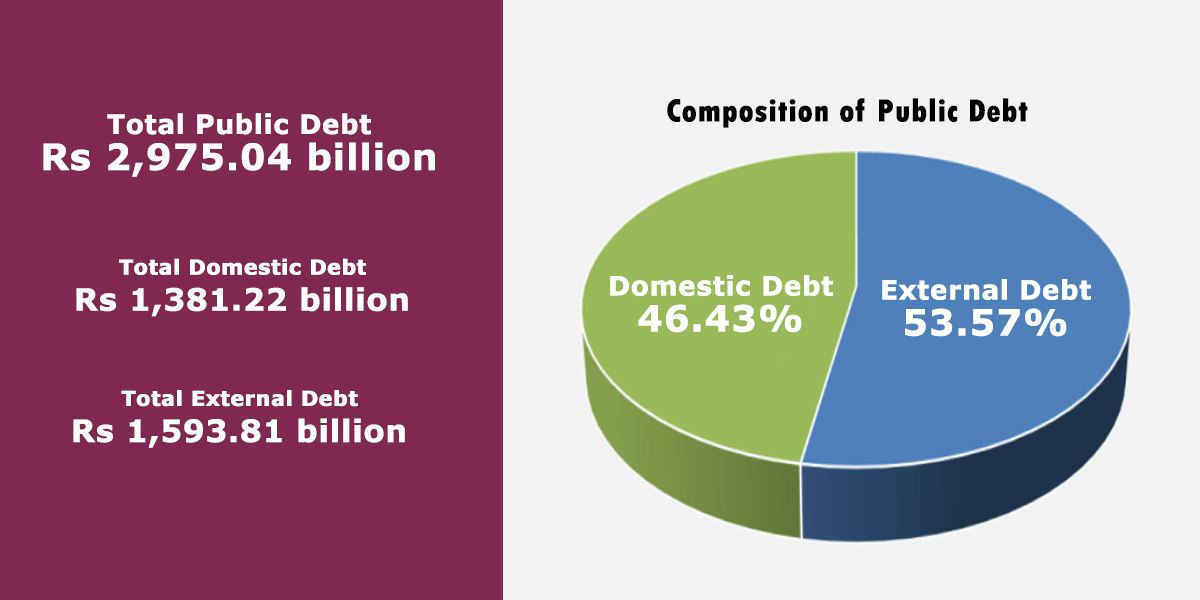
KATHMANDU: Nepal’s total public debt rose by 11% over the first 10 months of the fiscal year, largely due to foreign exchange loss of Rs 167.75 billion, the Public Debt Management Office said in its monthly report on Tuesday.
Total debt liability increased by Rs 300.99 billion to reach Rs 2,975.04 billion at mid-May of the current fiscal year. Such liability stood at Rs 2,764.04 billion at the beginning of the fiscal year in mid-July last year. The rise has pushed the country’s debt burden to 45.08% of the gross domestic product (GDP).
The increase suggests that the government has continued to rely heavily on borrowing to finance budgetary needs amid weak revenue growth and rising expenditure obligations. Although the debt-to-GDP ratio is below levels considered critical for many developing economies, the steady rise indicates that fiscal strain for the government is mounting.
External borrowing accounted for 53.57% of the total debt, or Rs 1,593.81 billion, while domestic debt made up 46.43%, or Rs 1,381.22 billion.
According to PDMO, external debt accounts for 24.15% of GDP, while domestic debt is worth 20.93% of GDP. The data show that higher dependence on foreign borrowing has exposed the country’s debt portfolio to exchange rate fluctuations.
The data also shows that the government has been more successful in raising funds domestically than from external sources during the review period. The government has set a target of mobilizing Rs 595.66 billion in public debt for the fiscal year 2025/26. However, only Rs 365.16 billion, or 61.3% of the target, had been raised by mid-May. Domestic debt mobilization reached 82.50% of its annual target, while external debt mobilisation lagged far behind at just 28.46%. Domestic borrowing accounted for 81.79% of the total debt raised during the review period, while external sources accounted for only 18.21%.
According to PDMO, the government spent Rs 292.52 billion on debt servicing in 10 months. This amounts to 71.17% of Rs 411.01 billion set aside for financial management in the current fiscal year. The debt servicing costs accounted for 4.43% of GDP. The growing debt servicing burden indicates that an increasing share of government resources is being used to repay existing loans rather than fund development projects and public services.
Of the total debt servicing, Rs 60.59 billion went to interest payments and Rs 231.92 billion to principal repayment.