
The Gen Z movement on September 8 and 9 has created a new political situation in Nepal. The interim government formed after the uprising has announced that elections to the House of Representatives will be held on 5 March next year. The responsibility for conducting these elections lies with the Election Commission (EC).
As part of its election management duties, the EC must address the growing use of information technology and social media with great care. A large portion of Nepal’s population now relies on social media as their primary source of information. However, verifying the authenticity of online content is not easy. The rapid evolution of artificial intelligence has further complicated this task, enabling the creation of deep fakes—manipulated audio-visual content that combines real and fabricated elements to spread hatred, misinformation and disinformation.
The EC began using social media for voter education in 2017 and has been implementing its Social Media Usage Policy since 2020. As an interactive, technology-based medium, social media can make the electoral process more effective, transparent and credible. It helps disseminate election-related information, address grievances, and encourage voter participation—particularly among youth and those in remote areas. It also provides a vital platform for two-way communication between the EC and the public.
While social media offers many positive opportunities for election management, it also poses significant challenges. Online content often reflects individual opinions and cannot be easily edited or censored; even a single false or misleading post can erode public trust in the entire electoral process. During elections, social media platforms are frequently used to spread misinformation, propaganda, hate speech, misinterpretation and external influence through fake accounts, bots, clickbait, deep fakes, AI misuse and defamation campaigns.
Cybersecurity, Disinformation and Hybrid Threats
This scribe recently participated in the Canberra Fellowship Programme organized by Australia’s Department of Foreign Affairs and Trade (DFAT) from May 24 to June 1. The fellowship focused on cybersecurity, disinformation and hybrid threats. While in Australia, the Nepali delegation held extensive discussions with Australian government agencies, universities and research institutions.
The delegation included Policy Research Institute member Indra Kumari Adhikari; Executive Director of the Nepal Institute for International Cooperation and Engagement (NIICE) Dr Pramod Jaiswal; Director of the Center for Social Innovation and Foreign Policy (CESIF) Ajay Bhadra Khanal; Associate Professor at Tribhuvan University Lekhnath Pandey; and Executive Director of Youth Innovation Lab Pradeep Khatiwada.
Participants learned how various countries are addressing digital challenges and developing effective strategies to counter them. This scribe also gained insights into how election commissions can monitor and control social media misuse—such as violations of the election code of conduct, disinformation, propaganda and hate speech—through advanced and technology-friendly tools. Discussions with Australian experts revealed that balancing security and freedom of expression remains a complex challenge.
DFAT’s Cyber Security Division provided an overview of Australia’s multi-layered cyber strategy, shared lessons from major cyber incidents in the health, telecommunications and financial sectors, and highlighted the success of the eSafety program and ongoing debates around deep fake regulation. These insights underscore that cybersecurity is not only a technical issue but also an ethical one.
Engagements with representatives of the Australian Electoral Commission were particularly insightful. They share details about their digital literacy campaigns conducted in 13 languages, misinformation tracking systems and integrated physical-digital security measures to safeguard voting integrity. Such practices could serve as valuable models for strengthening Nepal’s election security. Similarly, journalists from ABC Verify demonstrated open-source intelligence tools used in fact-checking and emphasized that tracing the source of misinformation is often more effective than merely debunking it, as it helps citizens remain informed and resilient.
Misinformation refers to the creation and dissemination of false or exaggerated information about events or issues for personal or political gain. Such content often goes viral because it appears credible but is neither verified nor fact-checked. These misleading materials not only violate legal standards but also confuse the public. All stakeholders must therefore take the impact of misinformation on social media seriously and work to mitigate its negative effects.
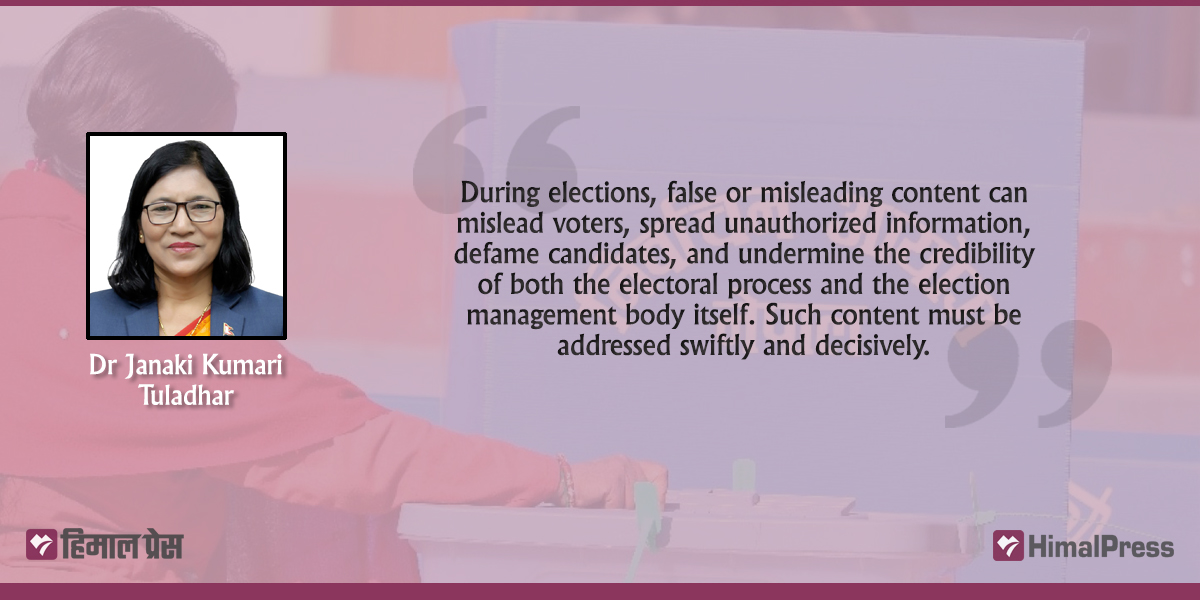
During elections, false or misleading content can mislead voters, spread unauthorized information, defame candidates, and undermine the credibility of both the electoral process and the election management body itself. Such content must be addressed swiftly and decisively.
Elections are the means through which people choose their leaders. However, social media can be exploited by political parties, candidates and their supporters to disseminate false, misleading or fabricated information aimed at swaying public opinion. This manipulates voter perception and threatens the integrity of the democratic process. A well-informed electorate is therefore essential for a strong and effective democracy.
The Election Commission has been introducing policies, strategies and guidelines to curb the spread of misinformation during elections. It is crucial to establish an empowered mechanism—adequately resourced and legally authorized—to monitor and regulate social media effectively. Clear legal provisions are also needed to identify and take action against the sources of false or misleading information.
It is, however, impossible to monitor all online activity across multiple platforms. Determining what type of content should be regulated and how to trace its origin remains one of the major challenges. Understanding local contexts and people’s social media usage patterns is therefore essential.
During the 2022 elections, the EC collaborated with social media companies to remove false and misleading content. It has since incorporated provisions on social media misuse into election laws and codes of conduct. Raising public awareness and ensuring cooperation among all stakeholders remain crucial to counter misinformation and promote accurate information during elections.
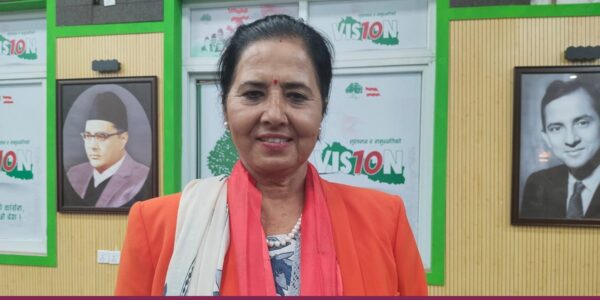
Dr Tuladhar is an Election Commissioner.