 Himal Press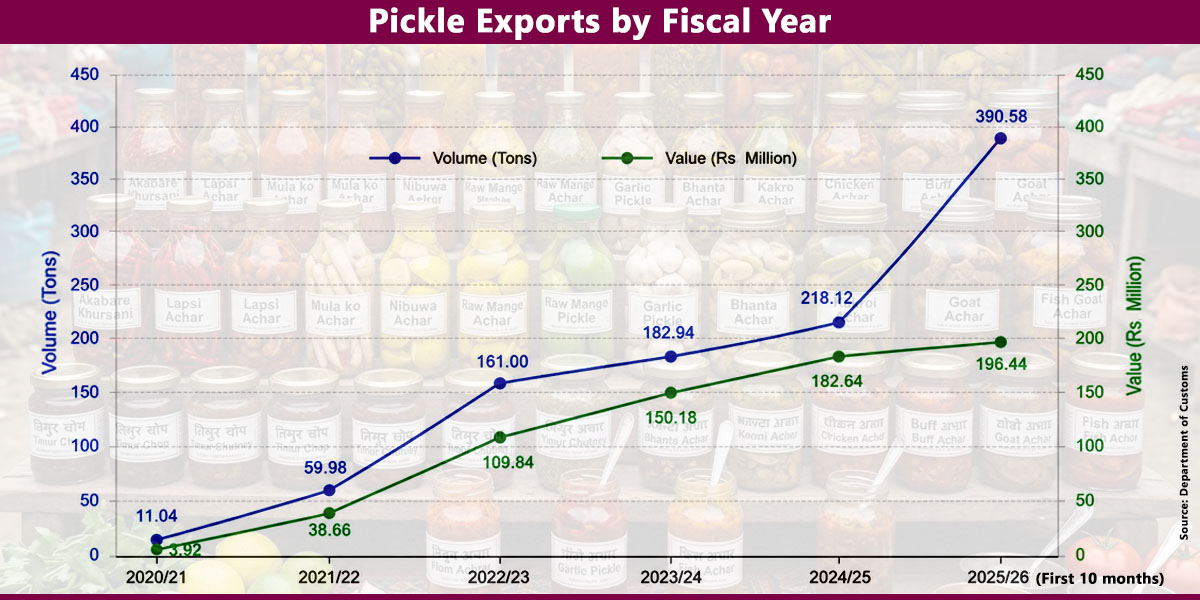
KATHMANDU: Known locally as achar, pickles are moving from their traditional role as a popular condiment in Nepali meals to become one of the nation’s fastest-growing export commodities.
Thanks to an expanding global diaspora seeking a taste of home, this culinary tradition is rapidly transforming into a multi-million rupee international trade for the country.
Recent data released by the Department of Customs show Nepal exported 390.58 tons of pickles valued at Rs 196.44 million over the first 10 months of the fiscal year 2025/26. This represents a whopping 174.43% surge in volume and a 55.99% increase in monetary value compared to figures of the same period of the previous fiscal year. In the first 10 months of 2024/25, Nepal exported 142.32 tons of pickles worth Rs 125.93 million.
The United Kingdom emerged as the top destination for Nepali pickles during the review period, accounting for 95.11 tons valued at Rs 32.84 million. Australia was next with an import of 73 tons worth Rs 35.02 million, while Canada ranked third, absorbing 71 tons valued at Rs 32.65 million. Sizable volumes were also dispatched to several other nations, including 57.26 tons to Italy, 49.72 tons to Japan and 20.65 tons to South Korea.
The Department of Customs began recording pickle trade data during the 2020/21 fiscal year, when shipments totaled a modest 11.04 tons valued at Rs 3.92 million. Since then, the numbers have skyrocketed with every passing year. Exports grew fivefold to 59.98 tons worth Rs 38.66 million in 2021/22, while they climbed to 161 tons worth Rs 109.84 million in 2022/23. Pickle exports grew further to reach 218.12 tons worth Rs 182.64 million in 2024/25.
One of the reasons for this phenomenal growth is the rising number of Nepalis who have migrated abroad or are living in a foreign country for study or work. For the diaspora, these traditional pickles offer an emotional connection and a memory of their homeland. This initial community consumption has triggered a ripple effect. As international stores stock up to meet the demands of Nepali residents, the distinct flavors have begun attracting foreign consumers as well.
This growing international appetite is fueling a boom in domestic manufacturing. A large number of pickle-producing industries have surfaced across the country. Most of these enterprises are owned and operated by women, and mostly include women in the local workforce.
Prominent domestic brands like Aama Ko Achar, Kitchen Recipe, Ghar Ko Achar, Desana, Achar Freak and Anjana Ko Achar, among others, are leading the market, processing a diverse array of distinct flavors. They export a wide range of products, ranging from the fiery Akabare chilies, tart Lapsi hog plums to citrus-rich Nibuwa, as well as radish, mango and garlic. Of late, the demand for non-vegetarian varieties made from chicken, buffalo, fish and goat meat is also rising.