 Himal Press
Highlights:
- The feasibility of introducing a peer-to-peer (P2P) lending framework based on individual credit-scoring systems to be studied.
- Fixed exchange rate regime with the Indian rupee now made an intermediate target, not an anchor of monetary policy
- Commercial banks to be encouraged to invest in foreign government securities
- The loan-to-value ratio for large electric vehicles used as public transportation to be eased.
- Special policy arrangements to be made to manage non-performing loans of sick industries
- Reviewing classification of banks and financial institutions and encouraging them to expand services in targeted sectors.
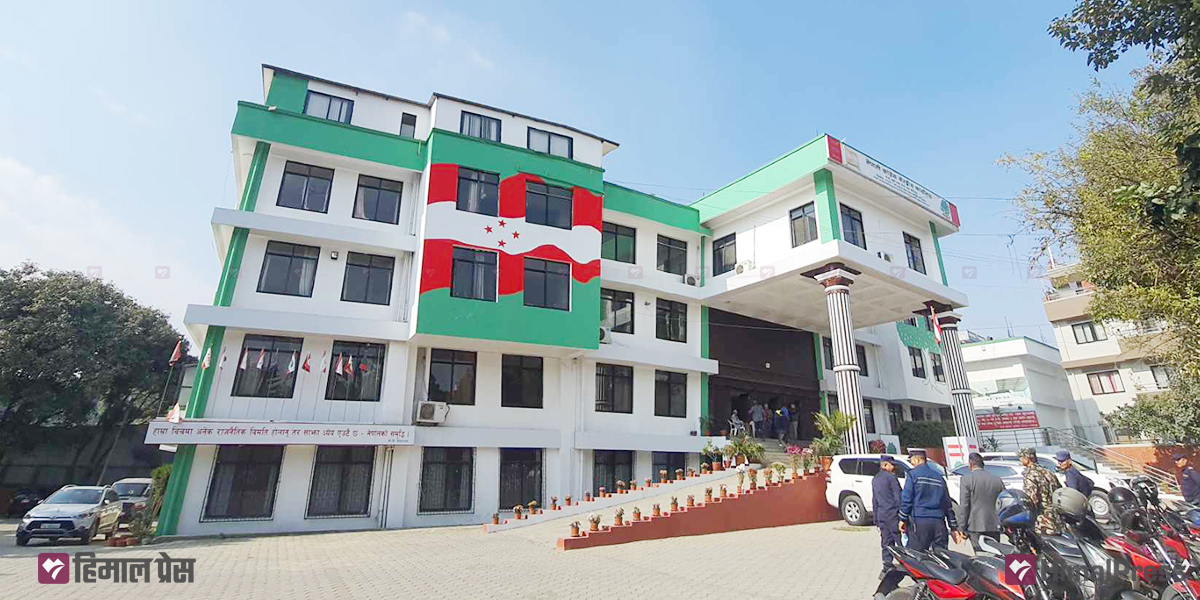
KATHMANDU: The Nepal Rastra Bank (NRB) has kept key rates and policies unchanged in the Monetary Policy for Fiscal Year 2026/27.
The policy unveiled on Tuesday outlines a cautious yet growth-supportive policy direction aimed at maintaining macroeconomic stability while ensuring adequate liquidity for economic expansion. The central bank has said that it would arrange the necessary liquidity and foreign exchange reserves to achieve the government’s target of 7% economic growth, contain inflation at 5.5%, and ensure sufficient foreign exchange reserves to cover imports for at least seven months.
While keeping the weighted average interbank rate of banks and financial institutions, which serves as the operational target of monetary policy, unchanged, the NRB has said that open market operations will be conducted to keep the interbank rate close to the policy rate. “For this, instruments of various maturities will be utilized for the management of structural liquidity as well as regular and contingency liquidity, depending on the nature of liquidity,” the central bank added.
The central bank has said that the fixed exchange rate regime with the Indian rupee, which had been the anchor of monetary policy in the past, will be maintained as its intermediate target.
To manage liquidity effectively, the central bank has said that it will use a mix of short-term and long-term instruments, including regular and standing liquidity facilities depending on market conditions. Key monetary instruments under the interest rate corridor, including the policy rate, standing deposit facility rate, and bank rate, have been kept unchanged. Similarly, existing provisions related to the cash reserve ratio (CRR), statutory liquidity ratio (SLR), and standing liquidity facilities will continue in the coming fiscal years as well, according to the central bank.
The NRB has also announced measures to ease liquidity management through foreign exchange operations, including encouraging commercial banks to invest in foreign government securities and conducting sterilized interventions.
The monetary policy says it will continue to use macroprudential tools to address systemic risks, acknowledging that monetary policy alone may not be sufficient to mitigate emerging vulnerabilities in specific sectors.
The NRB has also committed to advancing financial sector reforms, including improving governance in banks and financial institutions, promoting digitalization, and reducing operational costs to enhance service quality.
It also plans to implement regulatory measures based on an ongoing study on the classification of banks and financial institutions and encourage them to expand services in targeted sectors.
The NRB has also said special policy arrangements will be made to eliminate the situation where unlimited liability is created from personal guarantees as a form of credit security; to manage non-performing loans of sick industries; to reduce the situation where access to banking services are restricted for individuals who are blacklisted due to cheque dishonour cases; to rehabilitate stressed loans; to determine loan limits for shares as collateral based on the strength of the institution; and to ease the loan-to-value ratio for large electric vehicles used as public transportation.
The central bank has also said that it would simplify regulatory directives, particularly those related to lending, interest rates, and consumer protection, while streamlining foreign exchange regulations.
Additionally, the NRB has said that it would study the feasibility of introducing a peer-to-peer (P2P) lending framework based on individual credit-scoring systems.
The NRB expects inflationary pressure, driven partly by external factors, to gradually ease in the coming months and remain within the targeted range over the fiscal year. However, it has signaled readiness to review its policy stance if inflation rises, liquidity conditions tighten, or financial stability risks intensify. The central bank has said that it would adjust the interest rate corridor accordingly in such scenarios.
The central bank has also emphasized policy stability, noting that macroprudential measures will only be revised in exceptional circumstances to ensure predictability and support market confidence.