
 Himal Press
 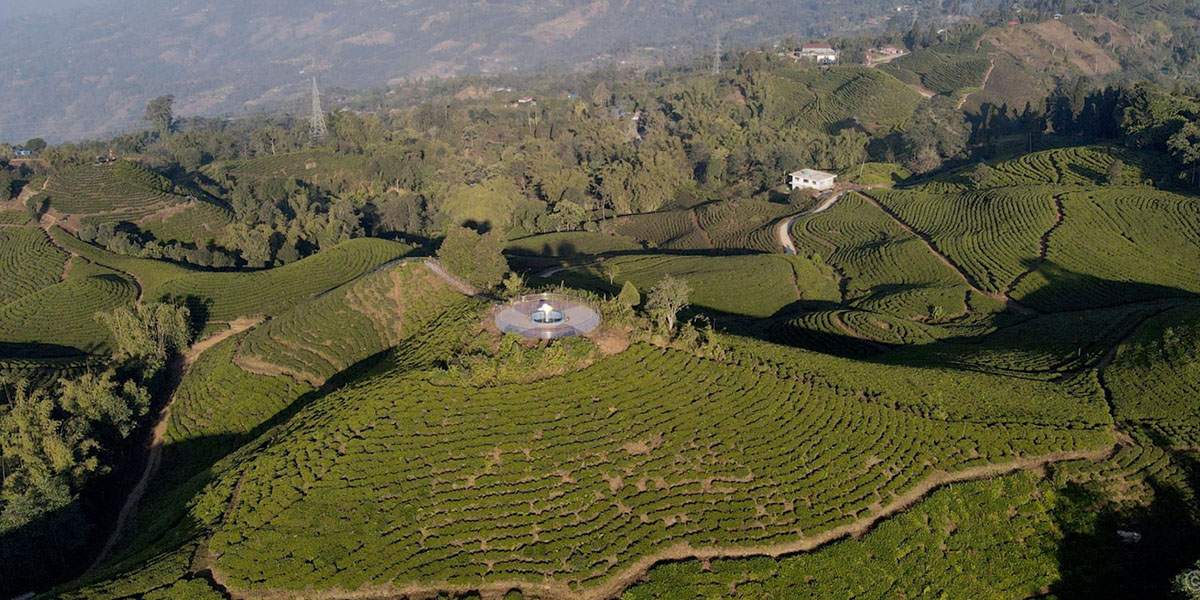 This file photo shows Panitar Tea Garden in Deumai of Ilam. (Photo: RSS)
KATHMANDU: Nepal’s tea exports have come to a halt after India imposed barriers on imports of tea produced in the country.
Tea exporters say shipments have stalled after Indian authorities increased procedural hurdles at customs points under the pretext of tea testing.
India is the primary market for tea produced in Nepal. Nepal exported 15.59 kilograms of tea worth Rs 4.59 billion in the fiscal year 2025/26. Of them, 14.97 million kilograms worth Rs 3.96 billion were exported to India.
Nepali exporters say Indian importers procure green leaves from Nepal, process them, package them as an Indian product, and export them to third countries. This time, however, traders say that India has blocked Nepali tea right in the peak plucking season.
Exporters say Indian officials have begun conducting quality checks at Kakarbhitta and other border points, and are allowing the product into India only if it meets their prescribed standards starting May 1. They say that while testing was previously conducted only once, it is now required for every shipment.
“Earlier, they would test the quality of Nepali tea twice a year. Now, they are saying that every consignment must be checked,” said Kamal Mainali, president of the Nepal Tea Association. “It takes 14 days to receive a report. Where are we supposed to keep the tea in the meantime?” he questioned. “Export to India has become very cumbersome and expensive. We haven’t been able to export Nepali tea for the past eight days.”
As per the circular of the Tea Board of India, samples must be collected randomly from two out of five containers within 24 hours of the arrival of the consignment.
Nepali tea is widely regarded as high-quality in the global market and often considered superior to tea produced in India. According to Uday Chapagain, founder of Gorkha Tea Estate, the new measures are influenced by Indian tea traders seeking to curb competition from higher-quality Nepali tea.
“We sell premium tea, which India cannot match in quality. That is why India has occasionally created obstacles,” Chapagain said. “This time, it amounts to an undeclared blockade on Nepali tea.”
Exporters also say Indian state governments, under pressure from domestic farmers, have periodically imposed such restrictions. “Whether in the name of quality or testing, India keeps troubling us,” Chapagain added.
Lab test of tea samples is not only expensive but also time-consuming. Rabin Rai, general secretary of the Central Tea Cooperative Union, said sample collection at the border, reports must be collected from Kolkata, which takes 14–15 days. “Testing every single truckload is simply not feasible. How are we supposed to manage this?” he said, adding that India has previously obstructed tea exports on various pretexts.
Why have exports stalled?
India has introduced a new rule requiring 100% laboratory testing of tea imported from Nepal, effective May 1. The move follows recommendations from an Indian parliamentary committee to tighten monitoring and control of tea imports from other countries.
Under the new provision, every consignment of tea exported from Nepal must now undergo full laboratory testing each time. Previously, exports were subject to a risk-based testing system.
Although India claims the rule is intended to prevent the distribution of substandard tea, Nepali exporters say it has imposed significant financial burdens and stress. Entrepreneurs like Chapagain describe the move as an undeclared blockade against Nepal. “India always finds one excuse or another,” he said.
Tea shipments bound for India are stranded at different border points at present.
The disruption has come during the main export season for first-flush tea. Tea leaves plucked between early mid-March and early April are considered to be of the highest quality. Since the leaves are the first to sprout after pruning and have not yet been exposed to rainfall, they are considered the best.
“This is the time when we should be exporting our premium tea to third countries,” Chapagain said. “We cannot resolve this alone—the state must intervene.”
According to the National Tea and Coffee Development Board, discussions are underway with the Indian side to facilitate exports. Officials are scheduled to hold talks at the Ministry of Industry, Commerce and Supplies on Monday.
“We are looking for ways to ease the process and resume exports,” said Deepak Khanal, a member of the board.
The Ministry of Commerce and Supplies has also stated that efforts are ongoing through diplomatic channels to resolve the issue. Ministry Spokesperson Netra Prasad Subedi said they were coordinating with tea producers and exporters to address the problem.
According to the latest data from the National Tea and Coffee Development Board, tea is cultivated on approximately 20,760 hectares in Nepal, with annual production reaching around 26.98 million kilograms.












![Yosin pole raised as Indrajatra festival begins in Kathmandu [In Pictures]](https://en.himalpress.com/wp-content/uploads/2026/09/Indrajatra-5-600x300.jpg)