 Himal Press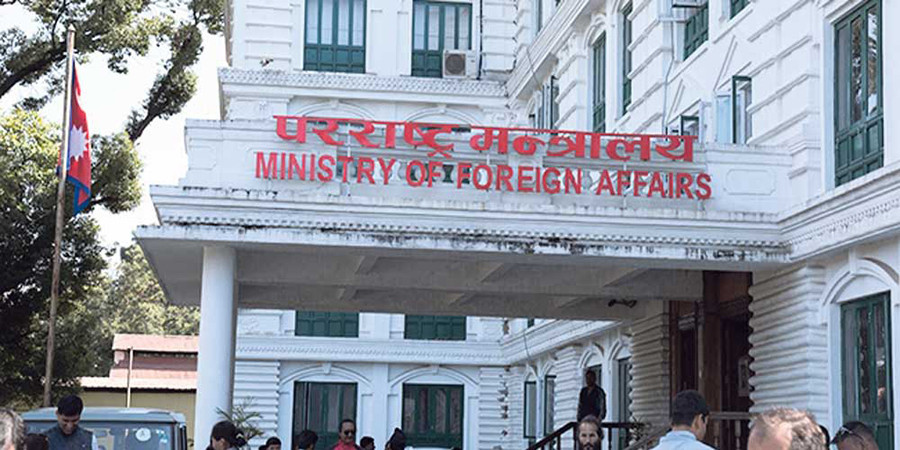
KATHMANDU: With the government preparing to reduce the number of ministries, attention has now shifted to restructuring internal bureaucratic systems, particularly the Ministry of Foreign Affairs, amid growing calls for a leaner, more strategic diplomatic apparatus.
The push comes at a time when the government is facing increasing pressure to expand development spending while controlling administrative costs. Policy experts say downsizing ministerial structures, by reducing divisions and departments, is a necessary step toward making the state more efficient and financially sustainable.
The ministry currently has two departments—the Department of Passport and the Department of Consular Services—15 divisions, 31 embassies, three permanent missions, and 10 consulate offices abroad. Despite this extensive presence, the system is neither efficient nor output-driven, with many missions reduced to ‘resting posts’ and some facing a shortage of staff.
The state invests a significant amount of money in maintaining diplomatic missions. Along with salaries and allowances, diplomats are entitled to housing, food, insurance, and education expenses for up to two children until they turn 18. However, these investments have not translated into meaningful diplomatic or economic gains for the country. Critics say Nepali missions, with a few exceptions, have struggled to deliver tangible results in promoting trade, attracting foreign direct investment (FDI), and upholding strategic diplomacy.
Over the past 15 years, the government has opened 19 new missions. These missions collectively cost the state over Rs 6 billion annually. More than 20 of these missions are considered largely ineffective. In the United States, Nepal operates five separate missions—an embassy in Washington, a permanent mission and a consulate in New York, and consulates in Dallas and San Francisco. Together, these five missions cost the state over Rs 1 billion annually. Despite this, Nepal’s trade with the US accounts for less than 2% of its total foreign trade.
The performance of missions in other countries is no different. The embassy in Brazil costs the state around Rs 70 million annually. However, exports to the country remain negligible. Missions in South Africa, Spain, Portugal, and Denmark have also come under scrutiny. Even the relevance of the permanent mission in Vienna has been questioned. In the Gulf region, experts suggest that embassies in Oman, Bahrain, and Kuwait could be managed from missions in the United Arab Emirates (UAE) and Saudi Arabia, where the concentration of Nepali migrant workers is significantly higher. They say the consulate in Dubai is also irrelevant, as Dubai is less than a two-hour drive from Abu Dhabi
The ministry’s internal structure also appears bloated. A single department employs nearly 50 staff, including a director general, multiple undersecretaries, and technical personnel. When combined with personnel across divisions, missions, and consulates, the administrative burden is very high.
Critics say any restructuring should focus on consolidating divisions along regional and thematic lines. For instance, separate divisions for Europe and the Americas could be rationalized, while economic diplomacy, labor migration, and diaspora engagement could be merged into a single, stronger unit. Likewise, public diplomacy should be expanded to include digital diplomacy, enabling Nepal to promote its global image, attract investment, and engage its diaspora more effectively at lower cost.
Countries such as Norway, Singapore, New Zealand, Vietnam, Bangladesh, and India have adopted lean but effective diplomatic models tailored to their economic capacities. These countries prioritize regional engagement, labor destinations, multilateral platforms, and digital tools to maximize impact while minimizing costs. New Zealand, for example, has reduced its number of missions and adopted a regional representation model, while Singapore relies on non-resident ambassadors and specialized teams. Norway focuses on neighboring regions and multilateral diplomacy, and India combines regional divisions for efficient resource use. Vietnam has also emphasized economic diplomacy and digitized much of its diplomatic engagement. Experts say Nepal should adopt similar approaches, particularly given its remittance-driven economy and need to attract foreign investment and aid.
Reforms are also being proposed in human resource management. Introducing mandatory diplomatic training, including a one-year certification before foreign postings, could improve professionalism. Language proficiency, such as Chinese, Japanese, or Arabic, should be made compulsory depending on regional assignments. Digital training platforms could further reduce costs while enhancing capacity.
On the administrative front, there are calls to transfer passport services to the home ministry, as is common in many countries. The foreign ministry could then focus on issuing diplomatic passports and strengthening consular services through fully digital systems.
Accountability is another major concern. The current practice of awarding near-perfect internal evaluation scores to senior officials has been criticized. Experts have recommended introducing performance contracts and digital monitoring systems, similar to those used in the UK and Australia, to ensure measurable outcomes.
The ministry should adopt a phased restructuring plan. It can focus the first year on reorganizing divisions, the second on reviewing and reducing missions, and the third on strengthening training and capacity-building.
Proposals also include clearly categorizing missions. Priority missions would include key countries such as India, China, the United States, the UAE, Qatar, Saudi Arabia, Japan, and major European partners. Others, such as Canada, certain European countries, and smaller Gulf states, could be managed through regional hubs or periodic high-level visits. Similarly, consulates could be limited to essential locations like Kolkata and Lhasa. This would significantly reduce administrative and operational costs.
Ultimately, the effectiveness of Nepal’s diplomacy will depend not on the number of embassies it maintains, but on how strategically it deploys its resources. A leaner structure, backed by professional human resources and digital innovation, could enable Nepal to overachieve without overburdening its limited budget.