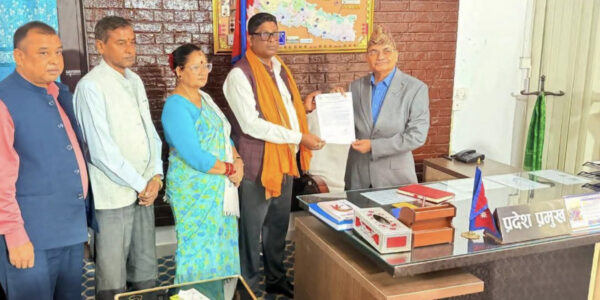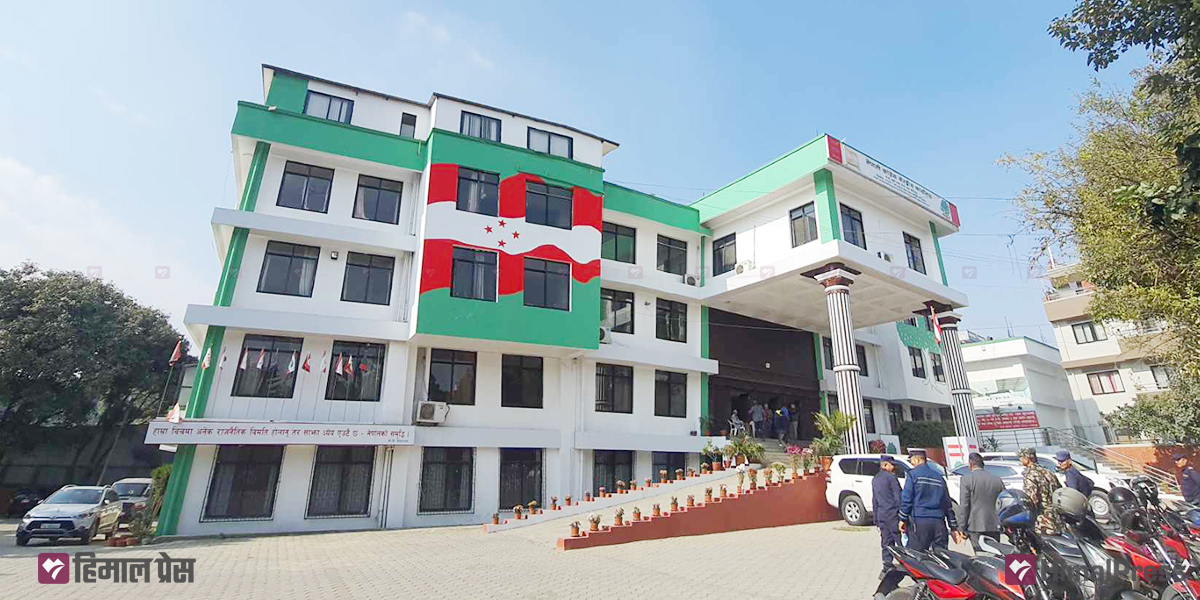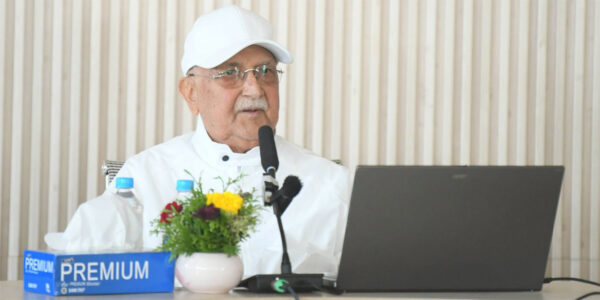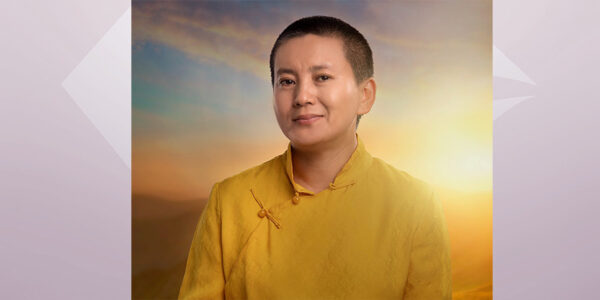
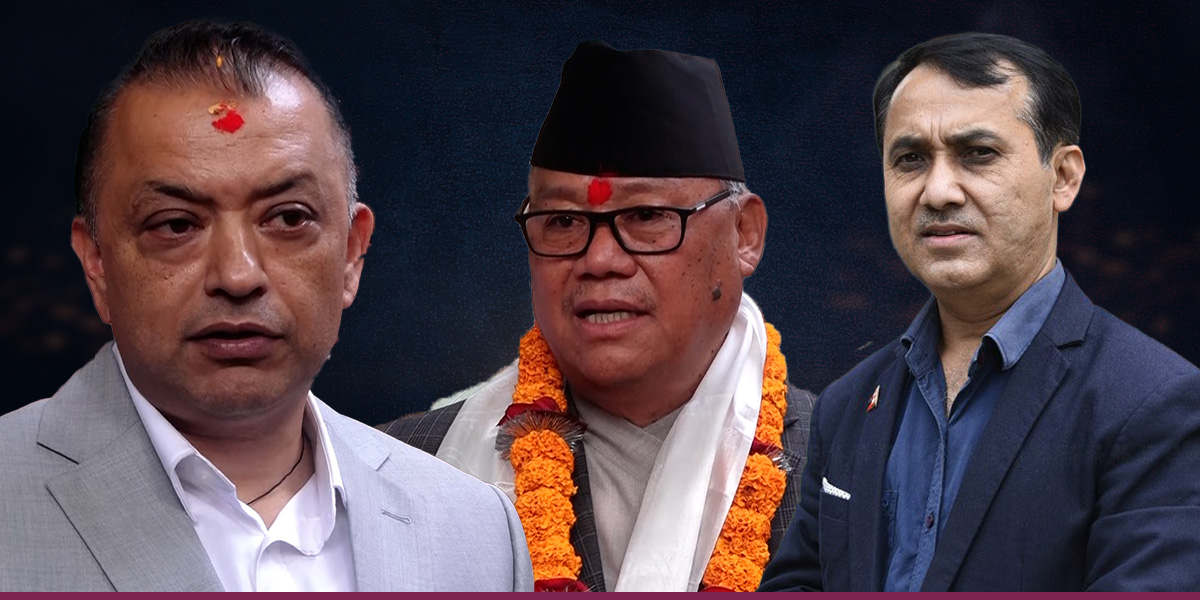
 This combo photo shows NC parliamentary party leader Bhishma Raj Angdeme flanked by President Gagan Kumar Thapa (left) and Vice President Bishwa Prakash Sharma.
KATHMANDU: Although the Nepali Congress (NC) claims to have transformed itself, its recent actions suggest a growing tendency to limit internal competition. The latest example of this is the party’s decision to select Bhishma Raj Angdembe as the parliamentary party leader unopposed, even though there were multiple aspirants for the position.
The top leadership appears to have dominated the decision-making process. While several leaders were interested in the post, the final choice was settled through consensus among senior leaders. As a result, younger lawmakers and those elected under the first-past-the-post (FPTP) system were denied the opportunity to compete.
Observers say that as the practice of selecting leaders through consensus replaces elections, internal procedures, transparency, and institutional democracy within the party are weakening.
Political analysts say the party ignored democratic norms in the selection process, which was held one and a half months after the House of Representatives election results were announced. The other five parties represented in the lower house selected their parliamentary party leaders within a few weeks.
Party leaders, however, argue that an election was avoided because there were too many contenders. “In this situation, we felt there was no need to create winners and losers, so consensus was reached,” Ajay Babu Shivakoti, a leader considered close to party president Gagan Kumar Thapa, told Himal Press.
Angdembe, who was chosen leader, had long been seen as close to former party president Sher Bahadur Deuba. But after he reportedly showed signs of distancing himself from the Deuba camp, other contenders were persuaded to step aside in the name of consensus, according to one party leader.
That leader added that Thapa himself ultimately stepped back. President Thapa had reportedly favored Mohan Acharya from Rasuwa for the position, while Vice President Bishwaprakash Sharma supported Angdembe. Disagreements between Thapa and Sharma delayed the selection process. In the end, Thapa himself proposed Angdembe’s name.
“Angdembe is capable of uniting everyone. That is why the decision was made to select him unanimously,” Shivakoti said.
Although Angdembe was presented as a leader who emerged from eastern Nepal, analysts note that there was no shortage of lawmakers elected under the FPTP system from Koshi Province.
“The Congress is becoming an autocracy within internal democracy,” said youth leader Dharma Raj Shahi. “If people are pushed forward in this way, it threatens not only democracy within the party, but democracy in the country,” Shahi said. “If this was done to maintain unity, that is understandable. But if this continues, we will become like the communists.”
There are also complaints that directly elected MPs were ignored in choosing the parliamentary party leader. The party currently has five MPs under the age of 40. Among them, Nischal Rai and Basana Thapa were considered contenders, but they were not allowed to compete, according to one NC lawmaker.
Basana and Nischal were later made Chief Whip and Whip of the party in the House of Representatives.
Analysts say that by promoting 66-year-old Angdembe, the party overlooked 35-year-old Nischal, who was elected from Ilam-1.
This is not the first time the party has avoided internal competition. During its special general convention held in January, office-bearers were also selected unopposed. That convention brought Gagan Thapa to the presidency, while Bishwa Prakash Sharma and Pushpa Bhusal were elected vice presidents. Gururaj Ghimire and Pradeep Paudel were unanimously chosen as general secretaries.
Ironically, many senior leaders in the past had argued that internal elections were necessary to strengthen party democracy. In 2022, Gagan Thapa himself contested against the then-party president Sher Bahadur Deuba for parliamentary party leader. Deuba won 64 votes, while Thapa secured 25.
After losing that race, Thapa had vowed to continue competing. “I lost the election today, but I will contest again whenever necessary,” Thapa had said. “Today the party president has won, but from now on I will continue trying to become parliamentary party leader.”
Now, party insiders say, the same Thapa has helped block competition.
Before the decision to pick Angdembe, the party’s Central Working Committee and Central Work Execution Committee discussed the issue. In these meetings, leaders reportedly pushed for a unanimous outcome rather than a contest.
Earlier, the party had formed a committee led by Assistant General Secretary Prakash Snehi Rasaili to oversee the process. Rasaili had also appealed for consensus. “We did not pressure anyone, but we did encourage leaders to reach an understanding if possible,” Rasaili said.
On UML’s Path
Many NC leaders say the party is heading towards UML’s path.
Suhang Nembang, who had earlier expressed interest in becoming the parliamentary party leader of UML, was unable to contest. The leadership backed Ram Bahadur Thapa, a proportional representation lawmaker. Suhang failed to secure even a proposer or seconder to file his nomination.
One UML leader said that after General Secretary Shankar Pokharel and Secretary Bhanubhakta Dhakal intervened in the selection process, even leaders initially supporting Suhang shifted to Thapa.
Competition for parliamentary party leadership has largely disappeared in the UML as well.
Before becoming party chairman in 2014, KP Sharma Oli had defeated the then-chairperson Jhalanath Khanal and rose to prominence also through his victory as parliamentary party leader. But since Oli took over the leadership, internal contests for the parliamentary party leadership have become virtually closed.