 Himal Press
 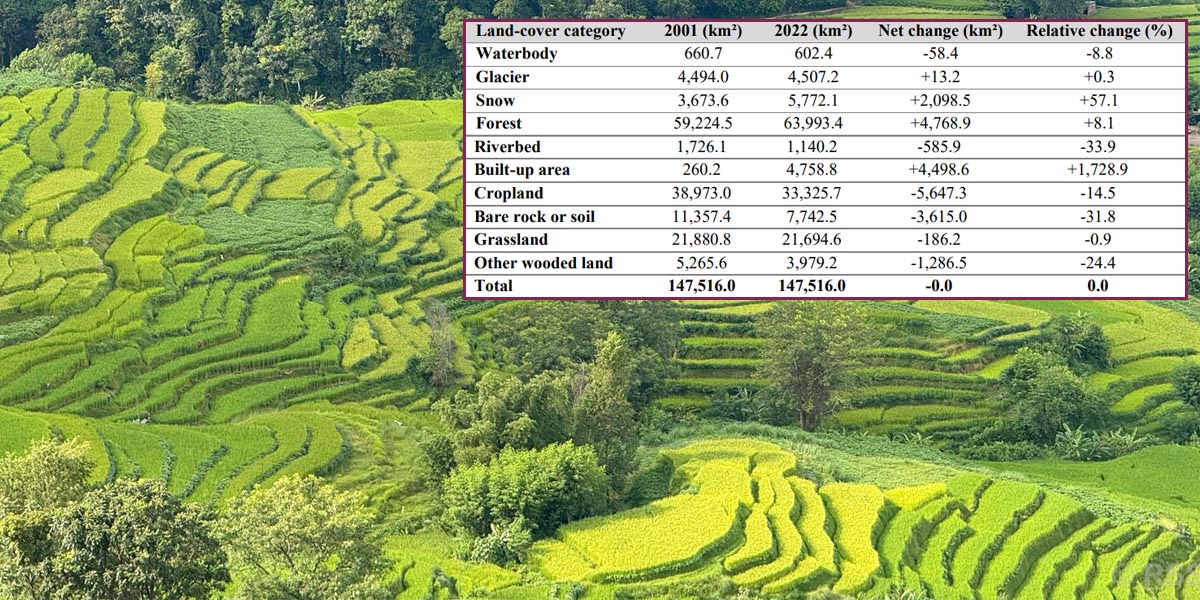 Photo: RSS Data: NSO
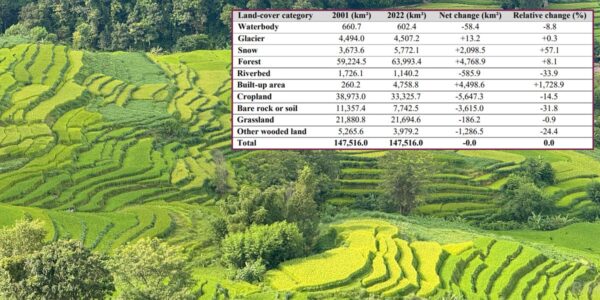
KATHMANDU: Cropland in Nepal shrank by 5,647.3 sq km, a 14.5% drop over the past two decades, as rapid urbanization and forest expansion consumed vast swathes of agricultural land between 2001 and 2022, according to a new study by the National Statistics Office.
The study shows total farmland in the country declined from 38,973 sq km in 2001 to 33,325.7 sq km in 2022. It found that cropland gained 4,713.5 sq km from other categories during the review period but lost a staggering 10,360.8 sq km. This resulted in a net loss of 5,647.3 sq km during the review period.
According to the study, much of the lost agricultural land was converted into built-up areas and forests. Of the 4,503.6 sq km of land newly classified as built-up, 3,559.3 sq km, or 79%, had previously been cropland. Meanwhile, some 5,891.8 sq km of cropland was converted into forest, while 1,626.3 sq km of forest changed into cropland.
Built-up areas expanded nearly 18-fold in two decades, largely at the expense of cropland, while forest cover also increased significantly during the period. The study, which analyzed changes in Nepal’s land cover between 2001 and 2022, found that built-up areas increased by 4,498.6 sq km, from just 260.2 sq km in 2001 to 4,758.8 sq km in 2022. This represents a 1,728.9% increase and makes built-up areas 18.3 times larger than they were in 2001.
Built-up areas refer to any geographic zone dominated by man-made structures such as residential buildings, commercial complexes, industrial facilities and associated infrastructure like highways.
Grassland accounted for another 621.6 sq km of the new built-up expansion, while 164.4 sq km came from riverbeds and 113.3 sq km from forest.
The study also found a substantial increase in forest cover in the study period. Forested areas expanded by 8.1% in two decades, rising from 59,224.5 sq km in 2001 to 63,993.4 sq km in 2022. The study found that forests gained approximately 9,707.7 sq km from other land-cover types while losing 4,938.9 sq km.
The study also recorded changes in high-altitude land cover. Snow-covered areas increased by 2,098.5 sq km, or 57.1%, while glacier coverage remained almost unchanged, increasing by 13.2 sq km, or 0.3%.
Water bodies declined by 58.4 sq km, while riverbeds shrank by 585.9 sq km. Bare rock or soil decreased by 3,615 sq km and grassland declined marginally by 186.2 sq km. Other wooded land declined by 1,286.5 sq km.