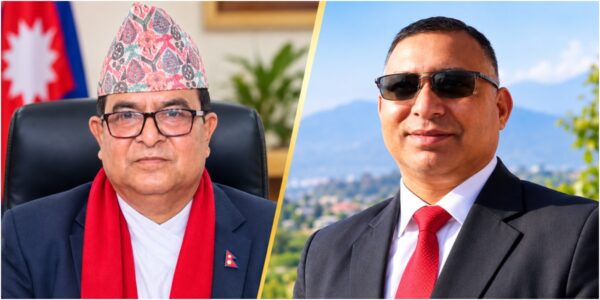

Back-to-back visits to India by Rastriya Swatantra Party (RSP) President Rabi Lamichhane and Minister for Foreign Affairs Shishir Khanal have significantly boosted camaraderie between New Delhi and Kathmandu. Lamichhane visited India on June 1-5 at the invitation of India’s ruling Bharatiya Janata Party (BJP), while Khanal visited the southern neighbor on June 5–7 at the invitation of Indian External Affairs Minister Dr S Jaishankar.
The Indian establishment appears to be taking the generational shift in Nepali politics seriously, as evidenced by the exceptionally warm welcome extended to Lamichhane. From a ceremonial welcome with flower petals to high-level meetings with India’s Home and Foreign Ministers, and even Prime Minister Narendra Modi, the reception for the RSP president was remarkably cordial. Interestingly, Lamichhane’s op-ed in an Indian newspaper published during the visit candidly outlined the kind of relationship the RSP envisions with New Delhi. While both Lamichhane’s political outreach and Foreign Minister Khanal’s diplomatic engagements have fostered new bonhomie, they have also generated contrasting narratives and perceptions within the public sphere. Did Nepal-India relations truly deteriorate before the RSP took the reins with a near two-thirds majority? And what exactly is the RSP trying to signal with its statement, “We do not carry any baggage from the past”? This article tries to explore these questions.
Whether it is Lamichhane’s article or his hour-long conversation with Prime Minister Modi, it is clear that Nepal is keen to cautiously advance its “development diplomacy” while navigating the multidimensional nature of the bilateral relationship. Following their meeting, PM Modi said on X that Nepal remains a priority partner under India’s neighborhood first. “Nepal is a priority partner under our Neighborhood First policy, and we look forward to collaborating with the new government to elevate the special and multifaceted relationship between the two countries to greater heights.”
By focusing on sectors like connectivity, IT, and industrial growth, the RSP’s goal of partnering in India’s economic trajectory is not entirely new. The sectors Lamichhane proposed to New Delhi are essentially an updated version of the “HIT formula”—originally shared by Modi himself during his historic 2014 address to Nepal’s Constituent Assembly. Between 2014 and June 2026, considerable progress has been made in cross-border infrastructure, including roads, railways, waterways, transmission lines, and digital payment systems. However, political ties have faced turbulent patches over this period. According to the 2025/26 Economic Survey published by the Ministry of Finance, India, which previously held the top spot for foreign direct investment in Nepal, has slipped to second place. While a growing trade deficit is a challenge for Nepal, growing bilateral electricity trade offers some respite for the country’s economy.
Before the RSP assumed power, a coalition government of the Nepali Congress (NC) and the CPN-UML was at the helm in Nepal. KP Oli was appointed Prime Minister on July 15, 2024. A few months later, on December 4, during Oli’s visit to China, Nepal signed the BRI Cooperation Framework Agreement. This move led some analysts to speculate that New Delhi might withhold a state invitation from Oli. However, India did formally invite him for a visit in September 2025. Unfortunately, that trip was aborted, and Oli was forced to resign after a massive, violent “Gen Z” protest in the second week of September. Even though Oli’s visit fell through, then-Foreign Minister Arzu Deuba still managed to hold crucial bilateral meetings with Jaishankar and Modi.
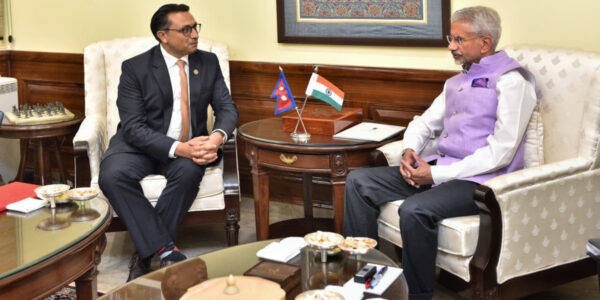
Building on that diplomatic momentum, Nepal’s current Foreign Minister, Shishir Khanal, recently concluded a successful three-day visit to India. Khanal held extensive bilateral talks with his counterpart, Dr. S. Jaishankar, met with India’s National Security Advisor (NSA), engaged with prominent think tanks, and addressed the mainstream press. During the visit, the two countries agreed to operationalize cross-border P2P retail transactions. Similarly, India formally handed over 72 health-sector and 12 cultural-sector post-earthquake reconstruction projects built with Indian assistance. Likewise, a memorandum of understanding between Kathmandu University’s School of Engineering (Digital Public Infrastructure and Artificial Intelligence Center) and Digital India’s Bhasini Division to co-develop a national digital infrastructure for a “Voice First” language translation platform.
The visit also served as vital damage control on Nepal’s part. Controversial remarks regarding the Nepal-India border made in parliament by Prime Minister Balendra Shah had drawn sharp criticism at home and raised eyebrows abroad. Minister Khanal, however, was largely successful in neutralizing the burgeoning negative narrative by extensively engaging with the Indian mainstream media.
Even though Lamichhane and Khanal insist that they “do not carry any old baggage,” the Prime Minister’s border-related rhetoric within just two months of taking office has inadvertently created fresh baggage that the RSP—and future political forces—will have to manage. While the emotional “roti-beti” bond is a defining feature of the relationship, the civilizational ties between the two countries is an undeniable reality. This relationship is deeply anchored at the grassroots level and cannot be easily derailed by political whims. Given its extraordinary public mandate, the RSP should instead use its political capital to systematically resolve the structural hitches that have long weighed down bilateral ties.
Ultimately, it remains to be seen how effectively the RSP’s diplomatic initiatives and economic collaboration with India will translate into domestic development. One thing, however, is certain: if the political chemistry between Rabi Lamichhane and Balendra Shah remains strong, their combined clout has the potential to resolve long-standing historical misconceptions while executing a highly successful strategy of development diplomacy.
(The author is an independent researcher. He can be reached for comments at X.com/randhirJNK)


![Yosin pole raised as Indrajatra festival begins in Kathmandu [In Pictures]](https://en.himalpress.com/wp-content/uploads/2026/09/Indrajatra-5-600x300.jpg)