 Himal Press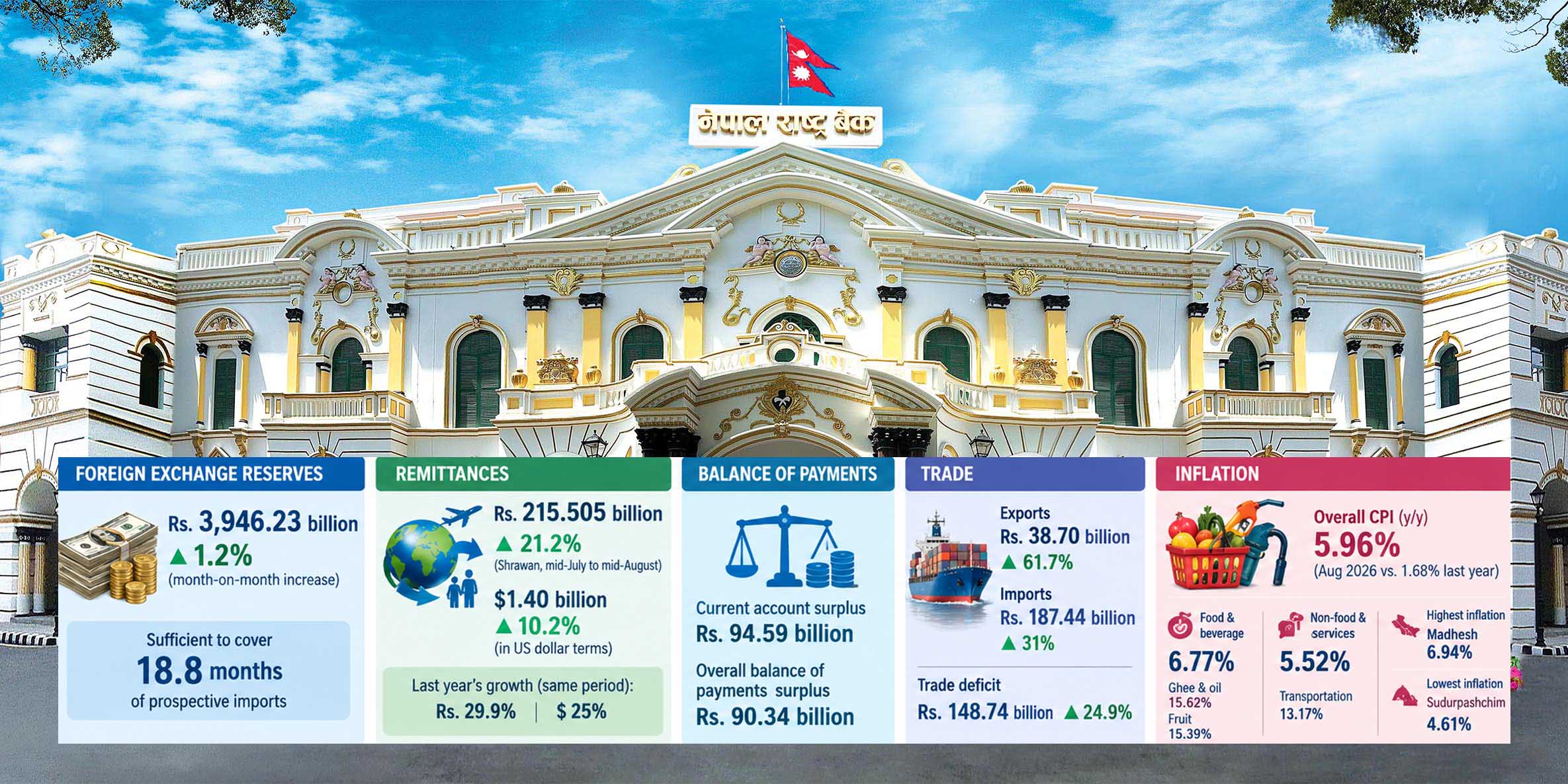
KATHMANDU: Foreign exchange reserves, remittance inflows and the balance of payments remained robust in the first month of the current fiscal year, ending mid-August 2026, while year-on-year consumer inflation accelerated sharply compared to the same period last year.
According to the latest macroeconomic and financial situation report released by Nepal Rastra Bank (NRB), gross foreign exchange reserves increased by 1.2% during the review month to Rs. 3,946.23 billion. The reserves are sufficient to cover prospective merchandise and services imports for 18.8 months.
Rising foreign exchange reserves can be attributed to healthy growth in remittance flows over the past couple of years. The central bank report shows remittances rose 21.2% to Rs 215.505 billion in Shrawan (mid-July to mid-August). In the same month of the previous fiscal year, remittances had gone up by 29.9%. In US dollar terms, remittances grew by 10.2% to 1.40 billion in the review
period. Such inflow had increased 25% in the same period of the previous year.
Thanks to healthy remittance flows, the country’s current account recorded a surplus of Rs. 94.59 billion, while the overall balance of payments also remained in surplus at Rs. 90.34 billion.
Merchandise exports increased 61.7% to Rs. 38.70 billion, while imports rose 31% to Rs. 187.44 billion. A larger import volume meant the country’s trade deficit widened by 24.9% to Rs. 148.74 billion.
On the domestic front, the economy has started to see inflationary pressures. The central bank report shows year-on-year consumer price inflation stood at 5.96% in mid-August, compared with 1.68% a year earlier.
Food and beverage inflation reached 6.77%, with ghee and oil prices rising 15.62% and fruit prices increasing 15.39%. Inflation in non-food and services stood at 5.52%, driven in part by a 13.17% increase in transportation costs.
Among provinces, Madhesh recorded the highest inflation at 6.94%, while Sudurpashchim recorded the lowest at 4.61%.
Meanwhile, interest rates are showing no signs of increasing. The weighted average deposit rate of commercial banks fell to 3.15% from 4.02% a year earlier, while the average lending rate dropped to 6.48% from 7.76%.
Deposits at banks and financial institutions contracted 0.3% during the month, while private-sector credit increased 0.4%. On a year-on-year basis, deposits grew by a healthy 14.5% while credit expanded by 7%.
The latest macroeconomic situation report shows that while the country has plenty of foreign currency, rising remittances, a current-account surplus and relatively cheap credit, inflation is accelerating, the trade deficit is widening and credit demand is modest.