
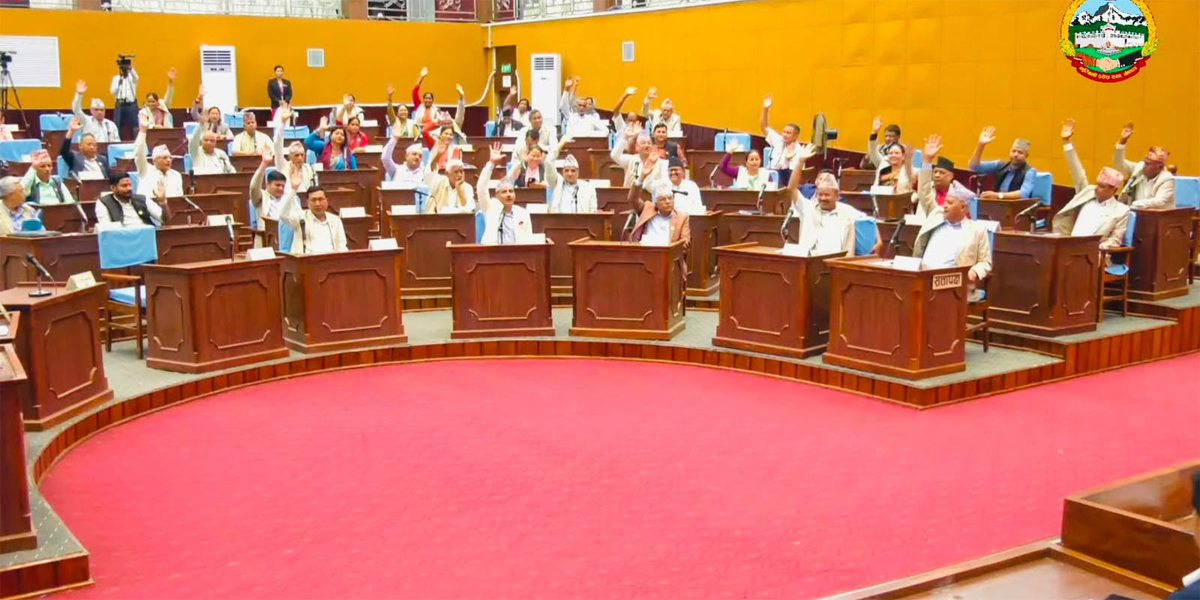
 Lumbini Province Assembly
BUTWAL: The decision of the Nepali Congress (NC) to end its alliance with the CPN-UML in all seven provinces has thrown the Lumbini Province Government into uncertainty.
Chet Narayan Acharya of CPN-UML became the province’s chief minister in July 2024 after a power-sharing arrangement was reached between the two parties.
However, NC leadership’s decision to withdraw from provincial coalition governments with the UML has put Acharya’s government at risk.
Amar Singh Pun, president of the Lumbini Province Committee of the NC, said they would abide by the central leadership’s decision and exit the government. “A decision has been made to withdraw from the government in line with direction from the party center,” Pun said. “We will initiate the process of recalling our ministers from the government as soon as we receive further instructions from the party leadership.”
Pun said they had only held preliminary discussions on the future political course and had not yet decided with whom it would form a new government. He added that the NC may also choose to sit in the opposition.
NC parliamentary party leader Dilli Chaudhary, however, appears to be in favour of continuing cooperation with the UML. Although he initially opposed the provincial budget, he later supported its passage.
Analysts say Chaudhary, who is considered close to former NC President Sher Bahadur Deuba, is willing to strike a deal with the UML if it allows him to become chief minister.
However, NC lawmaker Nima Giri dismissed the possibility of continuing the UML-Congress alliance in Lumbini alone.
“There is no need even to convene a parliamentary party meeting now. The alliance with the UML has already ended,” Giri said. “The party will now move forward as per the central leadership’s decision and seek cooperation with the Nepal Communist Party (NCP) and other parties.”
Meanwhile, the UML has stepped up internal discussions following the collapse of the alliance. Chief Minister Acharya expressed confidence that the coalition could still survive, arguing that there was no reason for the NC to be dissatisfied and that he had not yet received any formal notice from the party.
“We will review the situation at tomorrow’s cabinet meeting. If this coalition survives, we will continue with it; otherwise, we will explore other options,” Acharya said.
According to sources, Acharya is trying to preserve the coalition by honouring an earlier understanding to hand over the chief minister’s post to the NC. Dilli Chaudhary is also understood to be willing to lead the government with UML support. Some NC leaders believe Lumbini could still see a different political outcome because many of the party’s lawmakers are aligned with the Deuba faction.
Agriculture Minister Tulsi Prasad Chaudhary said the Chief Minister will seek a vote of confidence within a month as required by the law if the NC withdraws its support. “An NC finance minister presented the budget for the new fiscal year. Now it only needs to be implemented,” he said. “The decision from the center will certainly have an impact, but we are in a wait-and-watch situation.”
The NCP, meanwhile, sees an unexpected opportunity to enter government. NCP Chief Whip Indrajit Chaudhary said discussions on a new power-sharing arrangement had already begun.
“If the two major parties fail to work together, we are ready to provide an alternative,” he said, adding that the NCP was prepared to lead the provincial government.
He also said the party had initiated discussions with both the NC and the UML regarding possible cooperation.
No party commands a majority
The changing political equation has left no party or major alliance in a position to form a government without the support of smaller parties in the 87-member Lumbini Provincial Assembly.
The UML has 29 seats, the NC has 26 and the NCP has 13, including the Speaker. The Rastriya Prajatantra Party (RPP) has four seats, the Janata Samajbadi Party (JSP) Nepal three, the Janamat Party three, Janata Samajbadi Party (JSP) two, and the Rastriya Janamorcha one. There is also one independent lawmaker in the provincial assembly.
Even the NC-NCP alliance would fall five seats short of a majority. Likewise, a UML-NCP alliance would also be three seats short of the majority.
As a result, smaller parties are expected to play a decisive role in determining the next government in Lumbini.