As we live through a time of unprecedented polarization, a climate crisis and a silent epidemic of mental health issues, hope for the world’s future often feels dim. In such circumstances, we are observing Buddha Jayanti, also known as Buddha Purnima. The celebration of Buddha Jayanti becomes ever more relevant with each passing year, but this year the occasion is made more significant by an extraordinary confluence of events.
In 2026, we are observing Buddha Jayanti along with International Workers’ Day on May 1. Furthermore, we will observe International Museum Day on May 18. The theme for this year’s International Museum Day is “Museums Uniting a Divided World,” which can be interpreted as a modern Buddhist rallying call. Within this larger global context, this year’s observance of Buddha Purnima is thus endowed with an added dimension, heightened considerations, and immense potential.
The convergence of May 1, incorporating both International Workers’ Day and the Buddha Purnima, reminds us that workforce and peace are different, yet inseparable, entities in human life. The contemporary world economy is currently facing a two-pronged crisis: social disintegration and a depreciation in the quality of life. Depression and anxiety cost $1 trillion to the global economy in terms of lost economic productivity, according to the World Health Organization (WHO). Buddhism, as a wisdom-based psychology of ‘Equal Existence’ rather than just a spiritual ideology, presents an evidence-based strategy for social coherence and psychological stability.
The Science of Restoration: Neuroscience and Museotherapy
The foundations of Buddhism began in 623 BC (though some researchers claim 563 BC) when the Queen Mayadevi gave birth to the Buddha in Lumbini. The prince later attained enlightenment and gave humankind fundamental principles that serve as solutions for contemporary conflict. These fundamental principles are Ahimsa (non-violence), Karuna (compassion) and Sati (mindfulness).
The definition of Sukha (well-being) in Buddhism is not a momentary feeling, but a mental state attained by the end of Dukkha (suffering). These values are not only ethical suggestions; they are strategic pillars for diplomacy and social cohesion in the 21st century.
Modern research confirms that this is not merely theological. Studies in Mindfulness-Based Stress Reduction (MBSR) and neuroaesthetics demonstrate that “slow looking,” spending contemplative time with spiritual artifacts, triggers dopamine release and reduces heart rate variability. When museums shift from “cabinets of curiosities” to “therapeutic holding environments,” they function as social pharmacies. By integrating the “Museums for Well-being” framework, institutions can offer a reprieve from digital burnout and “nature deficit disorder.” The Lumbini Museum, as a world-class spiritual laboratory, can facilitate this by moving beyond transactional site-viewing to restorative engagement.
Nepal’s Soft Power: The Spiritual Patent
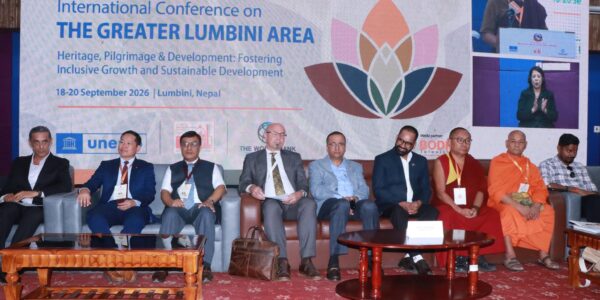
Nepal holds the “spiritual patent” to Buddhism as the birthplace of Prince Siddhartha Gautam. While military or economic hard power remains limited, Nepal’s “Spiritual Capital” is infinite. By championing Buddhist philosophy, Nepal can influence far beyond its economic weight, acting as a global vanguard for peace and a destination for millions seeking existential meaning.
Expanding Lumbini into a world-class, contemplative museum complex would create “sticky soft power”—a form of influence that persists because it is emotionally embedded in the visitor’s experience. But owning this sacred site is not enough; it should be oriented toward an institutionalized, broad soft power strategy for Nepal. According to political scientist Joseph Nye, soft power is the ability to shape preferences through attraction rather than coercion. For Nepal, this attraction is rooted in cultural purity.
Some renowned museums around the world have already adopted well-being as a mission by adapting the Buddha’s mindfulness philosophy. For example, the Rubin Museum in New York has run weekly 20-minute mindfulness sessions since 2015, focusing entirely on Buddhist meditation philosophy. On average, more than a thousand people participate in these weekly sessions, and the growing numbers demonstrate the popularity of the program. Similarly, Canterbury Museums in the UK host “Mindfulness Mondays” for children aged 5-14 to help manage mental health.
This evidence shows that Buddhist wisdom is practiced globally as a healing social pharmacy. Unfortunately, Nepal has not yet started systematic healing practices in its museum based on this wisdom, even as it is increasingly demanded by the world. By using the Lumbini Museum as an agent of global healing, Nepal can increase its ability to act as a connecting power in a divided world and lead the practice of spiritual diplomacy. This is not simply about ICOM’s 2026 International Museum Day’s theme; it is about securing the future of the Lumbini brand. A museum committed to our common humanity should not confine itself to a repository of the past; it should be a laboratory for the future. When Ahimsa, Karuna and Sati are incorporated at the top policy levels, Buddhism can be the “connective tissue” that heals our fractured society.
Way Forward
The recognition of Buddhist philosophy as a way of life for universal harmony is increasing day by day. The importance of the Buddha Purnima is enormous, as it celebrates the Buddha’s birth, enlightenment and Mahaparinirvana. The day, therefore, is a perfect opportunity to raise global awareness of his teachings.
Even though most people are familiar with the Buddha, many still do not know that he was born in Lumbini, Nepal. It is an unfortunate gap in information that many remain unaware of this historical and cultural fact. Therefore, it is crucial to optimize the message of the Buddha’s birthplace alongside his wisdom, spreading this information not only on Buddha Jayanti but also by linking it to other global occasions.
This year’s Buddha Jayanti is more meaningful because its message connects so naturally to May Day and International Museum Day. If this national celebration is effectively linked to the international level, it can explicitly showcase the relevance of the Buddhist message to contemporary challenges. It will not only present universal values but also help establish and propagate Nepal’s holy truth as the land of the Buddha.
Ghimire is the Secretary of the International Council of Museums Nepal (ICOM Nepal). He can be reached for comments at [email protected]