
ITAHARI: Even though the opposition appears weak against a government holding a commanding position in parliament with nearly two-thirds majority, a handful of lawmakers from Koshi Province have continued to question its decisions and performance. This has helped maintain a democratic balance despite the relatively weak voice of the opposition.
The government, led by the Rastriya Swatantra Party (RSP), commands a supermajority in parliament. This overwhelming support has placed it in a powerful position. Amid this dominance, many RSP lawmakers appear relatively quiet and ineffective in scrutinizing the government’s actions. Likewise, lawmakers from the opposition parties, including the CPN-UML and the Nepali Communist Party (NCP), have struggled to establish themselves as a strong opposition force.
In contrast, lawmakers representing Koshi Province from the Nepali Congress (NC) and the Shram Sanskriti Party (SSP) have taken a different approach. They have consistently challenged government policies, decisions and conduct, and are presenting themselves as active and responsible opposition figures. Though numerically weak, these lawmakers have continued to hold the government accountable from the opposition benches.
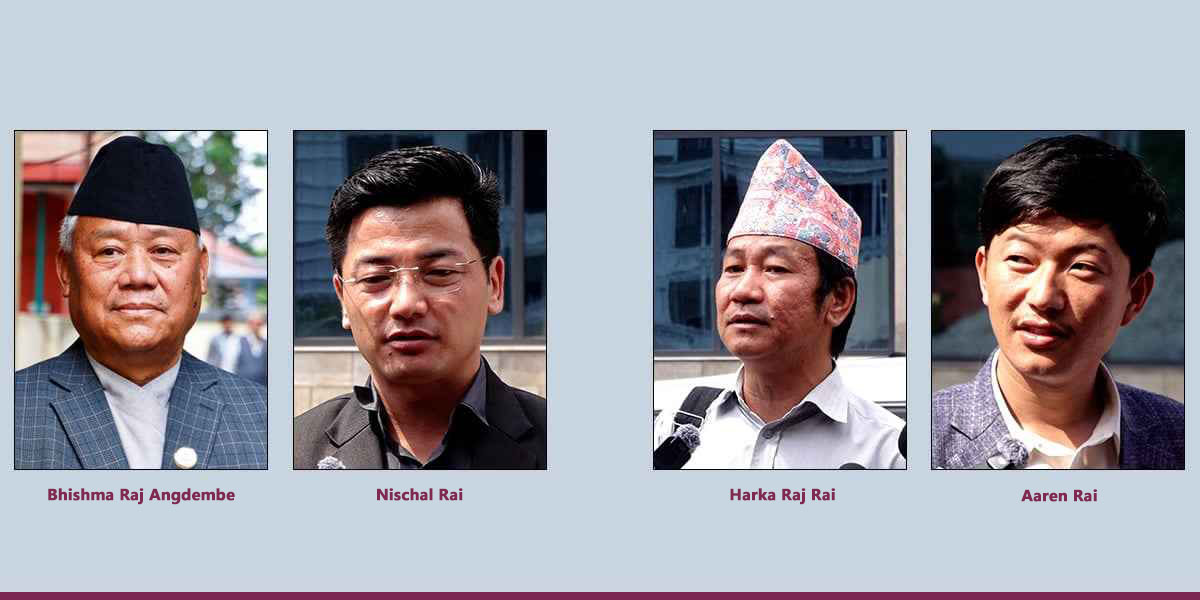
Bhishmaraj Angdembe
Bhishmaraj Angdembe, the NC parliamentary leader, represents Panchthar in the lower house. He recently gained national attention after delivering a speech in parliament that lasted nearly 40 minutes.
Angdembe’s political consciousness developed during his student years in Phidim, Panchthar, where he openly opposed the Panchayat system. Politics was also deeply rooted in his family background, as several family members had been involved in national politics over different periods. This environment naturally drew him toward organized political activity.
Active in party organization since 1980, Angdembe experienced both victories and defeats in electoral politics before establishing a notable parliamentary presence through the second Constituent Assembly election. He later chaired parliamentary committees and played an important role in policymaking and parliamentary practice.
Over the years, he rose through various ranks of the NC, from district leadership to central-level responsibilities. Today, as the leader of the main opposition party in parliament, he has emerged as one of the most prominent voices questioning the government. His calm, courteous and probing style of criticism has earned him considerable recognition.
Angdembe maintains that a parliamentary majority should never exempt a government from democratic accountability. Whether discussing legislation or matters of public concern, he has consistently sought to make the government answerable.
Nishcal Rai
Nishcal Rai, a Nepali Congress (NC) whip from Ilam, is among the lawmakers who frequently take the floor in parliament. Known as a young and educated politician, he has built a reputation not only for raising issues from his constituency but also for closely monitoring the government’s overall performance.
As an NC whip, Rai is responsible for coordinating party positions and keeping lawmakers informed about government activities. Beyond these formal duties, he has repeatedly drawn attention to issues concerning agriculture, tourism and local governance, among others, from eastern Nepal.
Rai has consistently advocated for tea farmers, black cardamom growers and infrastructure improvements in the hill districts of Koshi Province. By highlighting the gap between government policies and their implementation, Rai is performing the role of an opposition watchdog.
Harka Raj Rai
Harka Raj Rai, popularly known as Harka Sampang, has long been a prominent public figure. He rose to national fame after being elected mayor of Dharan Sub-Metropolitan City in 2022 as an independent candidate.
The SSP Chairperson is known for his unconventional political style. He has repeatedly argued that the government must remain accountable to the public, act responsibly on diplomatic matters and respond to people’s concerns. He has spoken out on issues such as landless settlers and border disputes.
According to him, a strong parliamentary majority alone cannot solve the country’s problems, and the government still has significant work to do to meet public expectations.
Rai’s political language is often direct and closely connected to ordinary people rather than the formal language of traditional politics. This has made him a frequent subject of discussion both inside and outside parliament. At the same time, he has also faced criticism for some of his social media posts and public remarks.
Aaren Rai
Aaren Rai is another young lawmaker known for his criticism of the government. An SSP lawmaker, he has emerged as one of the government’s strongest critics in parliament.
He frequently argues that development issues affecting hill districts have not received sufficient national priority. Rai regularly questions the effectiveness of government policies and programs and has repeatedly demanded greater clarity from the government regarding border disputes.
Why the opposition matters in a democracy
While these four politicians come from different political backgrounds, they are among the most outspoken critics of the government in parliament today. Despite differences in ideology, style and party affiliation, they are united by a common commitment to scrutinizing government actions.
In a democracy, the opposition is just as important as the government. Its responsibilities include acting as a watchdog over government policies and decisions, raising public concerns, defending democratic values, promoting transparency and good governance, combating corruption and maladministration and offering alternative policy perspectives.
At present, the RSP-led government enjoys nearly two-thirds support in the House of Representatives. As the government led by Balendra Shah approaches its third month in office, debate has emerged over whether it should already be subjected to strong scrutiny or be granted more time.
Preserving sovereignty, national unity and social harmony is a shared responsibility of the government and the opposition alike, as well as the public. Recent remarks in parliament by the Prime Minister regarding the Nepal-India border dispute have complicated the political environment. This has made the opposition’s role even more challenging.
Although the opposition lacks the numbers needed to mount a serious pressure on a government backed by nearly two-thirds of parliament, democracy is not merely a game of numbers. It is also a system of ideas, debate and oversight. Through questions in parliament, demands for accountability and alternative viewpoints, opposition lawmakers are helping to promote transparency, balance and good governance.
As debates intensify over government policies, budgets and development priorities, it remains to be seen whether these voices from Koshi Province will become even more influential in the coming days. For now, however, these representatives have emerged as some of the most visible figures applying pressure on the government from the opposition benches.