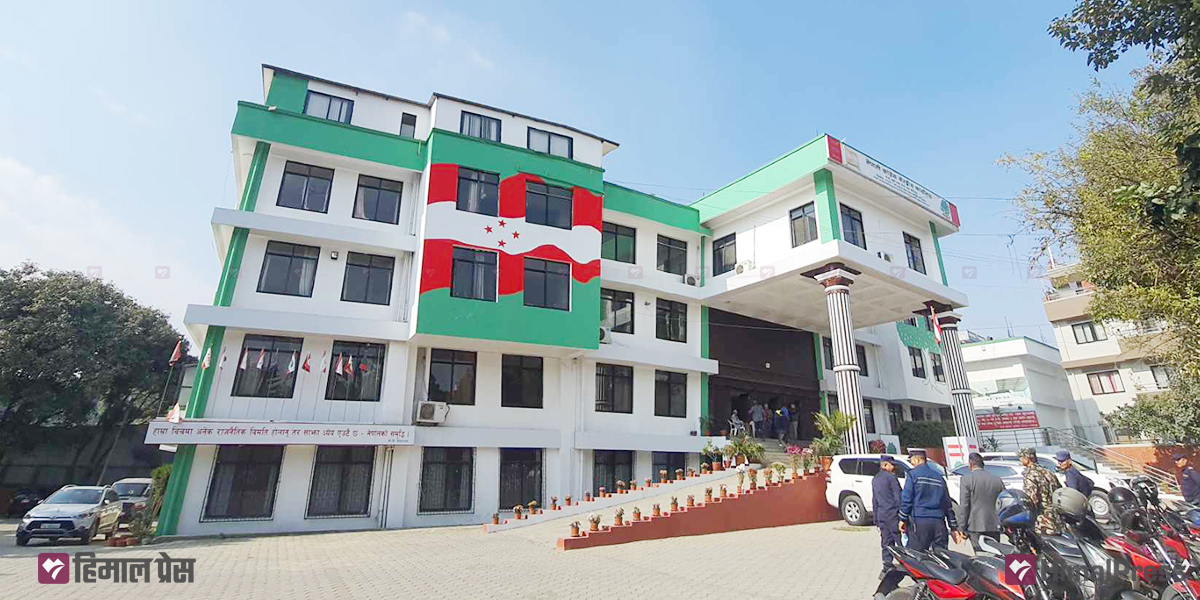


KATHMANDU: In just four years, the Rastriya Swatantra Party (RSP) transformed itself into one of Nepal’s most popular political forces. Today, however, the ruling party finds itself embroiled in controversy over its newly amended statute.
The debate surrounding the revised statute is no longer merely an internal party dispute. It is being viewed as a defining test of whether Nepal’s newest political force can live up to the democratic values and political culture it promised when it emerged as an alternative to the country’s established parties.
The amended statute has drawn criticism for granting extraordinary powers to the party president. Among its most controversial provisions are those allowing the president to remove the parliamentary party leader, appoint additional senior leaders and centralize public communication by lawmakers and party officials. Together, these changes have raised serious questions about the party’s future.
The revised statute, made public after the party’s first general convention in Chitwan, introduces a provision under which the parliamentary party leader automatically loses the position if he or she fails to follow the president’s policy directives. Clause 68 of the statute lists several circumstances under which the position becomes vacant automatically, including resignation, death, loss of parliamentary membership, expulsion from the party, losing a parliamentary vote of confidence while leading the government, failure to comply with the president’s policy directives, or the passage of a recall or no-confidence motion within the parliamentary party.
The provision has attracted particular attention because Clause 11 assigns the president responsibility for coordinating between the party and the parliamentary party. It states that when the president is not the parliamentary party leader, he or she shall provide policy guidance to ensure the effective implementation of the party’s official positions in parliament. Compliance with those directives is made mandatory for the parliamentary party, its leader and all members.
Critics say these provisions effectively empower the president to remove the parliamentary party leader simply by determining that the leader has failed to follow party directives. It also allows the party to recall its parliamentary leader. This means the position of parliamentary leader can be vacated through internal party procedures.
The controversy has deepened after some party leaders claimed that several of the disputed provisions were not included in the draft approved by delegates at the party’s general convention but were inserted afterward.
The revised statute also authorizes the president to nominate 51 members to the central committee, appoint additional senior leaders and link party discipline directly to the president’s personal directives.
These developments have raised a serious question: Is the RSP genuinely building the new political culture it promised, or is it gradually adopting the same centralized practices it once criticized in Nepal’s traditional parties?
The RSP was founded in response to what it described as excessive centralization, factionalism, personality cults, and a lack of transparency in Nepal’s established political parties.
After its formation in 2022, the party achieved a stunning victory in the 2025 general election. It secured a near two-thirds majority and formed the government. It had contested the election with a pledge to make former Kathmandu Mayor Balendra Shah, popularly known as Balen, prime minister.
Under an understanding between Balen and party president Rabi Lamichhane, Balen would lead the government while Rabi would oversee the party organization. That arrangement was widely viewed as a practical division of responsibilities rather than power struggle. However, critics now say that the amended statute reflects political maneuvering that could upset that balance and make it difficult for leaders to work independently within their respective roles.
Growing Unease Within Balen’s Camp
The amended statute has sparked growing unease among supporters of Prime Minister Balen Shah, who also serves as the parliamentary party leader.
According to leaders close to Balen, the new provisions could allow the party president to remove the parliamentary leader through internal party mechanisms. They say the provision undermines the autonomy of the parliamentary party and affects the power-sharing arrangement between Balen and Rabi.
Although Balen has not publicly commented on the issue, those close to him say he has become increasingly cautious about the direction the party is taking.
“The prime minister has always believed his focus should be on governing rather than internal party affairs,” one of his close associates told Himal Press. “But after the statute was made public, he feels he may now have to devote more attention to the party as well. His priority is on delivering results for the country, not becoming entangled in internal political maneuvering.”
Leaders close to Balen insist that two of the most controversial clauses—those allowing the parliamentary party leader to be removed for failing to comply with the president’s policy directives or through a recall process—were not included in the draft endorsed by the general convention. They allege that the provisions were inserted after the convention concluded.
Several leaders close to Balen, including Ganesh Karki, Sagar Dhakal, Bhupadev Shah and Sunil Lamsal, have described the amendments as a “warning sign” for the party’s future. They say empowering the president to remove the parliamentary leader through policy directives could weaken both the government and the party.
Political observers argue that the new provision raises broader constitutional and democratic questions. In a parliamentary democracy, the parliamentary party leader is expected to be accountable primarily to Parliament and fellow lawmakers, not to an individual party office-bearer.
While party discipline is an essential feature of parliamentary politics, they say it should be enforced through institutional mechanisms rather than through the personal authority of the party president. If the president can remove the parliamentary leader by declaring that party directives have not been followed, they argue that the parliamentary party may become subordinate to one individual instead of functioning as an autonomous democratic institution.
Some analysts say the changes resemble the concentration of power that the RSP itself once criticized in older political parties, particularly the CPN-UML under KP Sharma Oli. Others have gone further, comparing the emerging structure to the highly centralized leadership model historically associated with communist parties, where authority gradually becomes concentrated in a single leader.
“If leadership becomes permanent and institutional checks disappear,” one observer said, “the party risks repeating the very mistakes it promised to eliminate.”
People close to the prime minister say Balen has never been deeply interested in party politics. His decision to allow Rabi to manage the party organization while he concentrated on running the government reflected his belief that separating organizational and executive responsibilities would strengthen both institutions.
Since becoming prime minister, Balen has maintained a relatively low profile in party meetings and parliamentary affairs, preferring instead to focus on implementing government policies and delivering results. His strategy has been to build political credibility through governance rather than internal party influence. However, they say the amended statute has forced Balen to reconsider that approach.
The growing perception among Balen’s supporters is that the party leadership has increasingly favored its original inner circle while paying less attention to the understanding that has served as the foundation for the Balen-Rabi partnership.
A Party Divided?
The controversy has exposed what appears to be a growing divide within the RSP. Some lawmakers say the amendments have heightened concerns that internal democracy is gradually giving way to centralized decision-making.
According to one ruling party lawmaker, Rabi appears determined to consolidate his position within the party as legal cases against him gradually move toward resolution. At the same time, Balen and his supporters believe they must also prepare politically for the future.
“Things have reached the point where even speaking publicly now requires approval from the parliamentary party or the chief whip,” the lawmaker said. “If that continues, it could eventually trigger open dissent.”
Two distinct groups are increasingly visible within the party. The first consists of founding members who were involved in building the party from its earliest days. The second includes leaders and lawmakers who joined the party before the general election following the political understanding between Rabi and Balen. Many of them were later nominated to the party’s central committee.
Political history suggests that parties rarely fracture because of ideological differences alone. More often, they weaken after losing internal trust.
Major political parties in Nepal have repeatedly split not over ideology but because of disputes over leadership and the distribution of power.
Several RSP leaders say the party should remember that public support and internal authority are not necessarily the same thing. They say preserving both requires institutional trust rather than personal control.
Another provision drawing criticism is the requirement that party leaders and lawmakers coordinate with, or obtain approval from, the party’s chief whip before making public statements.
Requiring leaders to refrain from making public statements without the chief whip’s approval or coordination may appear to be a positive step from a disciplinary point of view. However, in a democratic party, there must be a balance between discipline and control. While suppressing debate to enforce uniformity may seem effective in the short term, it can ultimately stifle creativity and critical thinking over the long run.
Many successful democratic parties around the world manage differences of opinion through institutional debate rather than attempting to eliminate dissent.
The controversy has also revived comparisons with the organizational model traditionally associated with communist parties. Communist parties have historically operated under the principle of “democratic centralism,” where members are free to debate policy internally but are expected to present a united front once decisions are made.
In practice, however, critics argue that the model often evolves into highly centralized leadership, with authority increasingly concentrated in the hands of a single individual.
Observers say both the CPN-UML and the Maoist Centre have long faced criticism for allowing excessive authority to accumulate around their party president. The RSP’s amended statute, they say, risks inviting similar comparisons.
Beyond Internal Politics
The amended statute has also highlighted broader political challenges facing the RSP.
One of them is the party’s limited organizational presence in Madhesh, a region that has historically played a decisive role in Nepal’s national politics. Although the RSP won seats from Madhesh in the last general election, several party leaders now acknowledge that the organization remains weak in the province.
The issue surfaced during the party’s general convention, where the selection of delegates from Madhesh became a source of controversy. Some leaders from the province reportedly did not even attend the convention.
Dr Amresh Kumar Singh, RSP leader and lawmaker from Sarlahi-4, openly questioned the party’s strategy. “Why should I travel to Chitwan to congratulate those who have already lost?” he said, explaining his decision not to participate in the convention.
He argued that no party can truly become a national force by relying primarily on urban voters in Kathmandu or Pokhara while remaining weak in Madhesh.
The debate also carries implications beyond domestic politics. Nepal will have to navigate a complex geopolitical environment involving India, China and Western partners. Analysts say that if decision-making within the ruling party becomes excessively concentrated in one individual, foreign governments may begin to view Nepal’s policy direction as depending more on personal relationships than on institutional processes.
For neighboring countries seeking predictability and stability, transparent institutional decision-making is generally more reassuring than highly personalized leadership. If major political decisions appear to be driven by a single individual rather than by established institutions, diplomatic engagement itself may become increasingly personalized.
However, not everyone within the RSP shares these concerns. Supporters of the revised statute argue that as a relatively new governing party, the RSP requires clear lines of authority to maintain discipline, ensure policy implementation and coordinate effectively between the government and the party organization.
In their view, stronger organizational control is essential for delivering on the party’s electoral promises rather than an attempt to concentrate power.
Even so, questions continue to be raised about the expansion of the president’s authority, increased control over the parliamentary party and the growing influence of appointed central committee members.
The quiet unease among Balen’s supporters, combined with the prime minister’s increasingly visible distance from day-to-day party affairs, has only intensified speculation about tensions beneath the surface.
Ultimately, the RSP’s greatest political asset has never been simply its new faces. Its real strength has been the promise of a new political culture based on transparency, internal democracy and institutional accountability. That promise earned the party widespread public trust.
If that trust begins to erode, the party can lose the moral authority that distinguished it from the country’s other traditional political establishments.
Nepal’s older political parties gradually lost public confidence as power became increasingly concentrated around individual leaders. If the RSP follows the same path by placing personalities above institutions, prioritizing discipline over debate and concentrating authority within a small circle, it may eventually find it difficult to convince voters that it truly represents a new political alternative.
For any democratic party, the real test is not winning elections. It is whether, after gaining control of the government, it can continue to place institutions above individuals. That is the challenge now confronting the RSP.
Whether it repeats the mistakes of Nepal’s traditional parties or succeeds in creating the new political culture it once promised may well determine its long-term future. The unease within Balen Shah’s camp and the prime minister’s evolving political strategy could become the first major test of that promise.