 Himal Press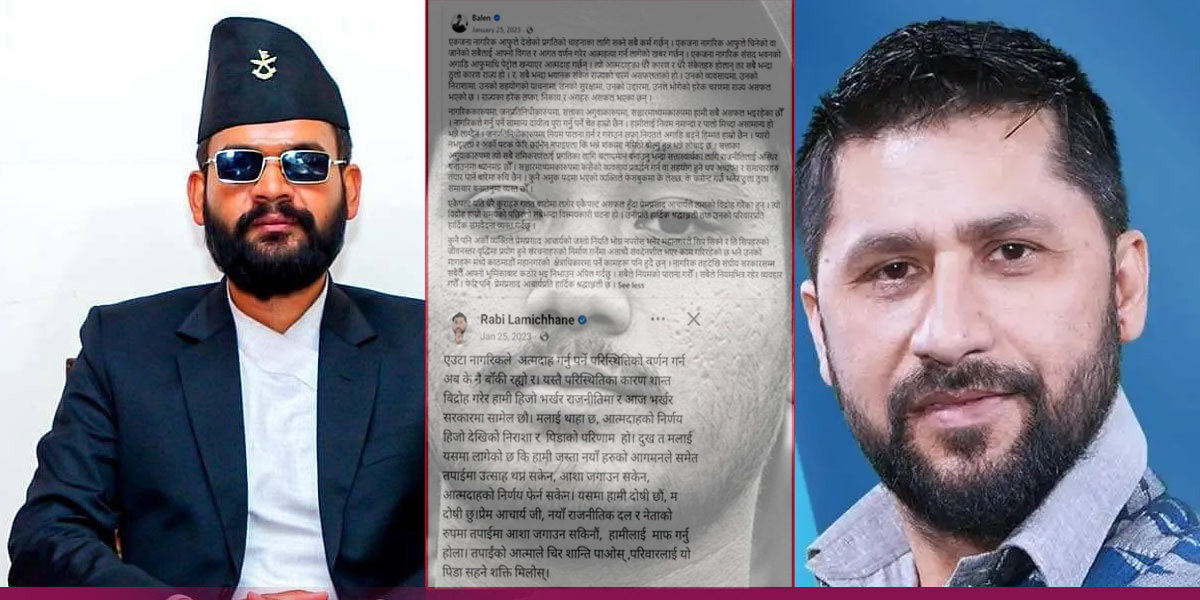
KATHMANDU: There is an enduring irony in politics: the words spoken in opposition often become the heaviest burden once a party assumes power. The death of Ganesh Nepali of Mugu after setting himself on fire has placed Prime Minister Balendra Shah and the ruling Rastriya Swatantra Party (RSP) President Ravi Lamichhane in that very position.
Three years ago, after Prem Prasad Acharya died after setting himself on fire, Shah had written: “The state is the biggest reason behind self-immolation. It is a sign of the state’s complete failure.” Similarly, Lamichhane had admitted, “We are responsible, I am responsible,” acknowledging that the state had failed to give citizens hope.
At that time, those statements were seen as expressions of political accountability and moral responsibility. Today, however, Shah and Lamichhane are themselves leading the state. The questions are therefore directed not at others, but at them. If self-immolation symbolized state failure three years ago, what does the death of Ganesh Nepali say about the state today? Is it truly a democratic achievement if citizens must risk their lives simply to be heard? When every door of the state is closed, and self-immolation becomes the only alternative left for people, it is not merely the defeat of one individual but a moral failure of the entire state machinery.
The most troubling aspect is the government’s indifference toward the pressing problems faced by ordinary people. When a person feels every avenue for seeking justice has been exhausted and is driven to the extreme act of self-immolation, it is not just a personal tragedy. It raises serious questions about the state’s sensitivity, public service delivery and accountability. Democracy is not merely a system for winning elections and forming governments; it is also about listening to people, addressing their grievances and doing everything possible to save lives until the very last moment.
Such incidents, therefore, cannot be dismissed as ordinary news stories that are forgotten with time. In a democratic system, no political achievement is greater than the protection of human life. Repeating slogans of development, good governance and change while remaining indifferent to people’s suffering undermines the very spirit of democracy. It is a matter of shame and such a situation cannot be accepted under any circumstances.
The government cannot consider its responsibility fulfilled by remaining silent on social media or issuing routine statements. Every aspect of Nepali’s death must be investigated through an impartial, independent and credible inquiry. If negligence, irresponsibility or misconduct by any government agency, official or any other party is established, those responsible must face legal action. Creating an environment where people feel justice has been served is the government’s obligation, not a matter of choice.
The state’s foremost duty is to protect the lives of its citizens. Only then do promises of development, prosperity and good governance carry meaning. A state that cannot save the life of one citizen stands on weak moral ground. Those in power must never forget one fundamental principle: people’s lives are not political laboratories. Human lives must never become subjects of political experimentation. When the state’s doors remain closed to its people and it responds only after hearing their cries, it signals a failure of democracy.
The old social media posts now circulating widely are not merely political satire. They are moral questions posed to the current government by its own past words. The statements made three years ago blaming the state now demand answers from the very leaders who are in power today.
The government must now respond not with words, but with action. The truth behind Ganesh Nepali’s death must be made public. If anyone is found responsible, they must be held accountable under the law. Clear policies and effective mechanisms must be put in place to prevent such tragedies from recurring. Otherwise, the words written three years ago declaring the state a failure will no longer remain historical quotations—they will become the defining description of the present government’s own rule.