 Himal Press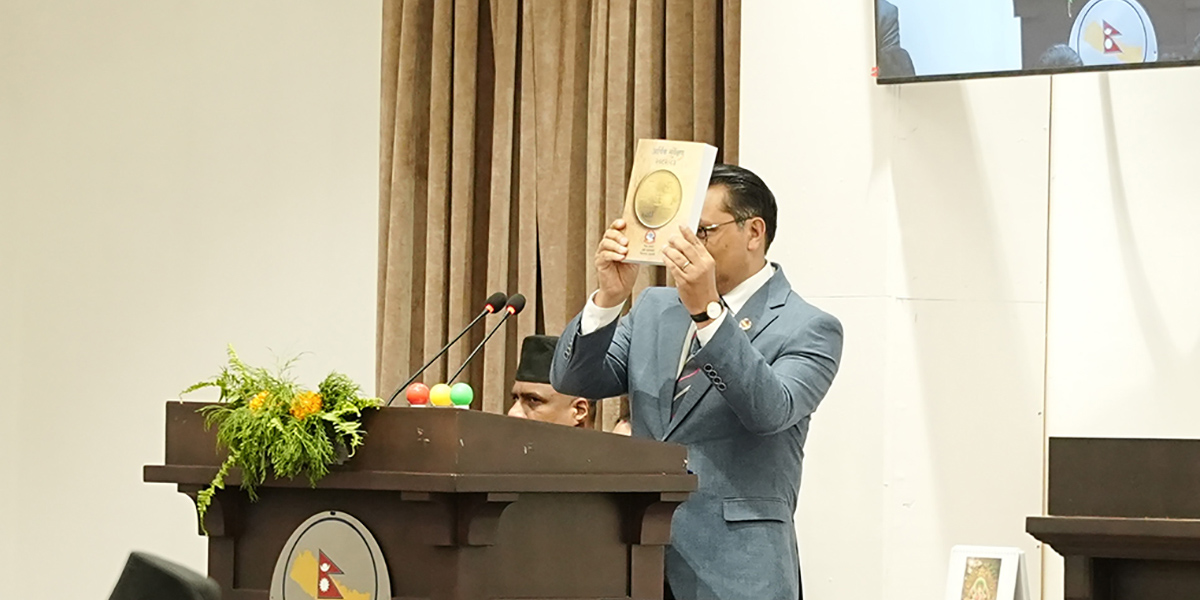
KATHMANDU: Minister for Finance Dr Swarnim Wagle presented the Economic Survey for the fiscal year 2025/26 in the joint session of the federal parliament on Wednesday. Presenting the survey, Minister Wagle said that despite uncertainty in the global economy and ongoing regional conflicts, Nepal has seen improvements in its macroeconomic indicators and made satisfactory progress in the social sector.
Here we present major highlights of the Economic Survey:
Economic Growth: Nepal’s economy is estimated to grow by 3.85% in the current fiscal year 2025/26, down from 4.43% in the previous fiscal year. Global economic uncertainty, trade disruptions, and continuing conflict in West Asia are expected to limit global growth to 3.1% percent in 2026, while there is a risk of inflation climbing above 6%.
GDP: Nepal’s nominal Gross Domestic Product (GDP) is expected to reach Rs 6,609 billion in the current fiscal year. Agriculture is projected to contribute 24% to the economy, while non-agriculture sectors are expected to account for 76%. The agriculture sector is expected to grow by just 1.58%, sharply lower than 3.05%, while the non-agriculture sector is projected to expand by 4.54%. The service sector is expected to contribute 61.81% of GDP.
Per capita GDP is estimated to reach $1,513, while per capita national income is projected at $1,535. Bagmati Province is expected to record the highest per capita income at $2,644, while Madhesh Province’s per capita income is expected to remain at the lowest $934. The economy continues to be consumption-driven, with consumption accounting for 90.3% of GDP. Private sector consumption alone makes up more than 91% of total consumption.
Inflation: Inflation remained under control in the current fiscal year. Average consumer inflation stood at 2.13% at mid-March of the current fiscal year, down from 4.72% during the same period last year.
External Sector: The external sector showed strong improvement, driven largely by remittance inflows. Remittances increased by 37.7% to Rs 1,449 billion by mid-March. This helped the current account and balance of payments remain in surplus. Foreign exchange reserves climbed to a historic high of Rs 3, 413 trillion. The reserves are sufficient to cover 18.5 months of imports of goods and services, according to the survey. Despite the strong external position, the trade deficit widened by 11.2% to Rs 1,098 billion during the review period as exports accounted for only 12.9% of the total foreign trade.
Liquidity: The survey states that private-sector credit expansion remained sluggish in the fiscal year despite excess liquidity in the financial system. Deposits in banks and financial institutions increased by 6.64% to Rs 7,745 billion, while lending to the private sector rose by only 4.4%. Non-performing loans of banks and financial institutions reached 5.42% by mid-March.
Public finance: Public finance indicators showed mixed performance. Federal expenditure increased by 10.4% and federal revenue by 3.2% during the review period. The federal government recorded a fiscal deficit of Rs 58.01 billion and a primary deficit of Rs 9.39 billion during the year. Public debt reached 43.6% of GDP to Rs 2,878 billion by mid-March.
Survey: Absolute poverty declined to 20.27% and multidimensional poverty to 17.4%. Human Development Index stood at 0.622 in 2025, while average life expectancy rose to 71.3 years. Youth literacy reached 94.2%.
Energy: Electricity access expanded to 99.1% of the population, while installed power generation capacity reached 4,105 MW, including 3,798 MW from hydropower. Nepal exported 2,918 gigawatt-hours of electricity to India during the fiscal year.
Tourism: Tourism also continued its recovery. Nepal welcomed 1.162 million foreign tourists in 2025, with the average stay increasing to 16.34 days.
SDGs: Nepal ranked 85th among 167 countries in the 2025 Sustainable Development Goals Index with a score of 68.58. However, achieving the SDGs will require an additional average annual investment of Rs 755 billion in the coming years.