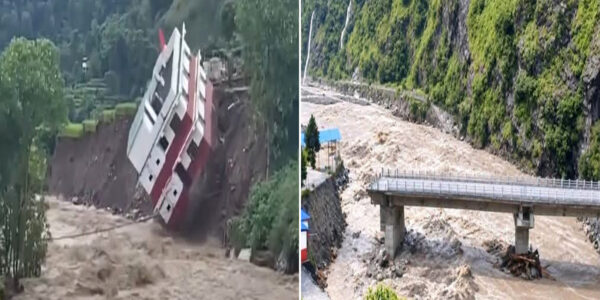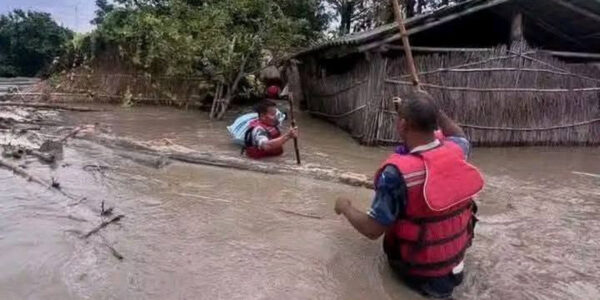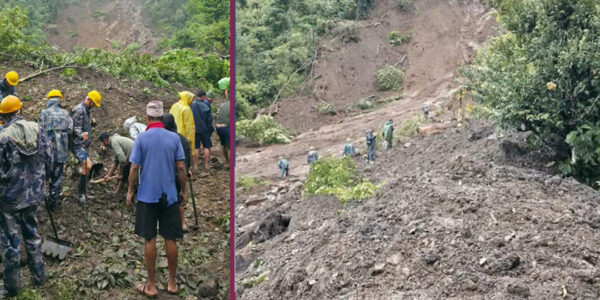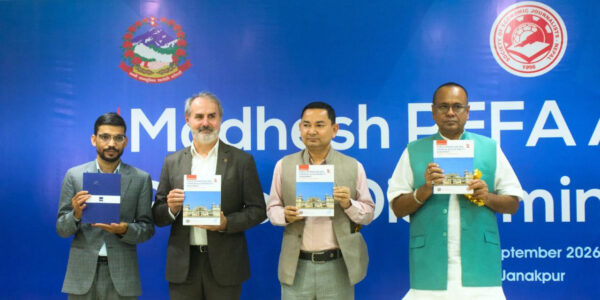

KATHMANDU: Although most parts of the country are expected to receive below-average rainfall this monsoon, the risk of disaster-related incidents are high, states the National Monsoon Preparedness and Response Action Plan 2026, published by the Nepal Disaster Risk Reduction and Management Authority (NDRRMA)
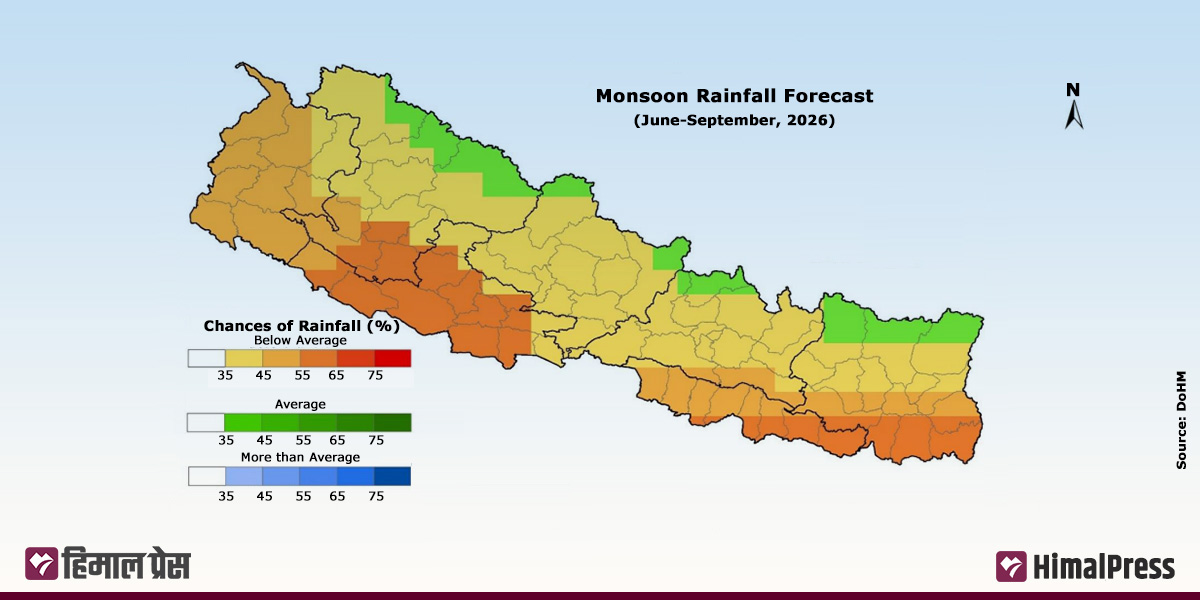
According to the action plan, below-average rainfall is expected this year in the southern regions of Karnali Province, most parts of Lumbini Province, eastern areas of Madhesh Province, and southern regions of Koshi Province.
The report states that temperatures across the country are likely to remain above average during the monsoon season. There is a 55-65% probability that below-average rainfall will occur alongside these temperatures in the northeastern regions of Sudurpashchim Province, northern regions of Karnali Province, western regions of Lumbini Province, northeastern and southern regions of Gandaki Province, western regions of Bagmati Province, eastern and western regions of Madhesh Province, and eastern and southern regions of Koshi Province.
The monsoon generally begins on June 13 and ends on October 2. Last year, the monsoon entered through eastern Nepal on May 29, 15 days ahead of schedule, and retreated on October 10. According to the NDRRMA, the total duration of last year’s monsoon was 135 days. Although the average monsoon duration is 112 days, last year’s monsoon persisted for over 23 days longer than average. However, the NDRRMA has indicated that the monsoon period could be shorter this year.
NDRRMA Information Officer Shanti Mahat told Himal Press that there is a 35-45% chance of average rainfall in the central regions of Koshi Province and the eastern parts of Sudurpashchim Province.
According to the NDRRMA estimates, more than 226,000 people across the country could be affected by monsoon-induced disasters this year. The action plan states that these people face a high risk due to floods, landslides, inundation, soil erosion, flash floods, and heatwaves. “An estimated 1,000 to 4,000 households are expected to be directly affected,” it added.
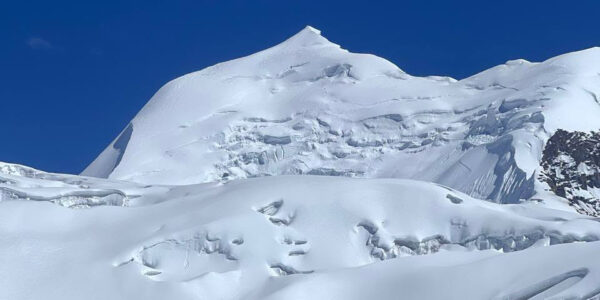
Although the likelihood of more than average rainfall across the country is lower compared to the past, the projected rise in average temperatures means high-altitude regions will face an increased risk of glacial lake outburst floods. This significantly increases the risk of monsoon-related disasters such as floods, landslides, inundation, land erosion, and flash floods in riverside areas. The Tarai plains are also highly likely to be impacted by extreme heat or heatwaves. According to the action plan, this year’s monsoon forecast closely mirrors the monsoon weather patterns observed in 2014, 2016, and 2022.
During last year’s monsoon, most parts of the country recorded between 1,000 and 1,500 millimeters of rainfall. Some locations in Gandaki, Bagmati, and Koshi provinces receive over 2,000 millimeters of rain, resulting in above-average precipitation across most regions. While the DoHM has forecast below-average rainfall for many parts of Koshi, Madhesh, Lumbini, Karnali, and Sudurpashchim this year, it has warned that the risks of temperature spikes, glacial lake outbursts, flash floods, and landslides remain high.
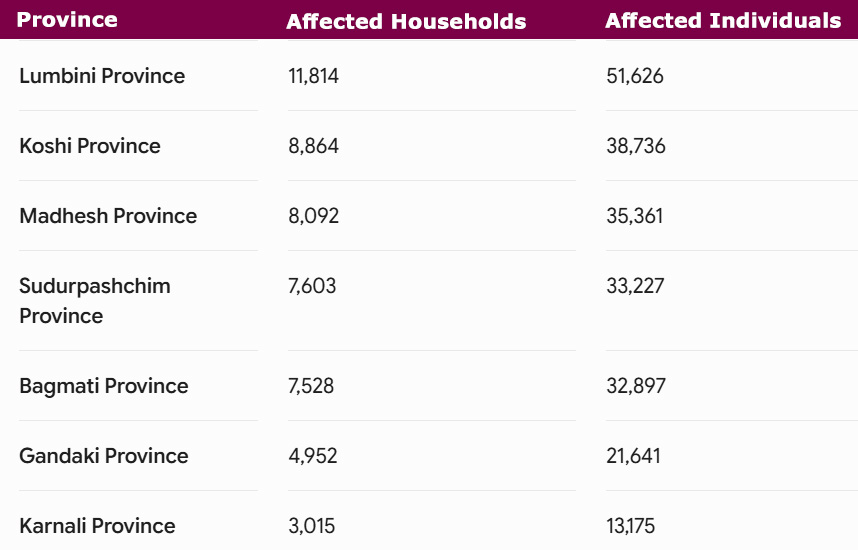
The NDRRMA estimates that Lumbini Province faces the highest risk this year, where over 51,626 people from 11,814 households may be affected. In Koshi Province, 38,736 people from 8,864 households are expected to be directly impacted. The high-risk zones include the three Tarai districts of Jhapa, Sunsari, and Morang, alongside Udayapur in the inner Tarai, and the hilly districts of Ilam, Panchthar, Taplejung, Sankhuwasabha, Bhojpur, Khotang, and Solukhumbu. Last October, continuous rainfall caused severe damage in various districts, including Ilam, which was declared a disaster-crisis zone.
Similarly, an estimated 35,361 people from 8,092 households in Madhesh Province and 33,227 citizens from 7,603 households in Sudurpashchim Province are expected to be affected. In Bagmati Province, the NDRRMA projects that 32,897 citizens from 7,528 households will be directly impacted. Gandaki Province is estimated to see 21,641 individuals from 4,952 families affected, while 13,175 people from 3,015 households are expected to be affected.
In terms of government preparedness, responsibilities for this year’s monsoon response have been assigned to various agencies, including the Ministry of Home Affairs, Nepal Army, Nepal Police, Armed Police Force, Ministry of Health, Department of Roads, and the DoHM. According to Mahat, separate clusters will be deployed to manage rescue operations, relief distribution, communication, health services, temporary shelters, drinking water, and food security. The NDRRMA has also concluded that drones, helicopters, rescue boats, SMS alert systems, and early warning systems extending down to the local level must be effectively utilized.
Monsoon-induced disasters claimed 3,074 lives, left 502 people missing, and injured 4,769 individuals, affecting more than 33,000 families over the past decade. Between 2016 and 2025, landslides caused the highest number of fatalities with 1,483 deaths, followed by lightning strikes, which killed 805 people. Additionally, floods claimed 678 lives, while heavy rainfall resulted in 108 fatalities.