 Himal Press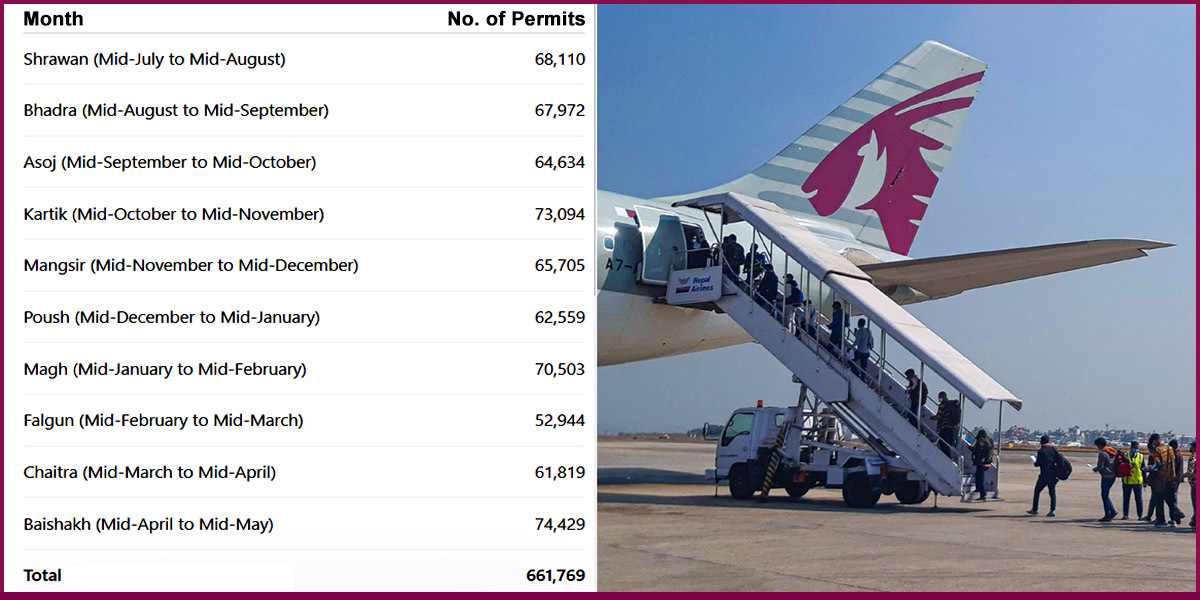
KATHMANDU: The number of Nepali youths leaving for foreign employment declined by 3.52% in the first 10 months of the fiscal year 2025/26.
According to the Department of Foreign Employment (DoFE), a total of 661,769 labor approvals, including renewed permits, were issued for overseas jobs during the review period. In the same period of the previous fiscal year, the department had issued 685,924 labor approvals.
The slight decline has been attributed to the government’s decision to suspend labour permits for 12 countries—Saudi Arabia, the UAE, Qatar, Kuwait, Bahrain, Oman, Iraq, Yemen, Jordan, Lebanon, Turkey and Israel—after tensions escalated in West Asia on March 1. The suspension remained in place until April 20.
Despite the decline, foreign employment outflow remained high during Baishakh (mid-April to mid-May), with 74,429 individuals obtaining labour approvals. Of them, 41,324 received new approvals, while 33,105 secured renewed entry permits.
Malaysia emerged as the most preferred labor destination for Nepali workers during the review month, with 17,252 permits issued for the Southeast Asian nation. The United Arab Emirates followed with 17,108 workers, while Qatar absorbed 10,667 Nepali workers.
Monthly data show that 68,110 individuals left for foreign employment in Shrawan (mid-July to mid-August), followed by 67,972 in Bhadra, 64,634 in Asoj and 73,094 in Kartik. Similarly, 65,705 Nepalis departed in Mangsir, 62,559 in Poush, 70,503 in Magh, 52,944 in Falgun and 61,819 in Chaitra.
Remittances sent home by migrant workers play a crucial role in making the country’s external sector stable. According to the Nepal Rastra Bank, total remittance inflows reached 1,723.27 billion in fiscal year 2024/25.
In the first nine months of the current fiscal year 2025/26, remittance inflows increased by 39.1% percent to Rs 1,659.41 billion.