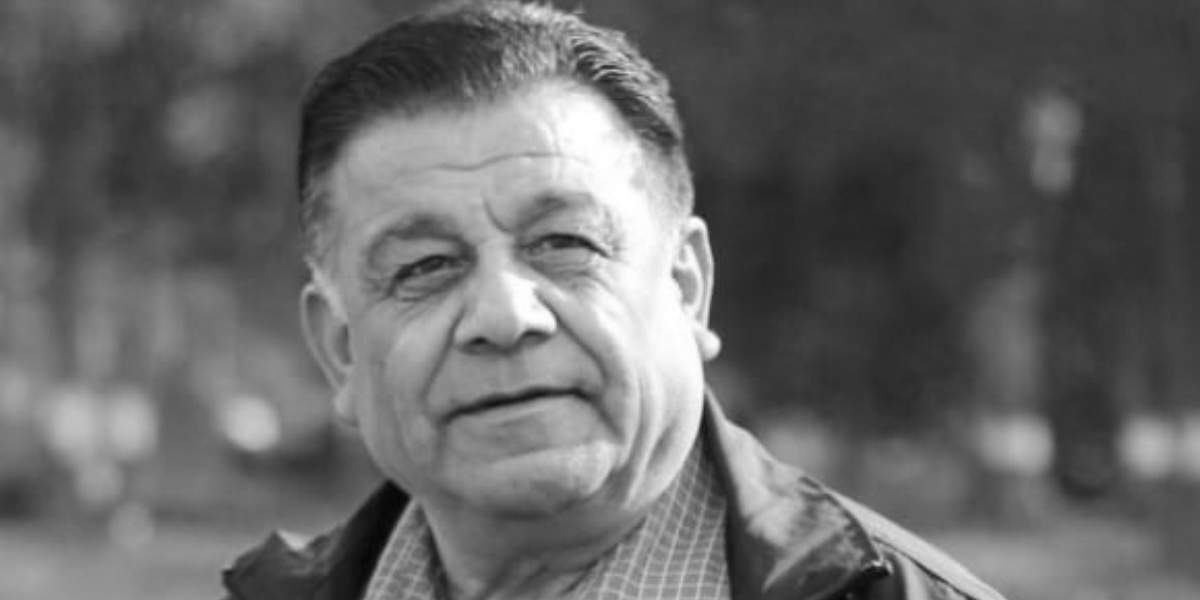
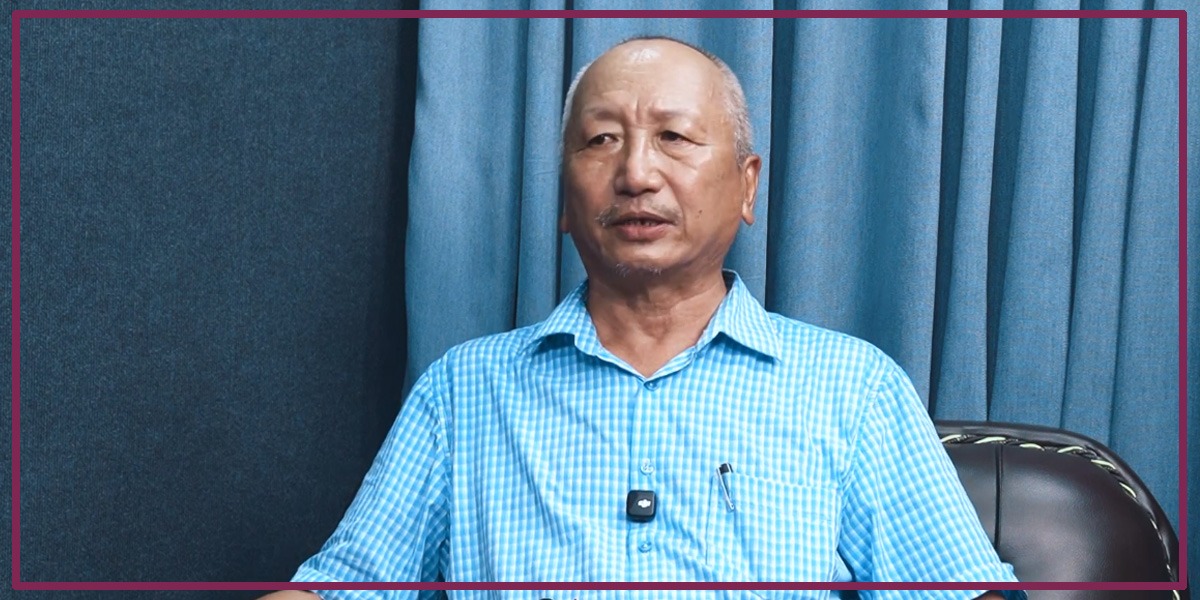
Few contemporary Nepali poets have connected with readers across generations as deeply as Shrawan Mukarung. His poems and songs have captured the memories, emotions, struggles and aspirations of Nepali society. From love and loss to social injustice, politics and human struggle, his writing draws on the tensions and experiences of everyday life. Mukarung, however, is not only a poet and lyricist. His creative journey has also taken him into fiction, drama and other forms of writing, driven by a persistent engagement with society and its changing realities. In an interview with Bibek Bibas Regmi of Himal Press, Mukarung reflects on his literary journey, the struggles that shaped him, the relationship between love and rebellion, the state of Nepali literature and music, the impact of technology and AI on creative work, and his thoughts on life, death, politics and the meaning of success. Excerpts:
The voices of the marginalized, rural areas, labor, the hills, and the struggles of the underprivileged recur frequently in your poetry. Did you seek out these characters, or did they find you?
It works both ways. From a creator’s perspective, creation begins when we observe disharmony and injustice around us. A creator cannot emerge from a utopian ideal where everything is perfect. True artistic creation is sparked when one witnesses systemic flaws, social fractures and the disruption of human harmony. The medium of expression varies—a painter picks up a brush, a musician chooses an instrument, a politician raises a flag and a writer relies on the pen.
Our country lived through a prolonged period of political and social suffocation—a monarchical system with clear master-slave dynamics. Having grown up witnessing parts of the Panchayat era, seeing these systemic inequities pushed me toward writing. It is a moral duty of a writer to stand up for the oppressed and advocate for those subjected to discrimination.
Given our deep-rooted socio-cultural disparities, writing against these injustices became the foundation of my creative journey.
Has being a poet, lyricist, or writer ever felt like a burden?
Creators emerge from all walks of life—from affluent backgrounds as well as from the lowest socio-economic strata. Talent, dedication and artistic discipline are what ultimately matter.
I came from a modest background in a remote village in Bhojpur. Rising from that level brings significant challenges, especially in Nepal, where literature is not financially viable. Decades ago, print runs averaged around a thousand copies. That has remained largely unchanged today.
Coming from a Rai community, where young men are typically expected to serve in foreign militaries or seek overseas employment, choosing poetry and literature led my family to worry that I was straying off course. It required a major struggle, but I have no regrets. It is a hardship I consciously chose.
Have you ever regretted or feared publishing any of your works?
Not at all. Writing is a deliberate process guided by a clear creative purpose. Once you establish your intent, there is no room for regret. At least, I have never felt any.
Your work spans love, rebellion, philosophy and sociology. What is the relationship between love and rebellion in poetry?
Love is universal; it connects the world and defines our humanity. Every living entity relies on love to exist.
Rebellion, social transformation, and advocacy for change are matters of moral responsibility for a conscious writer. While one is entirely free to focus solely on love or write ghazals for a lifetime, a writer’s conscience compels them to speak out whenever they confront injustice and discrimination.
Who has given you the greatest love, and who has caused you the deepest pain? How have these experiences shaped your writing?
Love manifests in many forms, and I have lived a life sustained by it. I have survived without holding a conventional, high-paying job. Literature alone is not financially productive here, but I am giving continuity—not through divine intervention, but through the love and support of my family, society, readers and the Nepali people. People purchase my books, invite me to recitations, publish my work and engage in interviews like this.
Nepali society is inherently empathetic. If someone faces a medical emergency, a single social media appeal can prompt overwhelming financial support. We are a deeply emotional and loving people. However, those who love deeply can also criticize fiercely.
As for life’s pains are concerned, stumbles and setbacks are natural occurrences on any journey. Ultimately, they serve as fuel for creative expression.
You possess a strong political consciousness as both a poet and a citizen. Has politics made you more cynical or more optimistic?
Our democratic systems are relatively young compared to older democracies. Transformations do not occur overnight; they follow a gradual process.
Despair often arises when we make direct, unrealistic comparisons with developed nations. When viewed in its proper historical context, progress is steadily taking place.
Dialogue and empathy seem to be diminishing in modern society. This has led to social fragmentation. How do you view this shift?
Modern communication technology makes every incident globally visible in real time. Dehumanizing acts and systemic cruelty existed in the past.
There were extremely inhumane acts; people were killed because of their caste or gender, for example. Such atrocities existed, but there was no medium through which we could learn about them immediately.
Today, whatever happens anywhere reaches us instantly.
That may make it seem that our human side has become weaker. But it is not that humanity did not exist in the past. These things fluctuate. Sometimes compassion becomes stronger, sometimes weaker. That process continues.
Our responsibility as creators and writers is to make society, people and the nation more humane.
That is what we are trying to do through writing. Whether someone listens to a song, reads a poem or reads a work of fiction, a good work should push aside other things for a moment and create a deeply human feeling within that person. That is precisely what a good work of art should do.
We see a lot more today, so sometimes we may feel that society is becoming more brutal. But I think such brutality existed in the past as well.
How do you spend your time during periods of writer’s block? What does a poet’s silence signify?
I cannot simply sit quietly. It is almost an illness, a kind of disease.
I am already addicted to writing. Even if I do not put pen to paper, my mind keeps searching. Even when I am simply walking and talking with you, one part of my brain is thinking, “Will a new poem come? Will a new idea emerge? Will I encounter something?”
It is constantly working. It searches for lines of poetry and plots for stories. It continues working even in the subconscious. That is what I mean by being addicted to it.
But writing itself happens only when one reaches a particular state or moment. One cannot simply remain idle.
Except for literature, is there anything that brings you the greatest joy?
Not really. If I listen to good music, I enjoy it very much. When someone creates good new music and I get to hear it, it gives me pleasure. Apart from that, there is not much else.
If you were to give a title to the life you have lived so far, what would it be?
Sisyphus. It comes from Greek mythology. Many great poets have used the metaphor. Sisyphus keeps pushing a huge boulder up a mountain, only for it to roll back down before he can ever get it to the top.
Sometimes I feel like Sisyphus. I think I have written something and moved forward, only to realize later that there is still more to write. I still feel that I have not become a complete writer.
But that feeling keeps me active. It motivates me to write. I feel like a traveler who has not yet reached his destination.
At a time when AI is being used increasingly in technology, is it becoming a challenge for writers? Are new writers being directly affected?
We have seen reports of writers and artists protesting against AI in the United States and Europe. But I don’t think AI has creativity in the true sense.
If you tell it to write a poem, it will write something and give it to you. But that is not necessarily a poem. If you ask it to write a song, it will produce one, but that is not necessarily a song.
What it does is take from the creations of writers and creators around the world — from everything accessible to it — and combine and rearrange those things to produce something.
That is not creation in the true sense.
So I don’t think writers, poets and creators should be afraid of AI. We should use it. It can be useful in music and other fields. We can make it an assistant.
But if you simply take whatever it produces and call that your creation, then you are finished as a creator. You have become a cheat.
We can use what it produces to generate ideas. Sometimes it can open up another avenue for us. We simply need to learn how to use it.
There is no point in boycotting it and keeping it completely aside. It is a technology. Another technology will eventually come along and surpass it. Creators need to learn how to master and use whatever new technology emerges.
For example, I travel by bus even today, and buses often play AI-generated songs. I once asked a bus driver, “Why are you playing this? The original singer’s version is much better.” These AI-generated songs often have no heart. They are basically technological singing. They may be played loudly and repeatedly, but they can disappear quickly.
Such things come and go. Technology keeps changing. Creators need to learn how to use it.
Ganesh Rasik used to say that a song without poetry does not have a long life. But many songs being released lately seem to lack poetic quality. How do you view the current state of music?
Songs and music have indeed weakened, particularly in terms of quality.
The market also has an influence. But we as consumers are partly responsible. If we stop listening to good music and stop supporting genuine new creations, while consuming ordinary content and making it viral, artists and creators are forced to move in that direction.
In that sense, consumers also have a role and a weakness.
This is particularly visible in music. Controversial and suggestive songs get more likes, comments and views, so they become viral and generate money. Once that happens, artists are encouraged to produce more of the same.
If we do not support serious and good creations, artists are forced to go elsewhere.
As for the statement that “songs without poetry” have no future, I think what Ganesh Rasik was really referring to was excellent creation. There are different levels of creation. Some works are ordinary, some are good and some reach a very high level.
That is true in every field.
So, yes, our creative sector is going through a somewhat weak period. But times change, and things can improve. It is also connected to literacy. We need to learn how to listen.
Our education system does not take art, literature and music seriously enough. We have not been properly introduced to our own literature. Even today, schools and colleges often fail to teach our literature properly or keep it updated.
Because we do not know how to teach these things properly, and because our overall education system has weaknesses, this also affects the quality of our artistic and literary culture.
Speaking of your debut novel Salaha, what challenges did you face transitioning into novel writing after establishing yourself as a poet and lyricist?
The novel was a new genre for me. I had been writing songs and poetry from the beginning, as well as essays and plays, so I was accustomed to those forms.
In every genre, the more you practice, the easier it becomes. If I write another novel, I think it may not be as difficult because I will have become accustomed to the form.
But because this was my first novel, I enjoyed the process. If I had not experienced that pleasure myself, I would not have been able to write it.
Even though I faced many difficulties, the process gave me a kind of catharsis. I experienced pleasure even in the pain involved in writing it.
When you write something on such a large scale, there are many challenges. You have to examine how capable you are in terms of language, expression and imagination. You also have to examine your research skills and your ability to understand society and people.
The novel allowed me to discover these things about myself. I was able to understand how capable I was after such a long journey, and where I was still lacking.
I discovered my weaknesses while writing it. After finishing it, I also discovered my strengths — what I was good at and where my abilities lay.
In that sense, writing the novel provided me an opportunity to learn many things and to understand myself better.
You have sometimes written about death in your poetry. Where does the urge to write about death come from? And after you are gone, how would you like people to remember Shrawan Mukarung?
Death is a subject in itself. We write extensively about life, but we should also write about death. Life and death are two sides of the same coin. We have to experience both.
As a writer, I became interested in thinking about death, and I wrote several poems about it. Some of them were written when I was going through extremely difficult periods, almost approaching depression.
Some were written during the COVID period, after seeing so many people die. Others were written after witnessing deaths during the earthquake.
There are also poems I wrote when I reached an extreme level of frustration, and some that were consciously written as meditations on death.
I have perhaps five or seven poems on death.
Writing about death is ultimately about making life more beautiful. We are all going to die one day. So these poems about death are also written to make the life we are living more beautiful.
I don’t have any great desire for fame or immortality. I know that everything eventually disappears.
The Romantic poet Percy Bysshe Shelley wrote in The Triumph of Life that the names and goodwill people acquire will eventually disappear into oblivion.
For example, when we think of Mahakavi Devkota, we remember Muna Madan. One day, even Muna Madan may be forgotten. The name Mahakavi Devkota may also eventually be forgotten.
We call Bhanubhakta the Adikavi, but perhaps there will come a time when even Bhanubhakta is forgotten. Human creations eventually disappear from memory. Nothing in the world is truly immortal.
I believe the same thing will happen to my works. One day, they may also disappear into oblivion.
But, as a writer, I do have one desire: I hope my works remain for a very long time. I would like people to remember my poems, songs and other works even hundreds of years from now. That is the only kind of desire I have.