
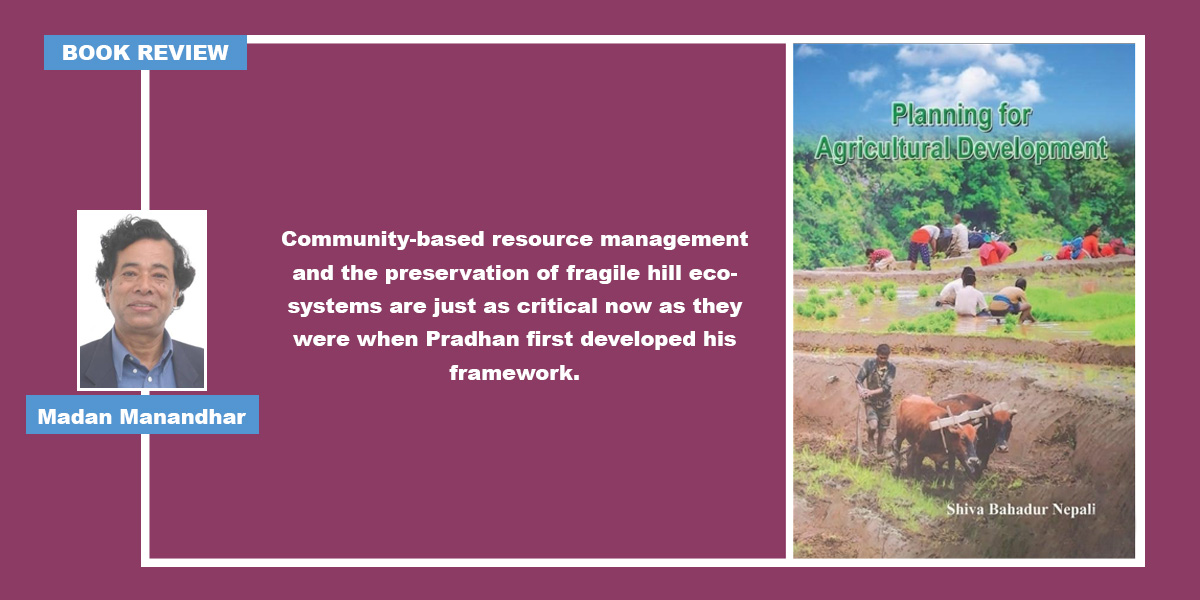
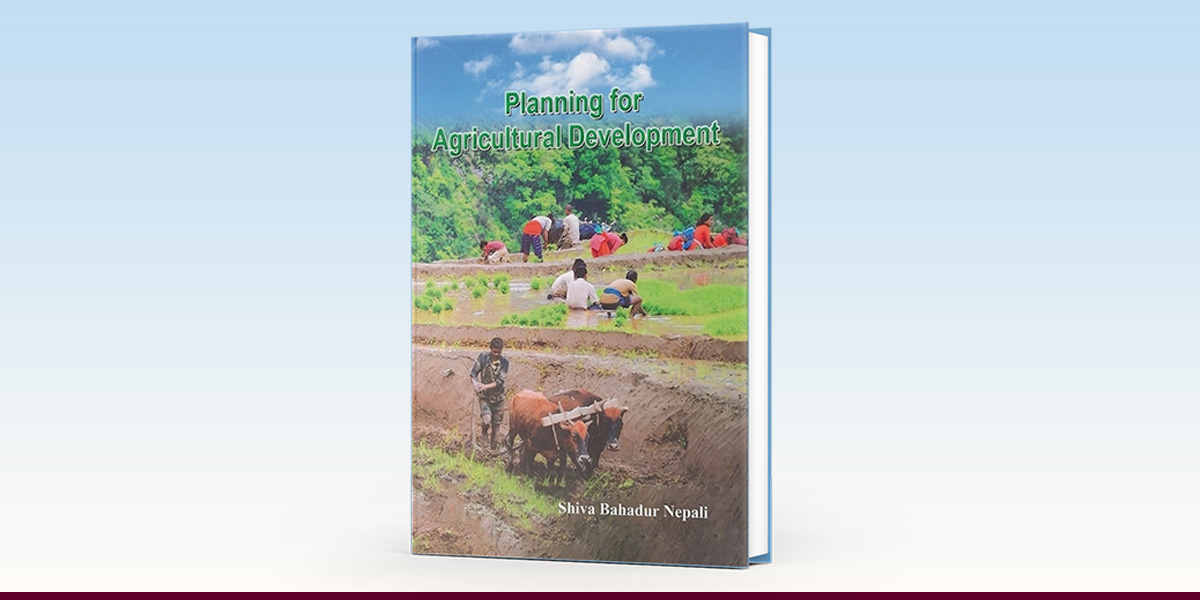
‘Planning for Agricultural Development: With Special Reference to the Intensification of Agricultural Production in the Hill Areas of Nepal – A Household Systems Approach’ is a seminal contribution to the study of rural economies in Nepal. Written by the pioneering Nepali agriculturist Shiva Bahadur Nepali Pradhan and reviewed here through a critical lens, the book represents a major shift in how agrarian development is understood in mountainous terrains. Pradhan has brought an exceptional expertise to this study, having served as the Director General of the Department of Agriculture and spent decades working with the United Nations Food and Agriculture Organization and various development agencies. His experience enabled him to bridge the gap between high-level policy thinking and everyday realities of farming communities, resulting in a work that radically challenged the conventional approaches of its time.
At the core of Pradhan’s work is the introduction of systems thinking to the Nepali agricultural landscape. When the book was written, most development strategies relied heavily on top-down planning, treating crop yields as isolated metrics that could be improved simply through modern technology or chemical inputs. Pradhan challenged this narrow approach by introducing the household systems framework. He argued that hill farming could never be fully understood by examining crops alone. Instead, he presented the farm as a deeply integrated ecosystem in which human labor, livestock, forest resources, water supply and household survival strategies are closely linked. By highlighting how families balance farming responsibilities, the book has provided a holistic understanding of rural resource management that remains highly relevant in development studies.
However, reading the book from a contemporary perspective also requires recognizing its historical limitations. Since the study was conducted several decades ago, its data naturally reflect the socioeconomic conditions of that period. The book does not address many of the major transformations that have reshaped rural Nepal in recent years, including climate change, increasingly unpredictable weather patterns, and widespread youth migration. The booming remittance economy, which has significantly reshaped rural household income, and changing labor patterns are also missing. Likewise, modern advancements such as digital agriculture, mobile banking, global value chains, modern market integration and commercialization of agriculture were far less developed when Pradhan conducted his research for this book.
These omissions, however, should not be viewed as flaws in Pradhan’s original analysis but rather as reflections of an evolving historical context in which the work was produced. Despite the passage of time, the conceptual foundations of the book remain remarkably relevant to contemporary development debates. Current discussions around sustainable intensification, climate-resilient farming and household food security closely echo the integrated themes that Pradhan explored decades ago. Modern researchers and policymakers continue to recognize that technological interventions alone cannot succeed if they overlook the social and economic realities of rural households. Community-based resource management and the preservation of fragile hill ecosystems are just as critical now as they were when Pradhan first developed his framework.
Ultimately, the central message of the books offers a timeless lesson for contemporary development practice. It reminds us that meaningful agricultural reform in Nepal cannot be achieved through a one-size-fits-all solution imposed from distant bureaucratic centers. Instead, it requires a deep and careful understanding of the complex household systems that sustain rural communities. For today’s planners, researchers and policymakers working within Nepal’s decentralized federal structure, Pradhan’s analytical framework remains a vital guide, reminding us that progress always begins at the household level.



![PM Shah inaugurates NPL Season 3 [In Pictures]](https://en.himalpress.com/wp-content/uploads/2026/10/Balen-NPL-1-600x300.jpg)