 Himal Press
 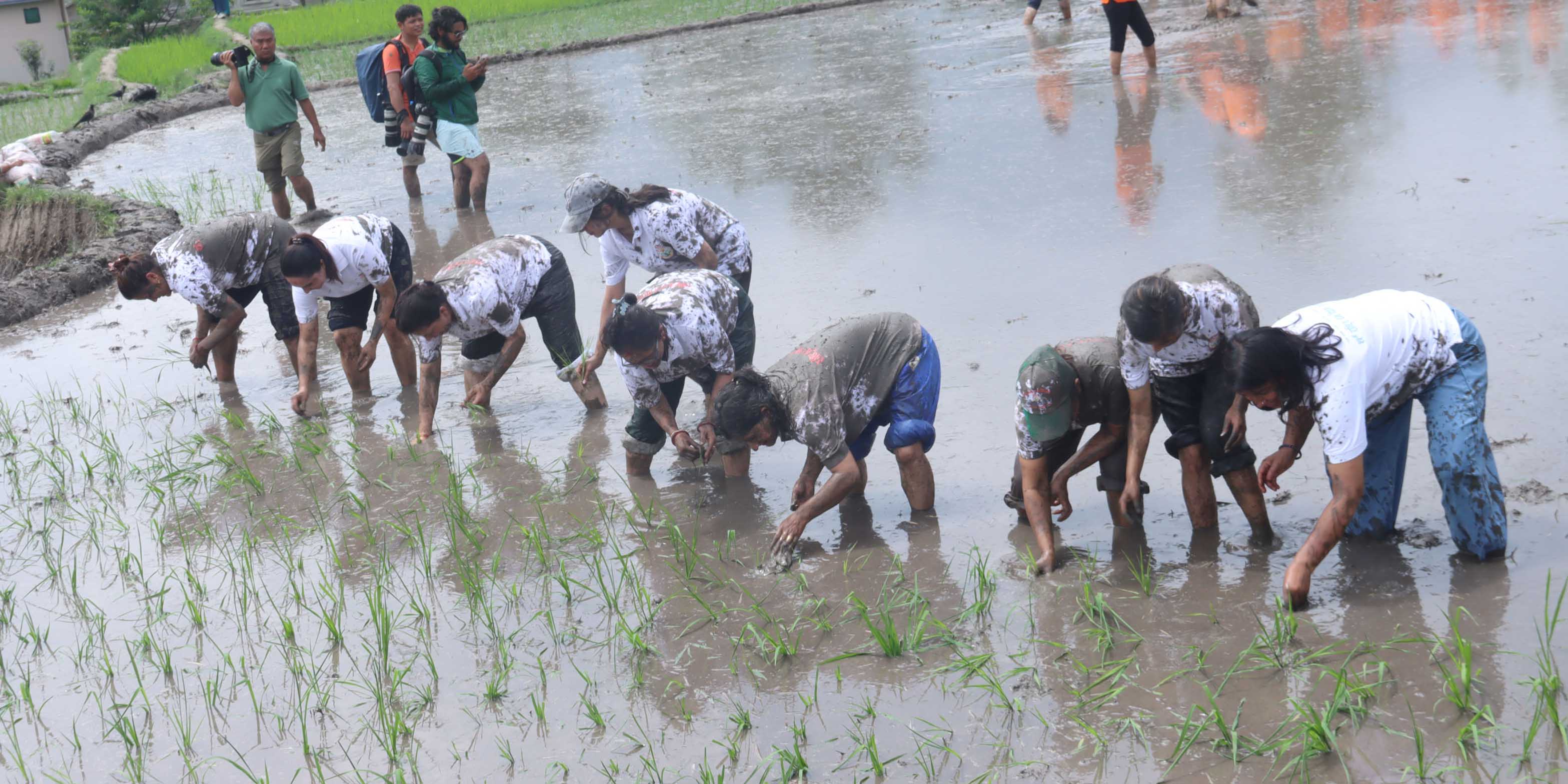 Photo: RSS
KATHMANDU: Nepal is celebrating National Paddy Day on Monday by organizing various programs across the country.
Issuing a message on the occasion of the 23rd National Paddy Day and Rice Plantation Festival, Gita Chaudhary, Minister for Agriculture and Livestock Development, said achieving self-sufficiency in paddy production requires modern technology, research, and coordinated efforts among stakeholders to tackle the challenges posed by climate change.
Stating that paddy is deeply linked with Nepal’s religion, culture, and traditions, she underlined the need to conserve and promote local and wild rice varieties. “Such efforts will contribute to biodiversity and climate resilience,” she added.
She also underlined the need to reduce rice imports by expanding the area under both monsoon and spring paddy, developing improved seed varieties, ensuring technology transfer, expanding irrigation facilities, improving access to agricultural inputs, and guaranteeing fair prices to farmers.
Paddy is Nepal’s major staple crop, accounting for roughly half of the country’s total cereal production. Rice provides nearly 50% of the daily calorie intake for Nepalis, who consume an average of 137.5 kilograms per capita annually—surpassing the FAO’s global recommended standard, according to a recent study by the Institute of Integrated Development Studies.
Moreover, rice plays a vital role in the nation’s economy, contributing around 20% to the agricultural GDP and 7% to the overall GDP.
According to official data, Nepal produced 5.95 million tons of paddy in the fiscal year 2024/25 from 1.42 million hectares of land.
Local production, however, is insufficient to meet domestic demand for rice. Nepal imported 238,721.51 tons of semi-or wholly milled rice, including the Basmati variant, worth Rs 18.95 billion during the first 11 months of the current fiscal year, according to the Department of Customs. With one month in the fiscal year remaining, rice imports in the current fiscal year are up by both value and volume compared to the entire fiscal year 2025/26. In 2024/25, Nepal imported 234,127.82 tons of rice worth Rs 18.35 billion.
The import bill rises to around Rs 40 billion if paddy import figures are also taken into account.