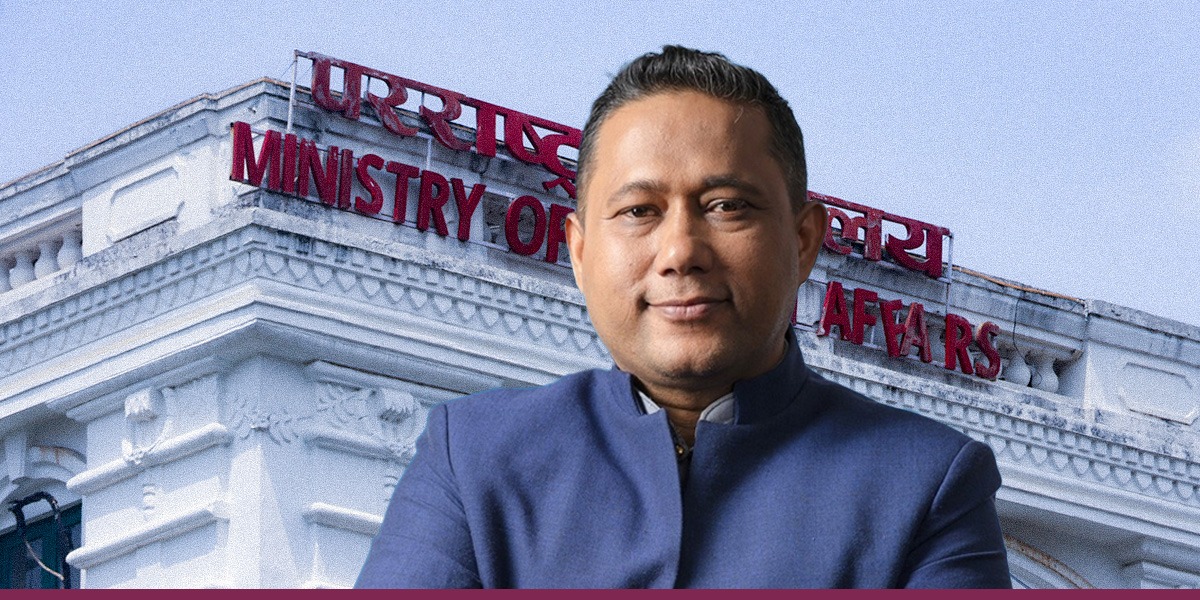
KATHMANDU: Foreign Minister Shisir Khanal has been proclaiming that the foreign ministry is developing country-focused strategic action plans. He should be clear that previous ministers also made similar commitments. His claim that various ministry divisions are working to strengthen bilateral strategies so Nepal can maximize benefits is not new either.
Of late, the ministry has become an example of an institutional culture where incoming ministers talk a lot upon taking charge and then do little.
Setting priorities by country and conducting foreign relations accordingly is not inherently controversial. Such a strategy is needed to make our foreign policy practical, results-oriented, and focused on the national interest. Whether a strategy is announced is not the main issue. The question is whether it becomes institutionalized, whether it is advanced in a way that lasts, or whether the next minister will simply make the same kind of announcement again.
Looking at social media, activity has increased at the ministry lately. A “MOFA Knowledge Forum” has been launched. Talks about country-specific strategic action plans are being heard. Discussions about online systems and improvements in consular services have taken place, and language training for foreign service staff has started.
None of this is particularly new. What has changed is that there is a new minister. Social media has been filled with posts, including Khanal’s speeches, meetings, and instructions to staff. Whether a meeting with an ambassador or a routine daily task, it appears with emphasis on the ministry’s social media channels.
Everything Khanal presents as newly started dates back a decade or more. This raises a serious question: Is the ministry doing new work, or repackaging past initiatives as achievements of the new leadership? If the minister were truly serious, many of these matters could be made mandatory through legislation. Instead, the focus appears limited to light talk on social media.
If the success of the foreign ministry begins to be measured by how much news it generates and how much discussion it creates on social media, that becomes a serious problem.
The ‘first time’ problem
The ministry has presented the MOFA Knowledge Forum as a program launched for the first time. The name may be new, but similar forums existed before. The goal of regular dialogue with researchers, academics, think tanks, and subject experts is sound. However, presenting trainees from the ministry’s own think tank, the Institute of Foreign Affairs, as experts raises questions about how institutional this can be considered.
Such practices are not entirely new. In the past, discussions were held with researchers, working papers were presented, and policy debates took place. But how many of those became institutionalized, continued, or fed into policy? Does the ministry have a systematic accounting? Officials say even the report prepared by the Eminent Persons Group on Nepal-India Relations has gone missing. The ministry does not focus on such serious matters.
The ministry’s main problem is institutional ownership and documentation. Although priorities may shift when ministers change, the institution’s identity should not. Until the permanent machinery understands that the minister is an individual and the ministry is an institution, this pattern will continue. If every program disappears after a minister’s term ends, the state’s institutional capacity will never be built.
Not much has changed in consular services
After taking charge, Khanal showed interest in consular services. The ministry’s consular service is a small mechanism. A minister should direct the director general to get the work done rather than micromanage.
For Nepalis abroad, consular service is their direct contact with the state. Many of the online processes or digital practices now visible did not start only now. Previous leaders and staff worked on this for years to digitize online applications, authentications, and other services. Claiming to have done something new by involving a preferred company without acknowledging prior work is inappropriate.
Improving existing systems is fine, but terming them “first time” to take credit is an injustice to institutional history and pure populism. If a new system has been introduced, what happened to the old one? What software is being used? Where is the server located, and how secure is it? Discussion is also needed regarding the documentation of previous systems.
Even instructions to ministry divisions are being turned into news reports. A government digital system holds citizens’ personal details and sensitive information, creating long-term dependence. Questions are natural when selecting any digital system regarding options, competitive processes, cost, data residency, and future flexibility. However, the pattern appears to be selecting preferred people and proceeding for now, consequences later.
Online consular services are an achievement only if people no longer wait hours in line, carry papers from office to office, and if processes become transparent while saving time and cost. Previous claims of going online sat in emails, stalling when directors or ministers changed. Now it appears to have restarted with considerable fanfare, but the question remains: For how long?
Passport problems persist
Some time ago, problems appeared in passport services. Although the situation has improved in recent days, sensitive services cannot simply be closed with “a problem arose and was solved.” Institutional answers are required regarding why it happened, where the system was weak, who was responsible, and how recurrence was prevented.
Passport services are tied to employment, study, business, medical treatment, and family visits. Even with online service, there were reports of staff or software personnel colluding with cyber cafes so forms could not be filled independently, forcing people to pay Rs 200 to outsiders.
Improving the system and announcing on social media that “the problem is solved” matters less than building structures that prevent recurrence. Genuine improvement occurs when the need for a minister to personally inspect rooms and urge action is eliminated.
Language over speeches
The importance of foreign languages in the foreign service is discussed repeatedly, but learning languages must not remain limited to speeches. A real diplomat must be proficient in both language and conduct.
Knowing the language of a relevant country enables understanding of that society, gathering information from local sources, reading political signals, and building relationships. Japan, for instance, treats ambassadors who know Japanese as language experts and engages them separately. Similar considerations apply in the Gulf for Arabic speakers, while in France, not knowing French has caused coordination problems.
Language needs to be linked to the foreign service career system. Arrangements to encourage specific languages for staff entering via the Public Service Commission should be made mandatory. Otherwise, voluntary efforts will start repeatedly and stop when attendance drops.
Nepal could adopt a system similar to India’s, where foreign service officers study for a year at a foreign affairs institute and pass one additional UN language besides English. Staff assigned to a country desk could then learn that country’s language and remain on the desk for several years before other assignments. For example, staff handling China could develop Chinese proficiency, those handling Japan Japanese, and so on. This must be made mandatory to develop true country experts rather than shifting staff across branches for brief periods.
The ministry needs diplomats who are country and subject experts rather than general administrative staff. Country-focused strategic action plans require expert teams for each important country to study politics, economy, trade, investment, technology, security, society, culture, and Nepal’s potential interests.
Country strategies should be updated annually and remain intact when ministers change. Fundamental aspects of the long-term national interest should stay protected in that institutional document even when governments change. Strong governments do this work, whereas the current style appears more about showing that work is being done than actually doing it.
The importance of foreign languages in the foreign service is discussed repeatedly, but learning languages must not remain limited to speeches. A real diplomat must be proficient in both language and conduct.
The risk of popularity in diplomacy
Another concern is the ministry’s public presentation style. News that the minister gave instructions, a meeting was held, or an online system has been adopted is not wrong in itself. But if the success of the foreign ministry begins to be measured by how much news it generates and how much discussion it creates on social media, that becomes a serious problem.
In diplomacy, the most important work often does not appear in the news. Serious discussions with ambassadors, months of preparation before talks, continuous efforts to reach trade agreements, or strategic thinking on sensitive issues may not be visible, but their effects last for years. Unseen preparation matters more than visible activity. Popularity may be needed in politics, but credibility is needed in the country’s diplomatic institutions.
The risk of cheap popularity is significant in diplomacy. A press statement can draw immediate applause at home, a social media post can go viral, or a statement can generate immediate discussion. But diplomatic relations do not work that way. Today’s statement can spoil tomorrow’s negotiating environment and damage trust built over years.
The ministry should think less about “What news was made today?” and more about “What will the result be in 10 years?” Minister Khanal has already stumbled in diplomacy by speaking in parliament about matters shared in informal discussions between ministers, losing a neighboring country’s trust.
Time for institutional reform
There is no reason to cancel the initiatives the ministry is advancing. Rather, there is an opportunity to turn these initiatives into long-term institutional reform. Immediate steps can include preparing an institutional record of all major past programs and practices, making past practice and evaluation mandatory before starting new programs, and making the MOFA Knowledge Forum a permanent knowledge system of the ministry rather than a minister’s program. Furthermore, the ministry should conduct independent technical and management reviews of digital systems for consular and passport services, transfer greater responsibility for passports to the home ministry to allow the foreign ministry to focus more on diplomatic affairs, and enforce competition, transparency, data security, and long-term ownership as mandatory criteria in government software procurement. Linking foreign languages to entry, training, and career development, giving staff opportunities to gain country expertise tied to career progression, preparing country strategies regularly for every important country, and evaluating ministry achievements by policy and diplomatic results rather than press releases are equally vital.
The ministry needs new thinking, technology, the energy of a new generation, dialogue with experts, and real improvement in consular services. But newness does not mean erasing the past. Remembering what was done before, distinguishing what succeeded, learning from what failed, and institutionalizing good practices is real newness.
The ministry must now demonstrate how it has continued work already underway rather than publicizing what it launched “for the first time.” If consular, passport, or language policies improve, service seekers and diplomats must experience the results directly. Appearing in the news is not an achievement.
Diplomacy is a field where tomorrow’s national interest is far more valuable than today’s cheap popularity. The ministry must create a situation where news is sought because serious work is being done on new subjects, not one where the ministry itself supplies the news.