 Himal Press
  File Photo/RSS
KATHMANDU: The Office of the Auditor General (OAG) has flagged duplication in the federal government’s air rescue service for pregnant and postpartum women, stating that several provincial governments are operating similar programs. This has created overlaps and unclear responsibilities, the OAG said in its 62nd Annual Audit Report.
In its latest report, the OAG said rescue services for pregnant and postpartum women facing life-threatening complications are also being operated by the Ministry of Social Development and Health in Gandaki Province, the Ministry of Social Development in Sudurpashchim Province, the Health Directorate in Bagmati, and the Health Directorate of Lumbini Province.
“Several programs operated by federal and provincial governments overlap in terms of coverage areas, objectives, activities and target groups. Running identical programs under multiple layers of government has created confusion in implementation and blurred accountability,” the OAG said in its report. “It is necessary to strengthen and make such programs effective through inter-governmental coordination and ensure that activities are not duplicated.”
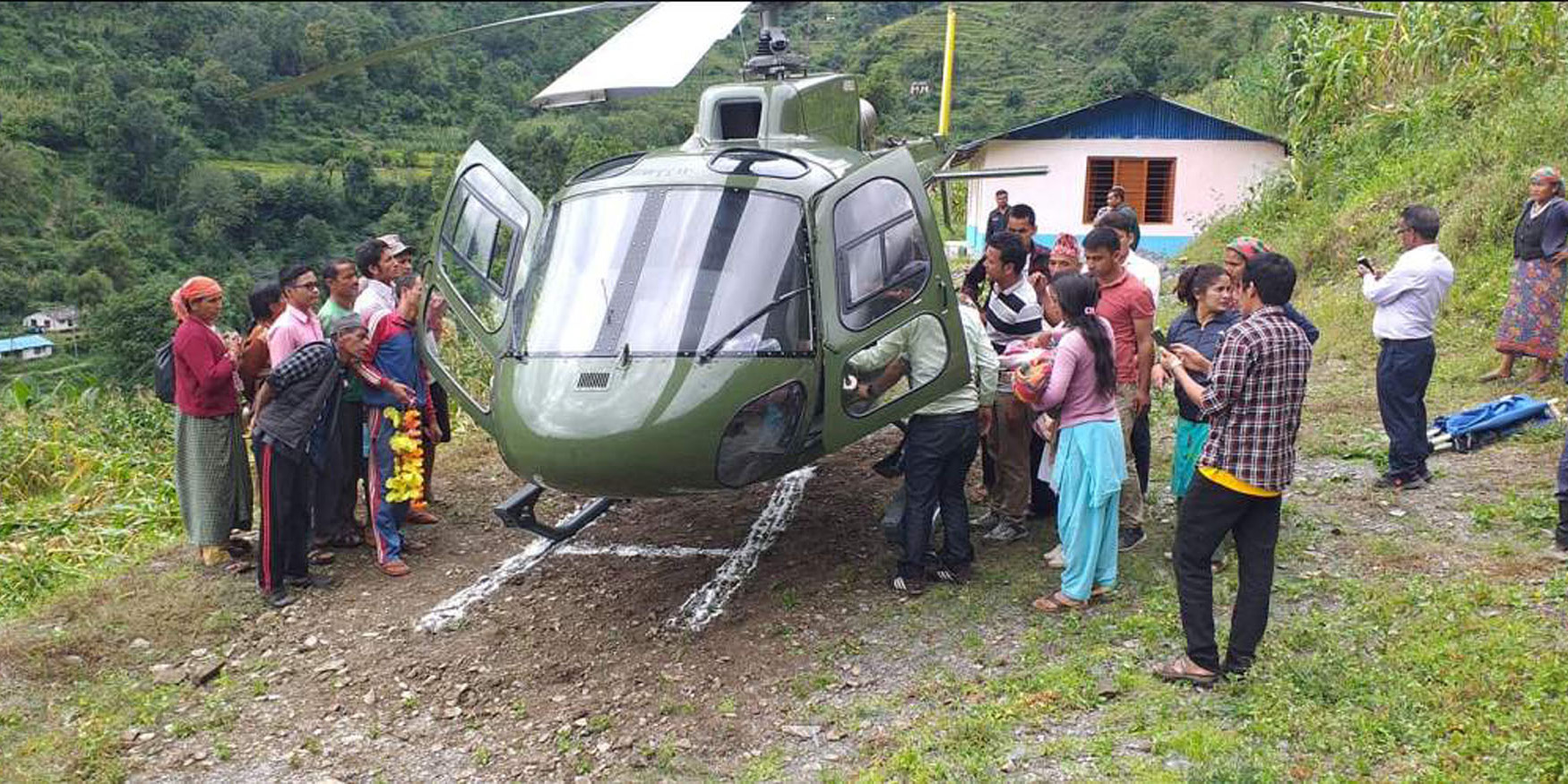
The federal government launched the air rescue program in 2018/19 to prevent maternal deaths and provide access to safe delivery services for women suffering complications during pregnancy and childbirth.
According to the report, the program is being fully implemented in 19 districts and partially in 29 districts. Stating that some districts with regular road connectivity have also been included in the program, it has recommended a time-bound review of the program’s coverage areas and operational locations to ensure resources are targeted appropriately.
Since the fiscal year 2018/19, a total of 713 women have benefited from the rescue service, according to the report.
The audit also found delays in emergency response. An average of 145 minutes is required to transport pregnant women to health facilities through air rescue operations. Of this, around 90 minutes are spent reaching primary health centers, 30 minutes obtaining helicopter flight permission, and 25 minutes on the actual helicopter flight.
The OAG has recommended improving coordination among local governments, relief and rescue coordination committees, and health institutions to expedite emergency response and ensure the immediate availability of resources for rescue operations.
The report also identified weaknesses in several areas of program management, including preparedness before implementation, rescue fund management, rescue request handling, review of coverage areas, procedural arrangements for air rescue, availability of rescue equipment, rescue response time, night rescue services, workload management, beneficiary treatment records, effectiveness of transportation expenditure, monitoring of transport payments, selection of service providers, and regular updating and monitoring of air rescue costs.