 Himal Press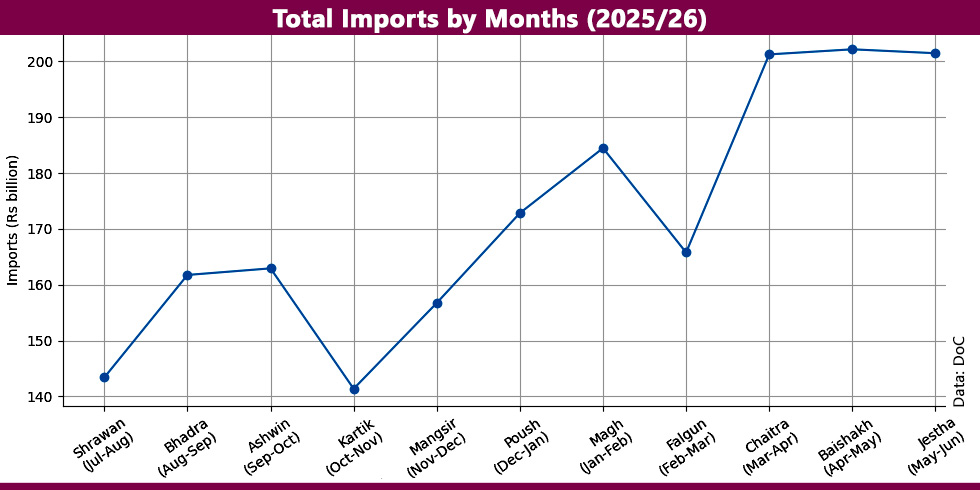
KATHMANDU: Nepal’s import bill in the current fiscal year is on track to match, or even exceed, the size of the country’s entire budget for the upcoming fiscal year.
Data released by the Department of Customs on Monday show Nepal imported goods worth Rs 1,894.09 billion during the first 11 months of the current fiscal year 2025/26. With monthly imports exceeding Rs 200 billion for the past three consecutive months and import demand typically rising in the final month of the fiscal year, total imports are expected to approach or surpass the Rs 2,124.34 billion budget allocated for fiscal year 2026/27.
This shows the country’s continued dependence on foreign goods despite persistent concerns over a widening trade imbalance.
Imports increased by 15.16% from Rs 1,644.79 billion recorded during the corresponding period of the previous fiscal year. Exports grew at a slower pace of 12.28% to Rs 277.96 billion, causing the country’s trade deficit to widen by 15.67% to Rs 1,616.13 billion.
The figures highlight the growing imbalance in the country’s total foreign trade, which expanded by 14.78% to Rs 2,172.06 billion in the first 11 months of the current fiscal year. Against imports worth nearly Rs 1,900 billion, the country exported goods valued at just Rs 277.96 billion during the review period.
A month-by-month breakdown shows imports gathering momentum throughout the fiscal year. Imports stood at Rs 143.40 billion in Shrawan (mid-July to mid-August), then climbed to Rs 161.75 billion in Bhadra (mid-August to mid-September) and Rs 162.93 billion in Ashwin (mid-September to mid-October). Although the figure dipped to Rs 141.37 billion in Kartik (mid-October to mid-November), likely reflecting lower trading activity during the festive season, it rebounded to Rs 156.74 billion in Mangsir (mid-November to mid-December) and Rs 172.83 billion in Poush (mid-December to mid-January).
The upward trend strengthened in the second half of the fiscal year. Imports rose to Rs 184.46 billion in Magh (mid-January to mid-February) before easing to Rs 165.77 billion in Falgun (mid-February to mid-March). However, they crossed the Rs 200-billion mark to Rs 201.24 billion in Chaitra. Total imports remained above the Rs 200 billion threshold in Baishakh (mid-April to mid-May) at Rs 202.15 billion and Jestha (mid-May to mid-June) at Rs 201.45 billion.
The surge in recent months suggests strong domestic demand as businesses ramp up imports ahead of the fiscal year-end, when government spending and private-sector activities typically accelerate.
Petroleum products continued to dominate Nepal’s import basket. Diesel was the country’s largest import commodity by value, with imports worth Rs 152.67 billion during the review period. Crude soybean oil followed at Rs 119.63 billion, while petrol imports stood at Rs 68.17 billion. Sponge iron and liquefied petroleum gas (LPG) rounded out the top five with total imports of Rs 53.69 billion and Rs 52.21 billion, respectively.
On the export front, soybean oil remained Nepal’s leading export product with total earnings of Rs 113.18 billion. Big cardamom ranked second with exports worth Rs 12 billion, followed by sunflower oil at Rs 7.99 billion. Refined palm oil and hand-knotted carpets completed the top five export items, contributing Rs 6.14 billion and Rs 6.07 billion, respectively.
The composition of exports continues to reveal heavy reliance on refined edible oils. Three of the five largest export commodities during the review period were processed edible oil products destined primarily for the Indian market.
Nepali refiners import crude edible oils, process them domestically and re-export them to India, taking advantage of preferential market access provisions. Economists have long warned that any change in these trade arrangements could significantly affect Nepal’s export performance, given the outsized contribution of refined edible oils to the country’s export earnings.