
 Himal Press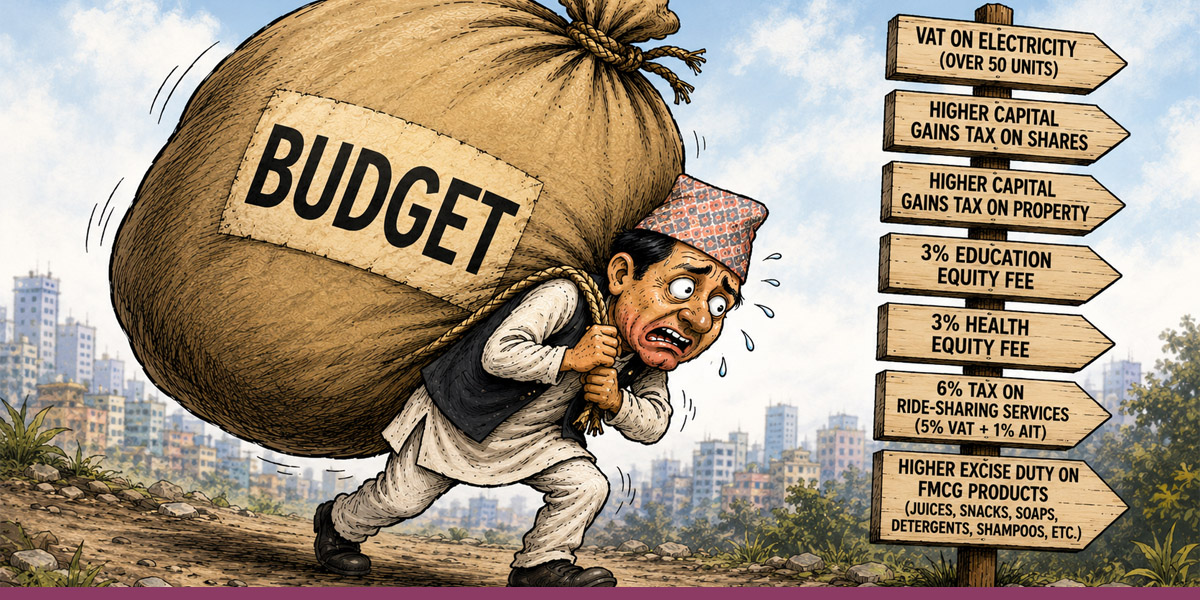
KATHMANDU: While the government has raised the individual income tax threshold to Rs 1 million in a move aimed at providing relief to middle-class consumers, it has simultaneously imposed new taxes and levies on a wide range of goods and services, saddling them with additional financial burden.
Presenting the budget in the federal parliament on Friday, Minister for Finance Dr Swarnim Wagle announced that household electricity consumers using more than 50 units per month will now be subject to a concessional value-added tax (VAT).
The new measures come just weeks after the government announced plans to boost domestic electricity consumption through measures like promotion of electric vehicles, expansion of charging infrastructure and a shift from LPG to electric cooking.
The government has also increased capital gains tax on shares and real estate transactions. Short-term stock investors—those holding shares for less than a year—are now required to pay a 10% capital gains tax, up from the existing 7.5%. Long-term investors will see the rate rise from 5% to 7.5%.
Capital gains tax on property sales has also been increased to 7.5% from the previous 5%.
In another major shift, the government has introduced a 3% “Education Equity Fee” on all charges collected by private educational institutions, including schools, colleges, universities and technical institutes. A similar 3% “Health Equity Fee” will be levied on fees charged by private hospitals and healthcare providers. The government has said that the revenue will be used to improve access to quality education and healthcare and to finance related infrastructure.
Consumers of ride-sharing platforms such as Pathao, inDrive and Yango, which have become an easy alternative to the largely unmanaged public transport system, will also face higher costs. As per the budget speech, ride-sharing services will be subject to a 5% VAT. An additional 1% advance income tax will effectively raise fares by around 6%.
The budget has further imposed higher excise duties on a range of fast-moving consumer goods (FMCG), including packaged juices, soaps, detergents and shampoos. Snack foods such as chips, cheese balls, instant pasta and puffed snacks will also face new excise duties.
Industry people say tax increases could raise consumer prices by as much as 30%.
The decision to increase the mandatory third-party motor insurance coverage limit to Rs 1 million from the existing Rs 500,000. This will ultimately increase insurance premium coverage for consumers.











![Yosin pole raised as Indrajatra festival begins in Kathmandu [In Pictures]](https://en.himalpress.com/wp-content/uploads/2026/09/Indrajatra-5-600x300.jpg)