 Himal Press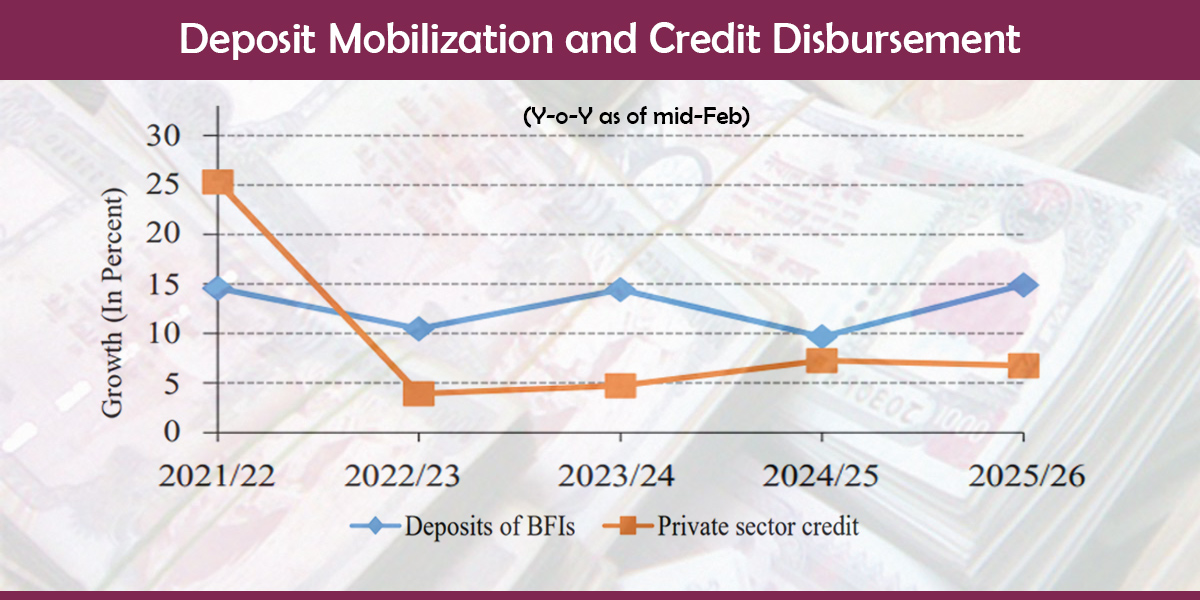
KATHMANDU: Deposit mobilization by banks and financial institutions (BFIs) rose 6% over the first seven months of the current fiscal year, while credit to the private sector grew at a slower pace of 4%, according to the Nepal Rastra Bank’s latest macroeconomic situation report.
According to the report, deposits at BFIs increased by Rs 433.71 billion to reach Rs 7,697.59 billion as of mid-February 2026. In the same period last fiscal year, deposits had grown by 3.8%, or Rs 245.34 billion. On a year-on-year basis, deposits expanded by 14.9% by mid-February.
The composition of deposits also shifted significantly over the year. Savings deposits accounted for 42.8% of the total deposits in mid-February 2026, up from 34.8% a year earlier. Demand deposits stood at 6.5%, compared with 5.2% in the same period last year. The share of fixed deposits, however, declined to 41.6% from 52.4% over the period.
Institutional deposits made up 34.3% of total deposits in the banking system in mid-February 2026, slightly lower than 35.3% a year earlier.
Meanwhile, credit disbursement to the private sector increased by 4%, or Rs 221.84 billion, to reach Rs 5,719.54 billion during the review period. This is lower than the 5.6% rowth, or Rs 283.46 billion, recorded in the corresponding period of the previous fiscal year. On a year-on-year basis, private sector credit grew by 6.8% by mid-February 2026.
The central bank has set the private sector credit disbursement target at 12% in the current fiscal year.
Of the total private sector credit, 62.6% was extended to non-financial corporations, while households accounted for 37.4%. These shares stood at 63.8% and 36.2%, respectively, in mid-February last year.
Credit from commercial banks increased by 4.2% during the review period, followed by development banks (3%) and finance companies (1.8%).
Sector-wise, lending grew most strongly in the consumables sector, which recorded a 10.6% growth. Credit to the construction sector rose by 8.7%, while loans to transportation, communication, and public services increased by 6.8%. Industrial production loans grew by 4.8% and services sector lending by 1.1%.
However, lending to the agriculture sector declined by 1.4%, while credit to the insurance and fixed assets sector fell by 1.9%.
Among loan categories, trust receipt (import) loans posted the highest growth at 16.2% during the review period. Margin loans increased by 11% and hire purchase loans by 9.3%. Term loans grew by 3.1%, real estate loans by 2.5%, cash credit loans by 2.1%, and demand and other working capital loans by 1.8%. Overdraft loans, however, declined by 3.4%.