 Himal Press
 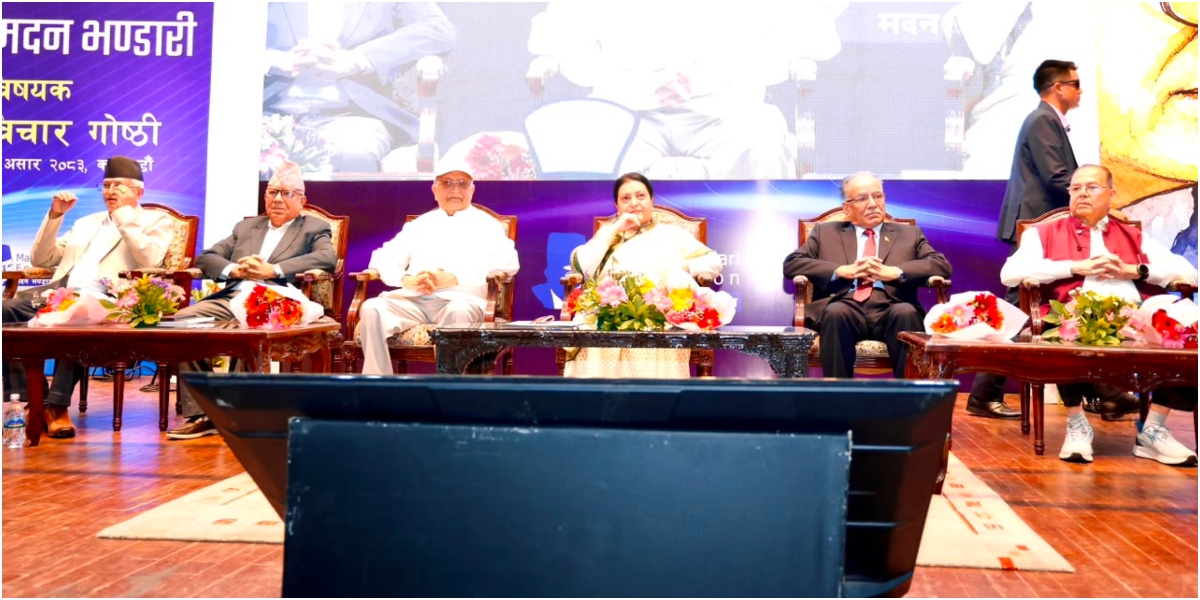 Former President Bidya Bhandari (center), who is preparing for a return to active politics, flanked by four former prime ministers and leftist leaders
KATHMANDU: Top leftist leaders of the country, who shared the same platform on the occasion of Madan Bhandari’s birth anniversary in Kathmandu on Sunday, called for self-reflection, change and left unity.
However, their statements also raise an important question: have they truly understood the public mandate, or is this merely a new political language adopted after losing power?
Speaking at the event, CPN-UML Chairman and former Prime Minister KP Sharma Oli vowed to defeat reactionary forces.”We are not finished after the electoral defeat; we will rise again,” Oli said. “The main task right now is to defeat regression. To defeat it, all democratic and leftist forces must come together through functional unity.”
Nepali Communist Party (NCP) Coordinator and another former Prime Minister, Pushpa Kamal Dahal, urged leftist and nationalist forces to unite without delay. “Let me say clearly, those in favor of national sovereignty, against authoritarianism, and against foreign pressure and interference must unite as soon as possible. Any delay would be a mistake,” he said.
Similarly, NCP Co-coordinator and another former Prime Minister, Madhav Kumar Nepal, emphasized the need for introspection. “We failed to understand the changing psychology of the people, or perhaps distortions emerged within us. We must reflect on this,” he said, adding that this is not just about one party but all communist groups in Nepal.
Another former Prime Minister and NCP leader, Jhala Nath Khanal, claimed that the election results would have been different if the left had remained united. “The left could have secured around 100 seats. This kind of ‘Balen-style’ authoritarianism would not have emerged, and the country’s situation would have been different,” he argued.
Meanwhile, former President Bidhya Devi Bhandari, who is also a former UML Vice Chairperson, acknowledged the public mandate and said the communist movement should adapt to changing times. She said the election results have made a serious ideological debate within communist parties unavoidable. “It would be premature to draw conclusions about the communist movement from a single election result. Nevertheless, it is essential to accept the message expressed by the people,” she added.
The statements of these four leaders had a common theme—self-reflection, change and unity. But the question remains: why have these themes become prominent only now?
Over the past two decades, these same leaders have repeatedly shared power and served as prime ministers. They have also split parties, formed new ones and reunited, only to split again. While they were in power, personal rivalries often overshadowed ideological differences. Leadership struggles became more about retaining positions than transferring them. As a result, not just the communist movement but communist parties themselves have weakened.
The message of the March 5 elections is that the public has challenged the unquestioned dominance of traditional parties. The rise of new political forces, declining support for established parties and growing dissatisfaction among youth all point to this transition. This is not merely about reduced seat counts for communist parties; it is also a mandate for changing political behavior.
This is why these veteran leftist leaders are now speaking the language of introspection, unity, and change.
Nepal’s political history shows that most party splits have been driven more by leadership rivalries than ideology. Disagreements over power-sharing have often led to fragmentation. However, when public support declines after elections, the same leaders begin calling for unity.
Times have changed. Today’s people are no longer willing to trust leaders based solely on their historical contributions. They demand good governance, transparency, results-oriented leadership, employment opportunities, efficient service delivery and accountability. The younger generation increasingly values performance over ideological slogans.
The real test of these leaders will be their actions. If introspection remains rhetorical, leadership transition is delayed, and old political habits persist, the public mandate will once again be ignored.
What Nepali politics needs today is not merely left unity or party restructuring, but a transformation of political culture. The message given to established leaders by the people through the election is not just an opportunity to regain power, but a chance to change themselves. If that opportunity is also lost, history may remember them not as agents of change, but as forces that resisted it.
No leader is indispensable in a democracy. The message from the election is clear—leadership transition, timely thinking, self-reflection and rebuilding public trust are no longer optional; they are essential. The people have long signaled that senior leaders should step aside with dignity and pass leadership to a new generation. The decision now lies with the same old leadership—whether to heed that message or continue repeating the same political cycle.