
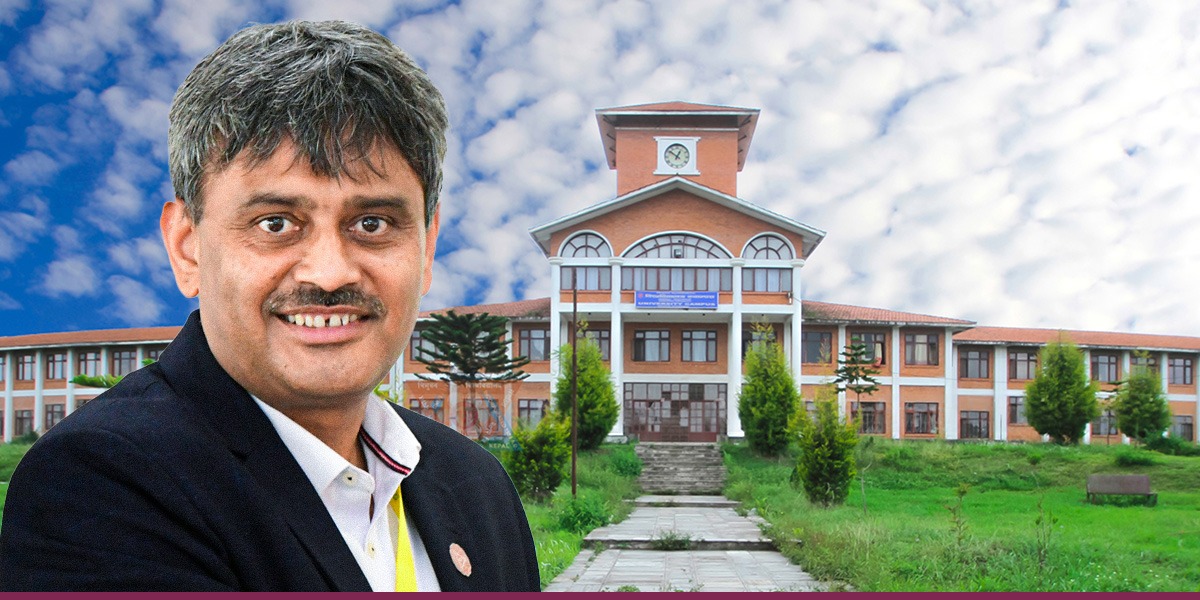
KATHMANDU: Newly appointed Vice Chancellor of Tribhuvan University, Prof Dr Bhola Thapa, has stirred controversy by saying that the university’s system was in disarray and requires the intervention or collaboration of the Ministry of Education and Sports and the University Grants Commission to put it in order.
With the vice chancellor, who is tasked with leading reforms, himself seeking external intervention, critics have questioned why such intervention is needed for an autonomous institution like the TU.
Thapa was appointed vice chancellor of the country’s oldest university on July 3. Although authorities say he was selected through a competitive process, academics have consistently raised concerns about its transparency.
At a Policy Lab on University Faculty Recruitment, Development and Promotion on Saturday, Thapa spoke about ongoing staff issues and institutional disarray at TU. “One category of contract staff comes and says, ‘There are a thousand of us in this category, but we lack this.’ Another category comes and says, ‘There are two thousand of us in this category,’” he said.
His remarks appeared to refer to part-time faculty currently teaching at the university.
He added that, while the university’s system remained disrupted, intervention or cooperation from the ministry and the commission was necessary for a certain period to put the institution in order.
However, voices are growing that a university leader should independently identify problems, set priorities, make institutional decisions and lead their implementation, rather than invite the ministry and commission to intervene in university affairs. If the ministry must step in to reform TU, critics ask, why is a vice chancellor needed?
This does not mean government support is unnecessary. The government’s role in budgeting, policymaking, legal reforms and developing a national higher education strategy is natural. Collaboration with the commission on resources, policies and coordination is also necessary. However, the boundary between policy support and institutional intervention remains at the heart of the debate over university autonomy.
Universities in Nepal have long faced criticism for political interference, government influence over leadership appointments, power-sharing and administrative pressure. The new TU leadership, therefore, was expected to make the institution more autonomous, competent and accountable. However, when a vice chancellor calls for ministry intervention, it risks fostering dependency rather than charting a path toward reform.
Educationist Prof. Dr. Bidya Nath Koirala said the foundation for autonomy within Nepal’s university structure remains weak. According to him, the ex officio roles of the prime minister and education minister in university governance signal state control.
“The prime minister and education minister serve as ex officio members, which inherently means government control. Our universities are simply not autonomous,” Koirala said.
He added that the recent appointment process further demonstrated that universities remain under government influence.
“This selection process showed that universities are not autonomous; they are merely shadows of the government, much like the National Planning Commission,” he said.
Koirala said Thapa might have meant that he could not make decisions alone and needed to consult relevant bodies.
“Looking at what he said and what his intent might have been, it seems he feels he cannot decide alone and must consult others. But it shows that he, too, feels helpless,” Koirala said.
Pointing to structural flaws in TU’s executive leadership, Koirala questioned the vice chancellor’s limited influence, even in the appointment of the rector and registrar.
“Our talk of university autonomy is just a wish; in reality, autonomy does not exist,” he added.
TU’s immediate challenges extend beyond the debate over autonomy. The university has long struggled with issues concerning the terms of service, job security, contract status and part-time arrangements of its teachers and staff. Resolving these issues remains a core responsibility of the university leadership.
According to Koirala, efforts to address teachers’ demands for permanent status must also be tied to academic quality.
“The issues facing university teachers and staff have existed for a long time. Internal teachers seek permanent positions, but an environment must be created to strengthen academic standards,” he said.
He suggested that institutionalizing job security while promoting academic competition requires making the TU Service Commission effective.
“The vice chancellor must have the courage to say that no one can move forward without passing the service commission examination,” Koirala said.
He added that establishing a system in which the TU Service Commission opens vacancies every two months would benefit both faculty members and the university.
Former TU Vice Chancellor Prof Dr Deepak Aryal also said that intervention by the ministry or a commission was not necessary to resolve the university’s problems. According to Aryal, the ministry should formulate policies, while the university should resolve its institutional issues within that framework.
“TU’s problems must be resolved from within. Intervention from the ministry or the commission is not necessary,” Aryal told Himal Press. “The vice chancellor can resolve the issues himself.”
Aryal said the vice chancellor needed to form his own team to address internal problems.
“Whatever problems arise, his team must resolve them,” he said.
Aryal also said the role of part-time teachers could not be completely dismissed.
“The university cannot run without part-time teachers. Part-time teachers exist everywhere in the world,” he said. “However, no one should be allowed to use part-time roles as a pipeline to secure permanent positions.”
Aryal added that permanent appointments should be made only through the process outlined by the TU Service Commission.