 Himal Press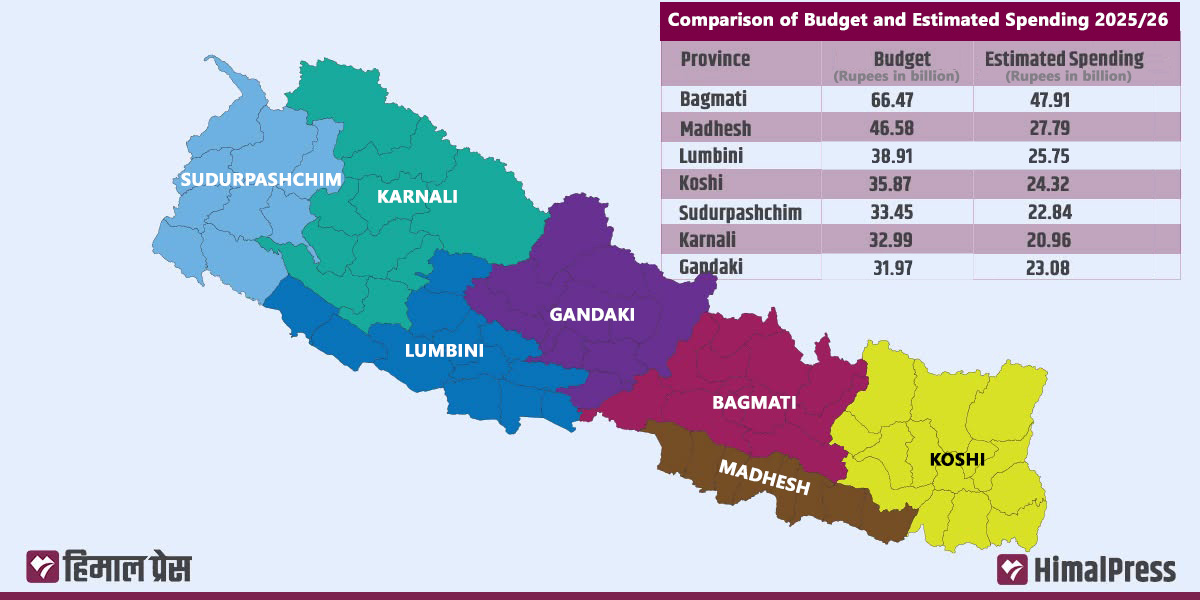
KATHMANDU: Provincial governments have once again unveiled budgets that significantly exceed their actual spending capacity.
All seven provincial governments unveiled their budget for the fiscal year 2026/27 on Ashad 1 (June 15 this year) as required by the constitution. They have continued a trend of allocating higher funds despite their low spending capacity in the coming fiscal year as well.
An analysis of provincial budget and expenditure data shows that all provincial governments failed to fully utilize their allocated budgets in fiscal year 2025/26. This resulted in a combined budget surplus of more than Rs 41 billion. However, these surpluses are not due to higher revenue mobilization by provincial governments; they stem from delays in project implementation, weak procurement performance and chronic under-execution of development projects.
Despite repeated criticism over low capital spending, most provinces have proposed larger budgets for the upcoming fiscal year 2026/27.
Bagmati Province, which has the largest provincial budget, is projected to record the highest budget surplus among provincial governments in the current fiscal year.
The province has allocated Rs 66.47 billion for the current fiscal year. However, its total spending is estimated to remain only Rs 47.91 billion, leaving a surplus of Rs 12.61 billion. The province managed to spend only Rs 46.40 billion in the previous fiscal year. This shows only marginal improvement in spending despite a large budget outlay.
Bagmati has proposed a slightly higher budget of Rs 66.93 billion for 2026/27.
Karnali emerged as one of the weakest performers in terms of budget utilization in the current fiscal year. Karnali’s estimated spending reached only Rs 20.96 billion in the current fiscal year against a budget of Rs 32.99 billion. This resulted in a budget surplus of Rs 6.41 billion.
The province’s total expenditure in 2024/25 was even lower at Rs 19.99 billion. Nevertheless, Karnali has increased its budget for the upcoming fiscal year to Rs 35.39 billion.
Madhesh Province also reported a substantial surplus of Rs 6.83 billion. While the province has allocated Rs 46.58 billion in the current fiscal year, it expects to spend only Rs 27.79 billion. Its estimated expenditure for 2025/26 is lower than the Rs 31.2 billion spent in the previous fiscal year.
Acknowledging the challenges in the execution of budgetary programs, Madhesh has reduced its budget for 2026/27 to Rs 43.13 billion.
Koshi Province allocated Rs 35.87 billion for 2025/26 but expects expenditure to remain at only Rs 24.32 billion. The provincial government’s budget surplus stands at Rs 5 billion.
Koshi’s total spending stood at Rs 28.18 billion in 2024/25. However, the province has proposed a larger budget of Rs 40.44 billion for 2026/27.
Sudurpashchim Province is on track to record a surplus of Rs 4.76 billion in the current fiscal year. The provincial government’s spending is estimated to remain at Rs 22.84 billion in the current fiscal year against a budget of Rs 33.45 billion. Its toal spending stood at Rs 22.2 billion in the previous fiscal year. This shows that there has been only a marginal increment in its spending capacity. Despite this, the provincial government has raised its budget for the next fiscal year to Rs 37.7 billion.
Among the provinces, Gandaki recorded the lowest budget surplus of Rs 1.72 billion. The province is estimated to spend Rs 23.08 billion out of its Rs 31.97 billion budget in the current fiscal year. This is slightly above the total expenditure of Rs 22.89 billion in 2024/25. Its budget for 2026/27 has been increased modestly to Rs 32.99 billion.
Lumbini posted a surplus of Rs 3.73 billion. Its expenditure in the current fiscal year is estimated to remain at Rs 25.75 billion against a budget of Rs 38.91 billion. Interestingly, the provincial government’s actual spending in 2024/25 was higher at Rs 27.89 billion.
Lumbini has slightly reduced its budget for 2026/27 to Rs 37.38 billion.
Except for Madhesh and Lumbini, all provinces have increased their budgets for the coming fiscal year despite repeatedly failing to spend the resources already allocated.
Madhesh appears to have the weakest budget execution performance, with estimated spending amounting to only around 60% of its budget. Karnali, Koshi and Sudurpashchim also continue to struggle with low utilization rates, while Gandaki has maintained comparatively better fiscal discipline.