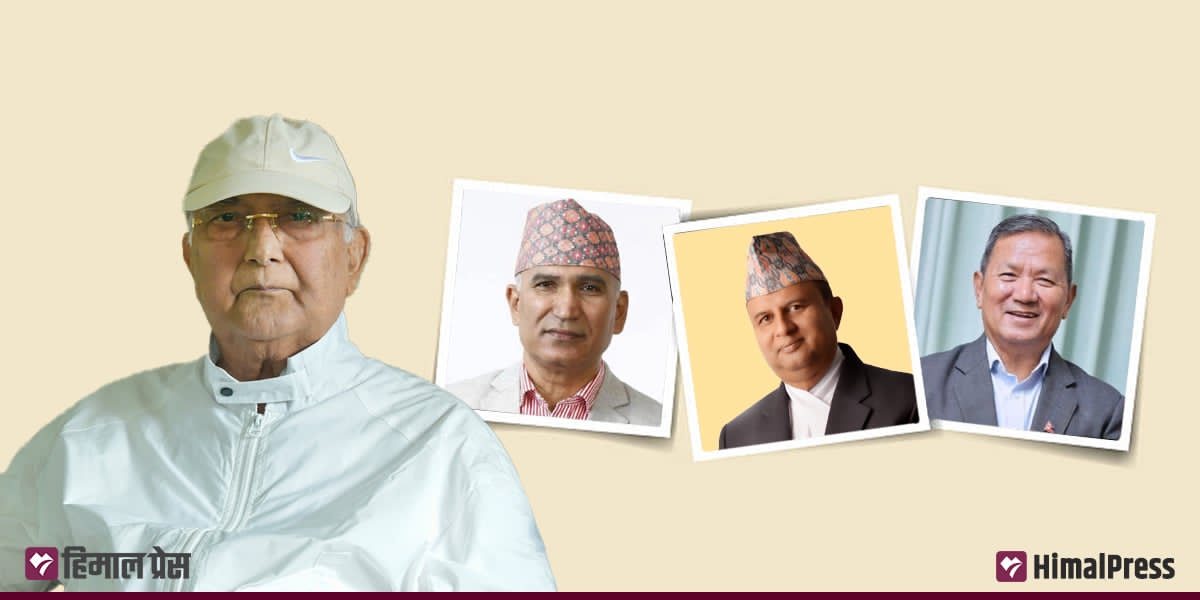
KATHMANDU: CPN-UML leaders who stood firmly in favor of KP Sharma Oli until six months ago have now turned against him. The very leaders who supported Oli for a third straight term as chairperson during the general convention held in the first week of December are now demanding that he step down.
With pressure mounting from the majority of the Secretariat members to resign, Oli is now facing humiliation from his own people at the twilight of his political career. Oli was pushed into the minority after a majority of office-bearers demanded his resignation during the ongoing Secretariat meeting in Gundu, Bhaktapur.
The 75-year-old leader, who has served three consecutive terms as chairperson, has found himself in the minority for the first time since taking over the party leadership. The leaders who put their hearts and souls into ensuring Oli’s victory in December are now actively pressuring him to resign.
Oli has been leading the UML since the party’s ninth general convention in 2014.
There were speculations that Oli would step down as chairman after he resigned as Prime Minister following the Gen Z movement on August 23 and 24. However, when Oli pushed forward to become chairperson for the third time, voices for a leadership handover began to emerge within the party. To suppress those voices, Oli selected his close loyalists as convention delegates right from the ward level. Leaders like Bishnu Poudel, Shankar Pokhrel, and Prithvi Subba Gurung actively supported Oli during the convention. They proposed that Oli should retain leadership for a third term. Vice Chairperson Bishnu Poudel had argued at the time that the country was under attack, making it the right moment to choose strong leadership, and that a newcomer could not safeguard the nation and the constitution.
While preparations were underway for Ishwar Pokhrel to contest against Oli, Poudel and Pokhrel worked at the forefront to weaken Ishwar and ensure Oli’s victory. A UML leader recalls that during the closed session, Poudel went so far as to call Oli a leader of leaders and the father of Eastern philosophy.
Before the general convention, two clear factions had emerged within the UML. With Oli on one side, Ishwar Pokhrel’s candidacy was certain. Leaders say Poudel and his allies were initially expected to support Ishwar, but they eventually aligned with Oli. Leaders like Poudel, Gurung, Raghubir Mahaseth, and Padma Aryal openly joined the establishment camp, claiming there was no alternative to Oli. According to leaders, Oli’s victory was certain after Poudel and Gurung openly supported him.
In a complete reversal, Poudel, Gurung, and Pokhrel are now leading the wave demanding Oli’s resignation. This new alliance has put immense pressure on Oli. During the Secretariat meeting, Poudel, Gurung, and Pokhrel directly raised the issue of Oli’s resignation. Poudel went on to say that the UML would not have weakened to this extent had Oli stepped down after the Gen Z movement.
Gurung took an even harsher stance, arguing that the UML is not Oli’s private company. According to a leader present at the meeting, an intense dispute broke out between Gurung and Oli. Pokhrel, whose stance is considered decisive in the meeting, also said that Oli should clear the way, officially pushing Oli into the minority. A secretariat member told Himal Press that three out of four vice chairpersons demanded an alternative to Oli. The general secretary and two out of the three deputy general secretaries were of the same opinion.
Vice Chairperson Ram Bahadur Thapa and Deputy General Secretary Lekhraj Bhatta openly supported Oli. Out of nine secretaries, Sherdhan Rai, Dr Rajan Bhattarai, and Hikmat Karki spoke against Oli. The member said Mahesh Basnet and Padma Aryal were the only ones left openly defending Oli.
Former Vice Chairperson Asta Laxmi Shakya says it would be best for Oli to step down immediately. “The party does not belong to Oli alone, nor is it a company run by his faction,” Shakya said, criticizing the mindset of holding onto the chairmanship until the last breath. “Oli should take a respectful exit and hand over leadership to the younger generation.”
In the March 5 elections, the UML was restricted to the third-largest party, and notably, every top office-bearer who contested the election lost. Along with Oli, Vice Chairperson Poudel, General Secretary Pokhrel, and Deputy General Secretaries Mahaseth and Bhatta all suffered electoral defeats.
Naresh Rokaya, a young UML leader, said bringing in the second generation at the leadership alone will not be sufficient. “The party must now look toward representation from the third generation,” he added.
Explaining why leaders changed their stance in just six months, UML leader Khim Lal Bhattarai said the election results sent a clear message that generational transition is mandatory. He added that delaying this change will cause immense damage and that a leadership transition is vital to make the UML a vibrant force for the next elections.
While discussions about changing the leadership had been brewing since the elections, the momentum accelerated after Balendra Shah of Rastriya Swatantra Party (RSP) became Prime Minister and the UML Chairperson was arrested for suppressing Gen Z protests.
Following Oli’s arrest, second-generation leaders joined hands to demand the handover of power. At the grassroots level, party leaders and cadres started collecting signatures for a special convention and organizing different creative programs. Student leader Kamal Joshi said the creative programs were designed to make the party relevant to the current times.
Leaders say the political environment after the last September protest, combined with the UML’s diminished electoral position, left them with no choice but to demand Oli’s resignation.
However, UML Secretary Mahesh Basnet argued that this is not the right time to seek an alternative to the party leadership. He maintained that it was wrong to demand a resignation at a time when the chairperson himself is already in a weakened position.