 Himal Press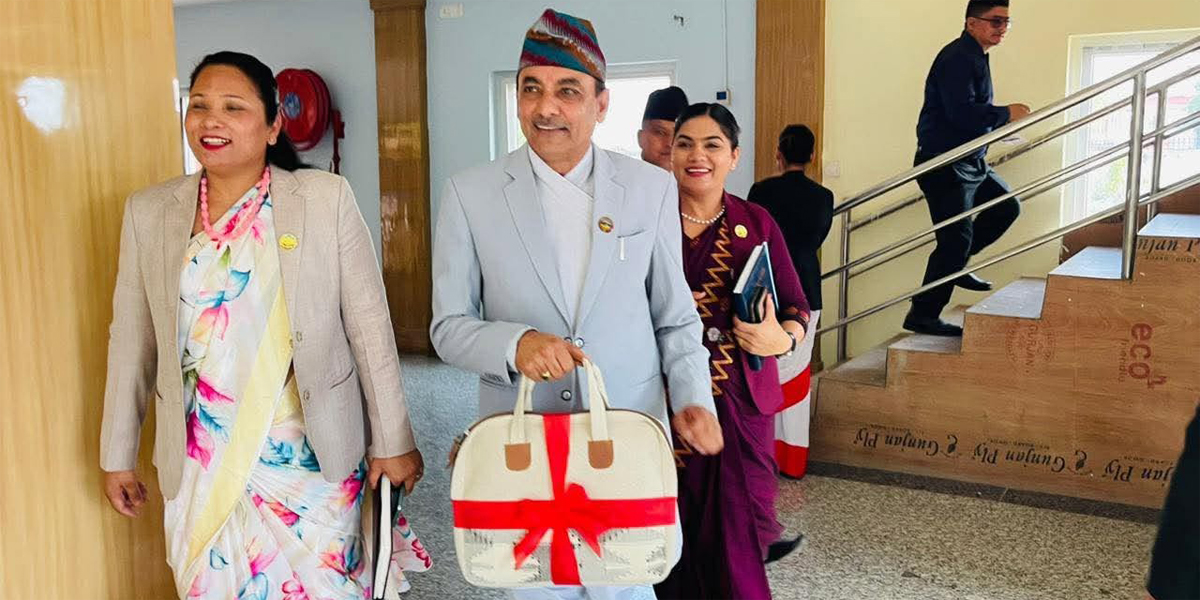
BUTWAL: Lumbini Province Government on Monday presented a budget of Rs 37.38 billion for the upcoming fiscal year 2026/27.
The annual income and expenditure estimates outline priorities focused on institutional strengthening, economic growth, and improved governance.
Minister for Economic Affairs and Planning Dhanendra Karki tabled the budget in the meeting of the Lumbini Provincial Assembly on Monday. The total outlay includes Rs 22.71 billion (around 60.7%) allocated for capital expenditure and Rs 11.11 billion (29.7%) for recurrent spending.
The budget is slightly smaller than the current fiscal year’s allocation of Rs 38.91 billion.
The province plans to finance the budget through multiple sources, including Rs 6.61 billion in internal revenue, Rs 12.31 billion from federal revenue sharing, Rs 300 million from royalty sharing, and Rs 5.56 billion from fiscal equalization grants. In addition, Rs 4.45 billion will come from conditional grants, Rs 765 million from complementary grants, and Rs 633.4 million from special grants. The government also expects to utilize Rs 3.73 billion carried over as a cash balance from the current fiscal year.
The government has identified key priorities such as strengthening provincial structures, institutionalizing the federal democratic system, boosting the provincial economy, ensuring fiscal discipline, and expanding participation of the public and private sectors to achieve economic prosperity.
As part of administrative reforms, the provincial government plans to restructure ministries and operate through eight ministries. The “Digital Lumbini Province” program has also been given priority to enhance governance and service delivery.
Under fiscal transfers to local levels, the government has allocated Rs 960 million for fiscal equalization grants, Rs 984 million for complementary grants, Rs 200 million for special grants, and Rs 1.41 billion for conditional grants.
Sector-wise, the budget allocates Rs 49.9 million to boost agricultural productivity and Rs 27.8 million for expanding technical services. In education and social development, Rs 110 million has been earmarked for technical education, Rs 400 million for community campuses and schools, Rs 15 million for teacher capacity development, and Rs 76 million for scholarships. The government has also increased the per-student allocation under the school midday meal program by Rs 5.
To ensure completion of ongoing infrastructure works, Rs 4 billion has been set aside for multi-year projects. Disaster management, information technology expansion and digital service delivery programs have also been prioritized. The budget includes provisions for the development of a Lumbini digital portal, formulation of integrity policies, policy dialogue programs, implementation of a provincial project bank, and strengthening public service delivery.
The provincial government has reiterated its commitment to achieving shared prosperity through cooperation among the public, private and cooperative sectors, while enhancing the capacity of civil servants to make service delivery more effective.