 Himal Press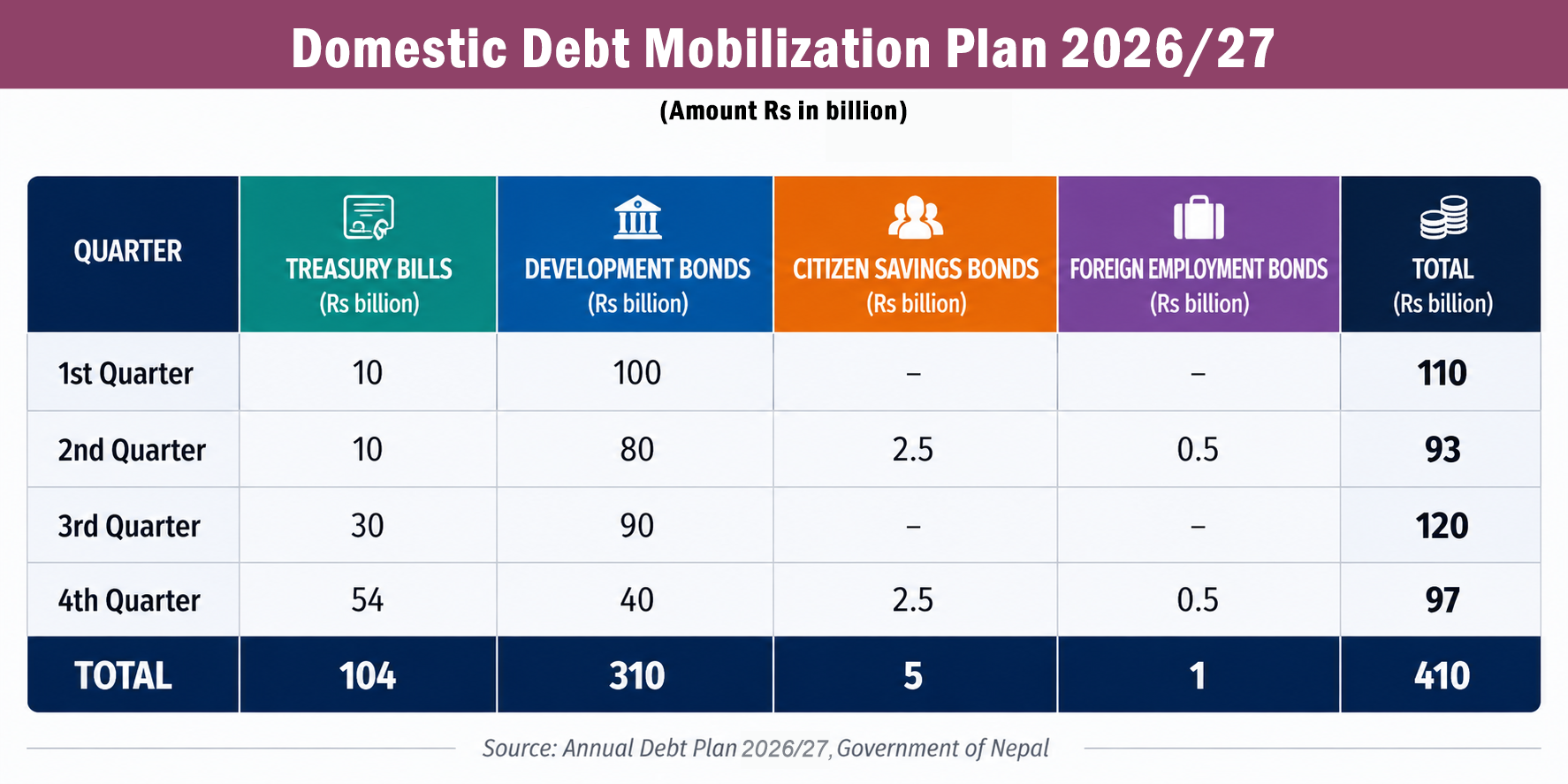
KATHMANDU: The government plans to mobilize Rs 110 billion in domestic debt in the first quarter of 2026/27, as part of its broader plan to raise Rs 410 billion from internal sources to finance its budget deficit in the current fiscal year.
Minister for Finance Swarnim Wagle unveiled a budget of Rs 2,124.34 billion for 2026/27, which began in mid-July, with a fiscal deficit of Rs 657.29 billion. The government plans to meet this shortfall by mobilizing public debt – Rs 410 billion from internal sources and Rs 247 billion from external sources.
According to the annual debt plan prepared by the Public Debt Management Office (PDMO), the government will rely primarily on treasury bills and development bonds, with smaller contributions coming from citizen savings bonds and foreign employment bonds.
As per the plan, the PDMO will mobilize Rs 110 billion in the first quarter. The PDMO plans to raise Rs 10 billion through treasury bills and Rs 100 billion through development bonds.
Similarly, the PDMO has targeted to raise Rs 93 billion in the second quarter. Of the targeted amount, Rs 10 billion will be raised through treasury bills, Rs 80 billion through development bonds, Rs 2.5 billion through citizen savings bonds and Rs 500 million through foreign employment bonds.
The third quarter will see the highest mobilization of Rs 120 billion. According to PDMO, it plans to raise Rs 30 billion in treasury bills and Rs 90 billion in development bonds in the third quarter.
Likewise, the PDMO plans to mobilize Rs 97 billion in the fourth quarter. This includes Rs 54 billion mobilized through treasury bills, Rs 40 billion via development bonds, Rs 2.5 billion in citizen savings bonds and Rs 500 million through foreign employment bonds.
Debts Rising
Public debt has been rising steadily in recent fiscal years, driven by persistent budget deficits and increased reliance on borrowing. By the end of fiscal year 2025/26, total public debt stood at Rs 2,974 billion, up from Rs 2,674 billion a year earlier.
With the rising public debt stock, the government’s debt servicing obligations have also been increasing. The government has allocated Rs 417 billion for debt servicing in the current fiscal year, including Rs 318 billion for principal repayments. The government’s debt servicing expenses are nearly as high as the budget earmarked for capital expenditure (Rs 431.1 billion)
The government’s medium-term debt management strategy for 2025/26–2027/28 aims to balance cost and risk by diversifying borrowing instruments and managing maturities. The strategy also assesses the composition of debt by source, instrument and currency.
As of the end of the last fiscal year, external debt accounted for 53.77% of total public debt, while domestic debt made up 46.23%. Within domestic debt, development bonds held the largest share at 33.61%, followed by treasury bills at 12.07%.
The government expects total public debt to reach Rs 3,364 billion by the end of the current fiscal year—about 44.94% of gross domestic product (GDP).
While domestic borrowing provides a relatively stable source of financing compared to external loans, economists warn that excessive reliance could tighten liquidity in the banking system and crowd out private sector credit if not carefully managed.
However, PDMO officials say they are making necessary efforts to smooth repayment pressures by balancing debt maturities. Around 34% of domestic debt principal is due for repayment in the current fiscal year, with the burden expected to decline in the long term, they say.