 Himal Press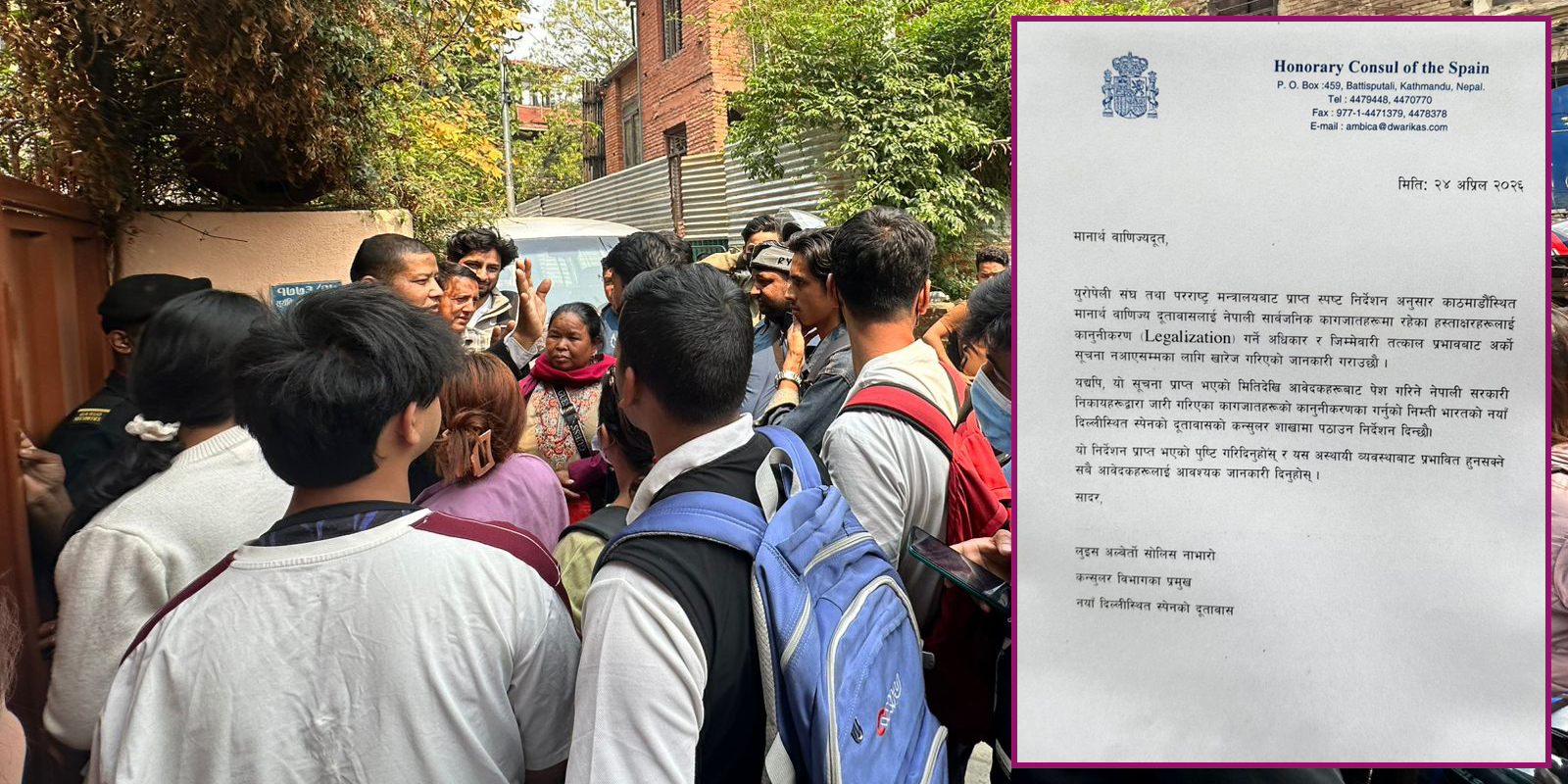
KATHMANDU: The document authentication process for thousands of Nepalis hoping to settle in Spain has been affected after the services were abruptly stopped in Kathmandu.
Since April 24, the Honorary Consulate of Spain, based at Dwarika’s Kathmandu Hotel in Battisputali, has completely suspended document authentication services. It has posted a notice to inform that the services have been stopped. As a result, all services, from visas to document verification, have now been shifted to the Embassy of Spain in New Delhi.
The decision has saddled Nepali applicants not only with additional costs but also made the process time-consuming. It has also raised questions about the role and accountability of honorary consulates, which are expected to provide services but are often run by private individuals.
A senior official at the Ministry of Foreign Affairs said the move was unusual. “It is not normal for an embassy to instruct a consulate to stop services altogether,” the official said, adding that such issues often receive little attention amid other priorities.
Honorary consuls in Nepal are typically prominent business figures. Critics question whether such positions are being used more for personal gain than public service. Applicants say they were being charged up to Rs 2,000 per document—often in cash and without receipts. This has also raised concerns about transparency as well.
There are also questions about why documents already verified by the Ministry of Foreign Affairs still need to be authenticated by an honorary consulate, and why Nepal’s own diplomatic channels have not played a stronger role in discouraging such requirements.
Nepal has an embassy in Spain. Spain, however, does not have a resident embassy in Kathmandu and oversees Nepal affairs from New Delhi.
Foreign ministry officials say the suspension of authentication services in Kathmandu follows repeated complaints about mismanagement at the consulate, including long queues, arbitrary fees, delays, and a lack of service without personal connections. They say the consulate shut down services altogether and redirected applicants to New Delhi after the foreign ministry showed some concerns about its services.
The Spanish consulate in Nepal had long been led by prominent hotelier Ambica Shrestha, who was actively involved in the delivery of such services through the consulate. After Ambica passed away, the responsibility shifted to her daughter, Sangita. Officials say service quality has deteriorated after Sangita assumed the role. Reports of overcrowding, disorder, and even police intervention to manage crowds had become common at the consulate.
Some officials have downplayed the issue, attributing service disruptions to high demand and shortages of stickers required for authentication. Others, however, admitted that such problems often go unaddressed due to a lack of seriousness and focus.
The impact on applicants has been severe. According to the Non-Resident Nepali Association (NRNA) Spain, documents of 3,000 to 4,000 Nepalis are currently stuck. With the June 30, 2026, deadline for Spain’s regularization (asylum-related) process approaching, many now face uncertainty.
Applicants say the process has become exhausting and humiliating. One man from Chitwan said he spent four days just to get a document stamped for his brother. “We thought this was an embassy, but it feels like a broker’s office,” he said.
Another applicant, a government employee, said even documents verified by the Nepali government required additional stickers from the honorary consulate. He criticized the system as unaccountable, saying that such positions are often passed within business families and have become commercialized.
Although honorary consuls do not receive salaries, they earn from service fees, which critics say create incentives for misuse. Past controversies, including allegations of human trafficking linked to some honorary officials, have also raised concerns.
The current system appears to prioritize personal benefit over public service. When Spain withdrew Kathmandu’s authority, the consulate simply posted a closure notice without prior preparation, alternative arrangements, or adequate communication.
The Ministry of Foreign Affairs has acknowledged the issue but has yet to announce concrete measures. Ministry Spokesperson Lok Bahadur Chhetri said the ministry was studying the situation and exploring solutions.
Experts suggest Nepal should push for recognition of notary or apostille systems, or develop digital verification processes in coordination with Spain to ease the burden on its citizens.