
POKOHARA: After years of debate, Gandaki Province has become the first province in the country to establish a legal framework for the cultivation of cannabis for medicinal and industrial purposes.
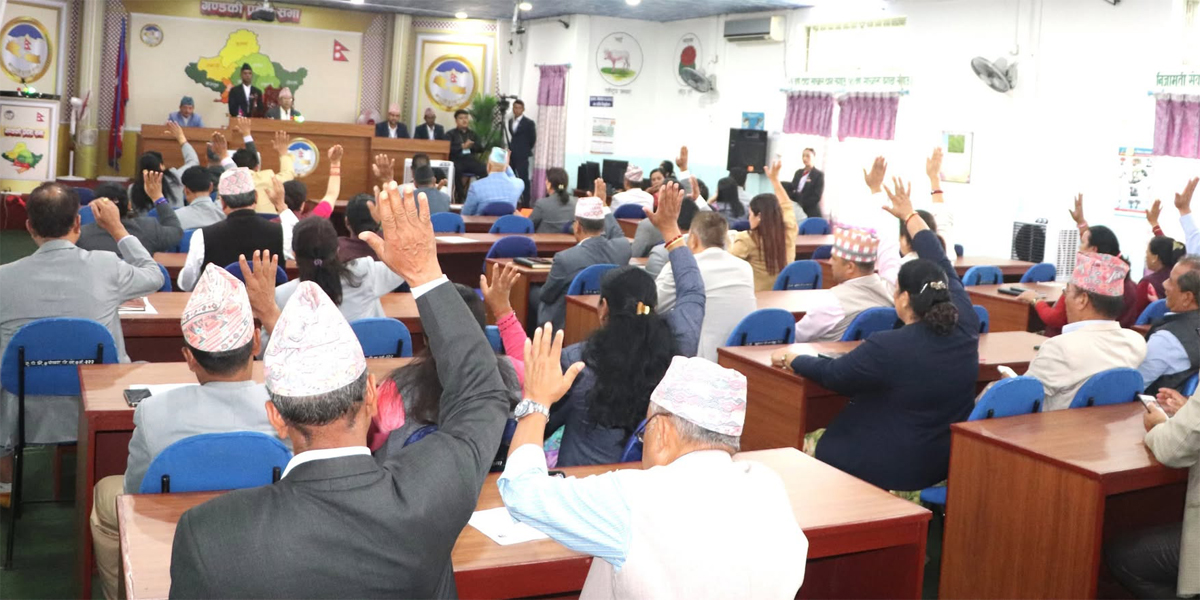
The Gandaki Provincial Assembly on Thursday unanimously passed the Bill to Regulate the Cultivation of Cannabis for Medicinal and Industrial Use, 2026, paving the way for licensed commercial cultivation under strict government oversight.
The Bill was endorsed after clause-by-clause deliberations in the provincial assembly, Provincial Assembly Secretary Govinda Paudel said. It was tabled by Minister for Industry and Tourism Yashoda Rimal along with a report from the Assembly’s Finance and Development Committee.
The Bill was registered in the provincial assembly in November last year. The Finance and Development Committee revised the government’s original draft following extensive consultations before presenting it for final approval.
Lawmakers Ganesh Man Gurung, Ashok Shrestha, Sushila Sinkhada and Bindu Paudel participated in the discussions on the Bill. Minister Rimal responded to their concerns before the legislation was unanimously passed.
Licensing system
With the passage of the bill, individuals and companies will be able to cultivate cannabis after obtaining a government license.
The provincial government will determine the application process, fees and licensing procedures through separate regulations. Different fee structures will apply for medicinal and industrial cultivation, and licenses will remain valid for five years.
The provincial government will designate specific districts or local government areas where cannabis cultivation will be permitted by publishing a notice in the provincial gazette based on recommendations from lower-level authorities.
The original bill had proposed allowing cultivation only on barren, fallow or low-productivity land. However, the parliamentary committee amended the provision, replacing it with the concept of specially designated cultivation zones.
Applicants must submit details of the land, including its location, cadastral number, area, boundaries and photographs. They must also specify whether the crop will be used for medicinal purposes, industrial purposes or both.
Those cultivating on leased land must submit a lease agreement with the landowner valid for at least five years.
Strict security requirements
The legislation requires license holders to implement strict security measures to prevent misuse.
Before receiving final approval, applicants must construct strong boundary walls or fencing to prevent unauthorized access. Where necessary, they must also install CCTV cameras and other security infrastructure.
Only after the required infrastructure has been completed will the Cannabis Cultivation Regulation and Management Unit conduct an on-site inspection and issue the final cultivation permit.
Applicants must also have no prior convictions for narcotics-related offences.
After harvesting, growers must notify the regulatory unit, the local monitoring committee and the nearest police office before cutting, storing or selling cannabis.
They will be required to maintain detailed records, including the size of cultivated land, the estimated number of mature plants, production volumes, sales records and buyer information. These records must be regularly updated and made available to the regulatory authority.
After harvesting, growers must destroy any plant material that could be used as a narcotic after the commercially usable portions have been processed.
Oversight mechanism
To prevent abuse, the bill establishes a high-level directive committee chaired by the chief minister.
Its members will include ministers responsible for agriculture, health, industry and forests, the chief secretary, the provincial police chief and the secretary of the ministry responsible for home affairs. The director of the regulatory unit will serve as member-secretary.
A dedicated Cannabis Cultivation Regulation and Management Unit, led by a ninth- or tenth-level government officer under the provincial ministry, will oversee licensing, monitoring, enforcement and license cancellation.
The parliamentary committee also reduced the discretionary powers originally proposed for the unit’s director by assigning many responsibilities to the institution itself instead of an individual official.
At the local level, a monitoring committee will be established in each ward where licensed cultivation takes place. Chaired by the ward chairperson, the committee will include representatives from the local police, the municipal agriculture office, a local farmers’ representative, two social workers—including at least one woman—and the ward secretary as member-secretary.
THC limit and laboratory testing
The law places particular emphasis on controlling the concentration of tetrahydrocannabinol (THC), the principal psychoactive compound in cannabis.
Cannabis cultivated for industrial purposes cannot contain more than 0.3% THC, a threshold widely used internationally to distinguish industrial hemp from narcotic cannabis.
Before cannabis can be harvested, stored, processed or sold, it must undergo mandatory laboratory testing to verify its THC content.
The provincial government will establish testing laboratories either independently or in partnership with other institutions.
The legislation has also clearly defined hemp seeds (bhango), describing them as the seeds produced by the cannabis plant that are traditionally used to make foods such as pickles, chutneys and roasted snacks. The bill classifies hemp as an industrial raw material.
Provincial Assembly Secretary Govinda Paudel said cannabis is a versatile crop capable of producing more than 50 industrial and medicinal products.
“Because cannabis can be used to manufacture more than 50 medicinal and industrial products, the law allows it to be cultivated, processed and used in a regulated manner within the legal framework,” he said.
He added that regulated cannabis cultivation could create new economic opportunities for farmers in Gandaki’s hill districts while ensuring that production remains under strict government supervision.
Penalties
The bill has prescribed penalties for cultivating cannabis without a license, cultivating it outside approved areas or on land larger than authorized, selling cannabis in violation of the law, or failing to maintain and submit required records.
Anyone cultivating cannabis without authorization or outside approved areas, or selling cannabis contrary to licensing conditions, will face action under the Narcotic Drugs (Control) Act, 1976.
For administrative violations, such as failing to maintain records, failing to submit required information on time or transporting cannabis without proper sealing and authorization, the regulatory unit may impose fines ranging from Rs 50,000 to Rs 500,000 based on an inspector’s report.
Although the bill has legalized cannabis cultivation for medicinal and industrial purposes under strict regulation, it does not legalize recreational use.
The Narcotic Drugs (Control) Act, 1976, however, continues to prohibit the cultivation, production, preparation, purchase, sale, distribution, import, export, transportation, storage and consumption of cannabis except as expressly permitted under law. The new provincial legislation is intended to operate within the framework of the federal law while creating a regulated licensing system for approved medicinal and industrial uses.