 Himal Press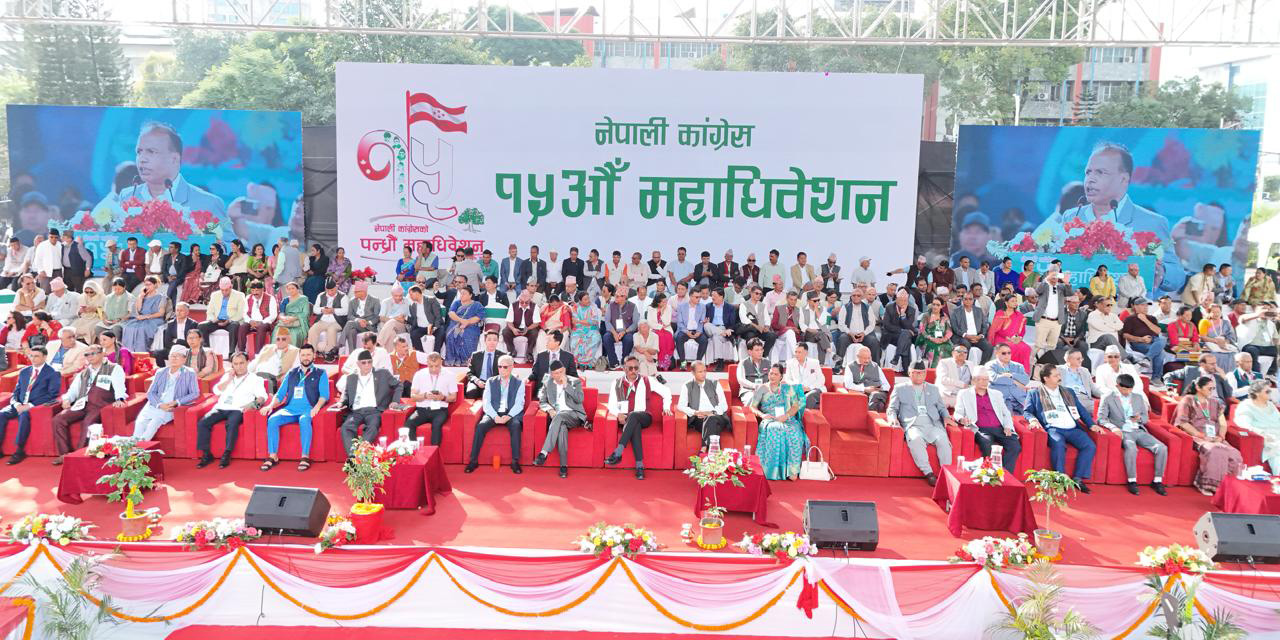
- Rastriya Swatantra Party (RSP) President Rabi Lamichhane said the NC’s greatest strength was its long political history.
- CPN-UML General Secretary Shankar Pokharel said the time had come for the UML and NC to work together to protect democracy and transform the country.
- Nepali Communist Party (NCP) Coordinator Pushpa Kamal Dahal urged NC President Thapa to bring together leaders and groups still outside the party’s mainstream and make the NC more united and inclusive.
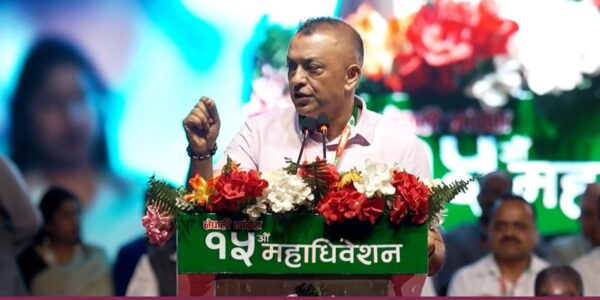
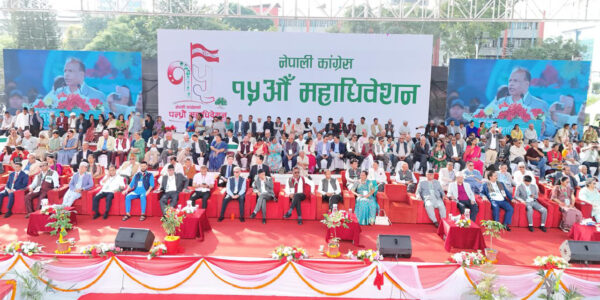
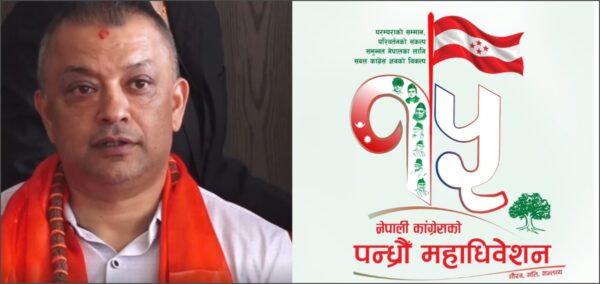
KATHMANDU: Leaders of various political parties have extended their best wishes to the Nepali Congress (NC) on the opening of its 15th General Convention.
Addressing the inaugural ceremony at Khula Manch in Kathmandu on Sunday, Rastriya Swatantra Party (RSP) President Rabi Lamichhane said the NC’s greatest strength was its long political history.
“I have always respected the contribution the NC has made to Nepal’s democratic movement,” Lamichhane said. “The strength of the NC is its history, and its weakness is also its history. We must learn from its history and move forward.”
He said the younger generation should learn from the role the NC had played in the past, as well as its weaknesses. Lamichhane also said political parties and their flags become secondary when matters concerning the country are at stake.
He also said no single political party should claim ownership of democracy. “People will defend democracy if it comes under threat. The authority to remove or replace political forces rests with the people through elections,” he added.
CPN-UML General Secretary Shankar Pokharel said the time had come for the UML and NC to work together to protect democracy and transform the country.
Recalling that NC President Gagan Kumar Thapa had been involved alongside them in the movement for the establishment of a republic, Pokharel said Thapa’s leadership of the NC was a positive development.
Pokharel said the two parties should again cooperate to protect democracy and bring about change in the country. He recalled their cooperation during struggles against the Rana regime, the Panchayat system and the direct rule of King Gyanendra.
He accused the current government of moving ahead without consultation and cooperation with political parties. He described the government’s failure to listen to parliament and the people as authoritarian rule.”
He expressed hope that the NC would play a leading role in addressing the issue.
Similarly, Nepali Communist Party (NCP) Coordinator Pushpa Kamal Dahal said Thapa had broken with the tradition of continued party leadership and was moving the NC towards a new chapter.
He urged Thapa to bring together leaders and groups still outside the party’s mainstream and make the NC more united and inclusive.
He also said Thapa should move beyond leading the party and work to take leadership of the country. “Now, you should move along the path of leading the country. We are ready to support you,” Dahal said.
Dahal said cooperation among major political forces was necessary to institutionalize the democratic republic. He also said the remaining tasks of the peace process should be completed without delay, warning that failure to resolve them could create a risk of renewed conflict.
Shram Sanskriti Party (SSP) General Secretary Aaren Rai said the NC was a party established through decades of struggle and sacrifice rather than publicity.
Stating that many NC leaders and activists had sacrificed their personal ambitions for nation-building, he urged the party to focus on what it could do for the people rather than how long it could remain in power.
Rastriya Prajatantra Party (RPP) Chairperson Rajendra Lingden said shortcomings in the existing political system and constitution should be addressed.
Lingden said developments over the past six months had shown that merely changing political leaders would not solve the country’s problems. “There are weaknesses in the existing system and the constitution. They must be corrected,” he added. and should be corrected.
He said the constitution was not an immutable document and that necessary flaws should be amended.
Lingden also called for national consensus by bringing together the monarchy, political parties and the younger generation to find a way out of the country’s current challenges.
Janata Samajbadi Party (JSP) Nepal leader Sharat Singh Bhandari said Nepalis would not accept controlled democracy under any pretext.
Stating that the country was going through serious economic, social and geopolitical challenges, he called for cooperation and national unity among major political parties.
Bandari said his party expected strong support from the NC in amending and improving the constitution according to changing needs, strengthening the federal democratic republican system and advancing the country towards greater inclusion.
Similarly, Nagarik Unmukti Party (NUP) founding leader Resham Chaudhary said he was confident that Nepali Congress President Gagan Kumar Thapa could lead the country.
Chaudhary said Thapa, who had played a role in the struggle for the establishment of a republic, would now play a leading role in nation-building. “Gagan can lead this country. I have faith in him,” he said. “The person who played a role in bringing the republic will certainly play a role in building this country as well.”
Chaudhary added that the Nepali Congress had played an important role in drafting the constitution and said the changes taking place within the NC had given him confidence.