
A familiar transaction has powered much of Nepal’s technology growth in recent years. A foreign client identifies a problem, writes a specification and sends it to a team in Kathmandu. Nepali engineers build the solution. The client keeps the customer relationship, product roadmap and, in most cases, the intellectual property. Nepal, on the other hand, earns revenue, jobs and gains valuable experience. That model has helped build the country’s IT sector into a $1 billion industry. But it should not define the limit of our ambition.
The World Bank’s 2025 Nepal Country Economic Memorandum reported that digitally delivered services accounted for more than half of Nepal’s service exports by the end of 2023. Those exports grew at an average annual rate of 11.6% between 2005 and 2023. The Institute for Integrated Development Studies (IIDS) estimated Nepal’s IT service exports at $515.4 million in 2022. By the end of 2025, that figure had doubled to about $1 billion.
This growth has enabled Nepalis to compete globally without leaving home while learning from demanding customers and difficult problems. The next question is how that capability can lead to greater ownership.
For the past two years at DevDash Labs, I have seen both the strengths and the limitations of the services model. It helped us build a team, earn clients’ trust and deliver under pressure. It also showed how value is created. A services company completes an assignment and gets paid. A product company continues learning from customers and controls what comes next.
We tried to bridge that gap by building our own products. We launched six products in two years. Four did not find a market. The software worked, but technical execution did not make the products valuable or necessary. Those failures changed our approach. We stopped treating a finished specification as evidence that we understood the underlying problem. Before defining the next product, I spent months in more than 125 conversations with owners, partners and advisers at professional services firms in the United States.
I expected them to ask for more leads or faster research. Instead, many described a deeper challenge. Their firms relied heavily on relationships managed by one or two senior people. Important context was scattered across memory, inboxes and personal spreadsheets. One executive worried the firm might not survive the retirement of its founding partners. Another learned about a valuable business opportunity only after it was too late to pursue.
Those conversations taught me that access to powerful AI models is no longer the scarce resource. Context is. Knowing which problem matters, when it matters, who experiences it and who will ultimately own the outcome is the scarce resource today. A team separated from customers can execute every ticket correctly and still build the wrong product.
AI makes this challenge more urgent. The International Labour Organization estimates that one in four workers is in an occupation with some exposure to generative AI, although transformation is more likely than complete replacement. Tasks that can be delivered remotely are often the easiest to describe, standardize and automate. Routine research, first drafts, standard coding, documentation and data processing will become increasingly difficult to differentiate. AI pressures the price of execution but gives leverage to the company that owns the problem and product.
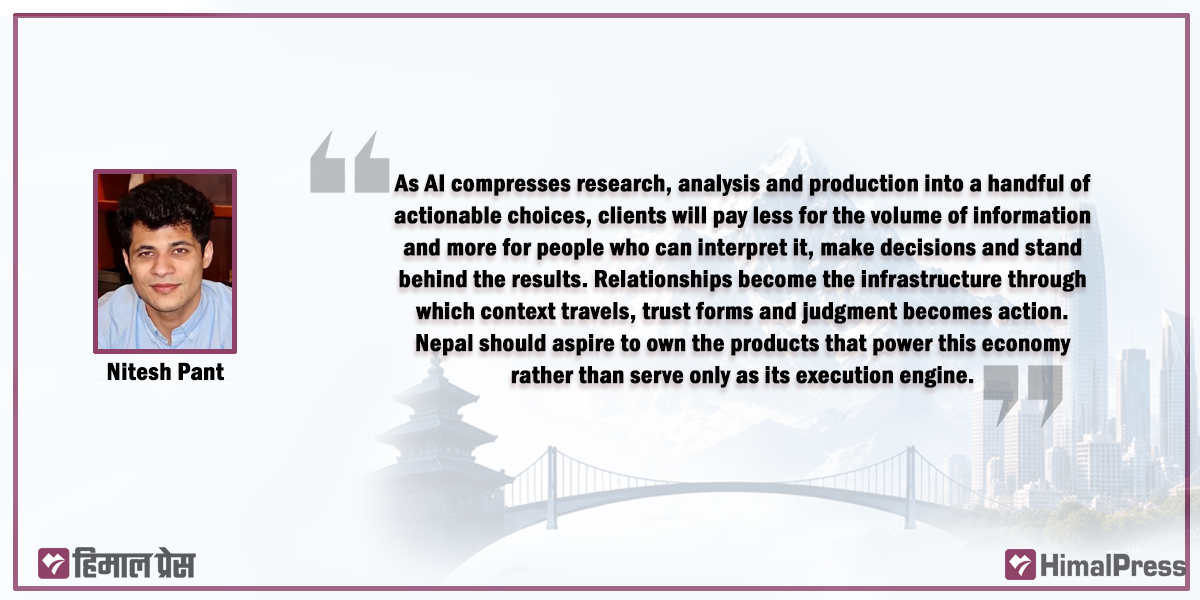
I call this emerging reality the relationship economy. As AI compresses research, analysis and production into a handful of actionable choices, clients will pay less for the volume of information and more for people who can interpret it, make decisions and stand behind the results. Relationships become the infrastructure through which context travels, trust forms and judgment becomes action. Nepal should aspire to own the products that power this economy, like alkemy, rather than serve only as its execution engine.
This is why ‘Silicon Peaks’ matters. Pukar C. Hamal of SecurityPal coined the term to describe Nepal’s growing technology ecosystem, linking the Himalayas with Silicon Valley. Silicon Peaks should not become shorthand for a lower-cost Silicon Valley, where one place thinks and another simply writes code. Instead, it should represent an ecosystem in which Nepali teams identify problems, speak with customers, make product decisions and remain accountable for what they build.
Silicon Valley and Silicon Peaks can be parts of the same product loop. The United States offers proximity to customers, experienced operators, capital and global distribution. Nepal offers technical talent, fresh perspective and ambitious builders. The greatest advantage emerges when customer insight and engineering judgment move freely in both directions.
In the weaker model, a specification travels from the United States to Kathmandu and code travels back. In the stronger one, customer conversations travel as well. Engineers understand why a problem matters, question assumptions, join product demonstrations and influence the roadmap. Teams in Kathmandu help decide what the product should become. In the new relationship economy, Silicon Peaks stands to benefit from the existing relationships.
Our company is still an early experiment in this model. The problems come largely from American professional firms, while the engineering happens in Kathmandu. We encourage our team to make product decisions rather than merely translate tickets into code. Building six products in two years has shown that we will not always get it right, but every failure improves the questions we ask.
Nepal does not need every services company to become a software startup. It does, however, need more pathways from services to product ownership.
Services companies can give Nepal-based teams greater access to customers and more authority over product decisions. Where contracts allow, they can turn recurring client problems into reusable products. Universities should teach customer research, pricing, writing, distribution and product judgment alongside programming. Investors and policymakers should measure success not only by export revenue and jobs, but also by products owned, international users served and intellectual property created in Nepal.
The Nepali diaspora can help build the other half of this bridge. Its contribution should extend beyond remittances, mentorship and investor introductions. Nepalis working abroad can bring access to real problems, become early customers and help teams understand global markets before the first line of code is written.
The future of Silicon Peaks will not be secured by simply writing more code for overseas clients. It will be secured when more global customers depend on products conceived, shaped and built by teams in Nepal; and when those teams share in the knowledge and long-term value that compound after launch. That network effect is one of Silicon Valley’s greatest strengths. Silicon Peaks must build the same kind of networks.
Nepal has already proven that it can solve difficult problems for the world. The next step is to decide more of what gets built, learn directly from the people who use it and own more of what that work becomes.
(Pant is a Dartmouth College-educated economist and AI expert leading Product and Growth at DevDash Labs. The article draws on anonymous conversations undertaken during product research and his experience at the company.)