
When students perform well in exams and secure good grades, it enhances their self-esteem and morale. Parents proudly share these results with friends, relatives and wider networks on social media to celebrate the achievements. However, when children struggle with their learning, it often brings stress and anxiety for both children and their parents.
In both small or large schools, parents of high achievers are treated with respect, and their wards are widely appreciated. On the contrary, parents of struggling students often hesitate to visit the school; even when they do, they rarely feel confident enough to inquire about their children’s progress. As a result, those students gradually lose confidence and self-respect, and they become discouraged and demotivated.
This raises an important question: how can teachers, through their collaborative reflection, make a difference in the attitudes and aptitude of students who struggle, particularly in resource-constrained schools?
The idea of collective reflection did not emerge from a comfortable or formal setting, but from a casual conversation among three self-motivated “three idiots”—teachers of English, Mathematics and Science—at a local tea shop. We covered a wide range of issues on children and their studies along with social issues. These conversations continued even during our hiking and trekking trips.
The story of the journey
I joined the school as an English teacher in the academic year 2082 BS, while my colleagues had been working there for several years. From the very beginning, I was struck by the strong connection my colleagues had with the students. As soon as classes ended, students would gather around their teachers and engage in casual, friendly conversations. Even in the classroom, students often participated in deep conversations; and when the teacher spoke, they listened attentively in pin-drop silence. To some extent, this made me feel envious. At one point, I even wondered whether such closeness might make it difficult to maintain discipline. As an old guard trained in traditional schooling, I believed there should be some distance between teacher and student. Even now, despite some improvements, I do not consider myself particularly good at building rapport.
Although I do not claim to be an ideal teacher, this is the profession I have enjoyed the most. I neither like to label students as ‘poor’ or ‘weak’, nor do I believe in blaming their previous teachers. If we continue to define students by their past or present learning difficulties, they may never regain confidence. Instead, teachers should identify the root causes of these challenges and help students unlock their potential by providing equal opportunities for all. As I had in my previous school, I told the management that no students would fail my subject. If any student did fail, I would consider it my own failure and reflect on my teaching. This was not a guarantee that everyone would succeed automatically, but rather a personal commitment to accountability and continuous improvement.
Everything was progressing well until one incident challenged me. A fellow teacher, whose brother was in Grade 10, raised a serious concern about the way I had evaluated the examination paper after comparing it with answer sheets of other students. Her criticism affected my morale and confidence. I had unintentionally missed a few marks and had given more weightage to originality, creativity and flow of writing than on grammatical accuracy. I listened to her carefully, acknowledged my oversight and corrected the marks. At the same time, the Mathematics teacher, who was also the class teacher, objected to the way the issue had been raised, arguing that he should have been consulted first
That evening, we went to a local tea-shop where we revisited the incident and we reflected on it together. I admitted my mistake, recognizing that it was largely a technical oversight rather than an intentional act. Nevertheless, I thanked my colleague for her constructive criticism, as it provided me with an opportunity for self-reflection. And, my fellow Math teacher’s professional handling of the situation
Small initiatives
Soon after joining the school, I conducted a quick survey and diagnostic test in each class to identify the students’ self-perceptions, strengths, aspirations and challenges. While some aspired to achieve ‘A+’ and ‘A’ grades in English, a considerable number struggled with basic pronunciation, reading fluency and comprehension, even though the subject was considered one of the easiest. Since many families could not afford remedial and tuition classes due to socioeconomic constraints, I decided to explore additional support systems within regular classroom teaching.
My colleagues had already introduced several practical and student-centred initiatives to move beyond rote learning. The Mathematics teacher had launched ‘Happy Friday’ and occasionally took students to the auditorium to watch educational and motivational movies. The Science teacher encouraged students to bring musical instruments to class and even performed with them. I, too, introduced a free dance session which the students greatly enjoyed. Many shared its therapeutic effect, saying that it made them so excited that they could not help but shout with joy. Looking back, these activities, though simple, were powerful means to instill confidence in students to express themselves. Unfortunately, the free dance session had to be discontinued due to structural constraints. However, the meditation session continued throughout the academic year.
One overlooked contradiction in our pedagogy is that meditation and yoga are included in textbooks but are rarely practiced. Although I am not an expert in yoga and meditation, I had some basic experience. I began with a simple two-minute meditation in my class. Most students followed the instructions, though a few were initially restless—opening their eyes, glancing around and giggling at their classmates. Gradually, however, they became accustomed to the practice. Eventually, students themselves began reminding me to conduct meditation whenever I forgot.
Every evening, the local tea shop came alive as villagers gathered to talk over tea, and some enjoyed local alcoholic drinks. They shared stories and debated issues affecting the social and political life of the village and the country. Amidst this lively atmosphere, the three of us would sit at a corner table and review our daily experiences, the performance of students, possible support strategies, their improvement and a further intervention plan. Initially, our conversations focused on school, teaching and learning innovations. Gradually, they expanded to include society, culture, politics and our responsibilities as educators, with reflections that often continued during our hikes and treks.
What sort of change did our initiative cause?
After our interventions, we began to observe the impact on learning attitude and classroom culture. We cannot claim that this change resulted solely from our efforts, as many factors contribute to such transformations. However, our interventions may have helped create a more conducive learning environment. Students who were once aggressive and disruptive gradually became calmer, while those who remained passive in the class grew more engaged, studious and hardworking. This transformation was not easy. Some students would come to us and share their frustrations, saying that their efforts to improve were failing repeatedly. From these experiences, we drew the conclusion that collaborative actions and reflections can open up the avenue of change—both within individuals and in the broader learning environment.
Another noticeable shift was in students’ learning attitudes and aptitudes. Initially, many submitted heavily copied assignments including AI-generated content. Instead of punishing them, I chose to encourage originality. I often told them, “Your own single word or sentence is more valuable to me than a page copied.” At first, this created some tension, and a few students expressed difficulty understanding my teaching approach. Gradually, however, they became more confident in expressing their own ideas. This change was evident not only in classroom participation but also in extra-curricular activities. Students, who had once struggled, began winning essay, poetry and creative writing competitions.
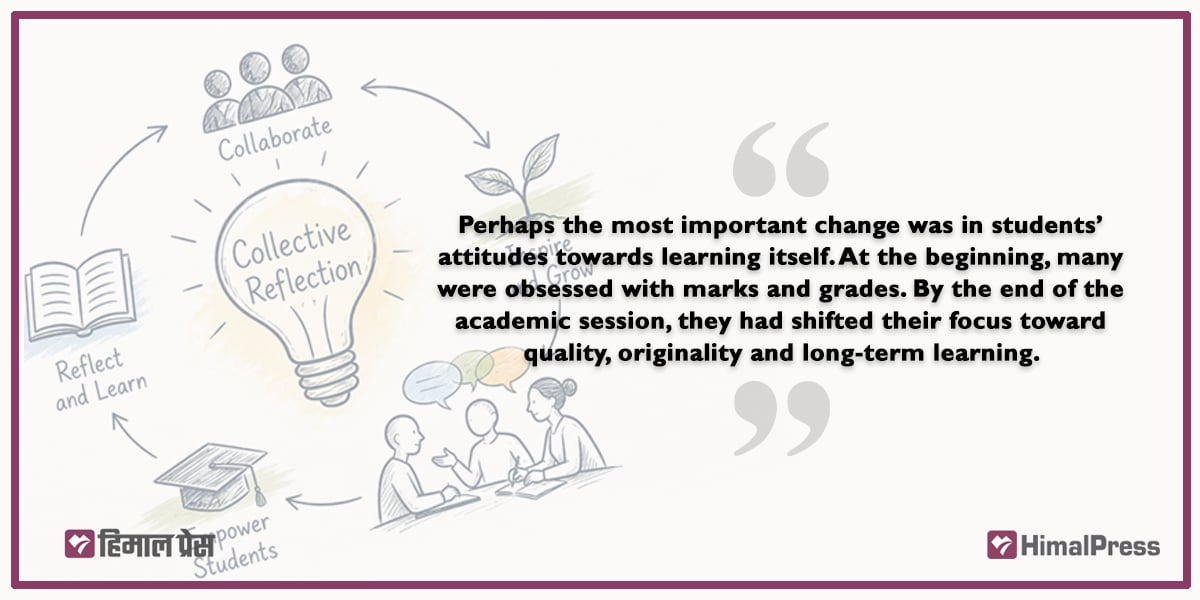
Perhaps the most important change was in students’ attitudes towards learning itself. At the beginning, many were obsessed with marks and grades. By the end of the academic session, they had shifted their focus toward quality, originality and long-term learning. Some shared, “Sir, we do not worry about marks as much. We have changed a lot. We want to learn something that will be useful throughout our lives.” Although not all students progressed at the same pace, many overcame fear that had once held them back. Looking back, both Grade Eight, the most struggling class, and Grade 10, which was considered an average cohort, achieved remarkable results in Basic Level Examination (BLE) and Secondary Education Examination (SEE) in 2082 BS.
What we learned?
Our journey reminded us that today’s schooling is largely driven by marks, grades and competition. However, schools have not fully become places where children genuinely enjoy learning. As Poonam Kuinkel, Co-founder of Lifelong Learning Mandala, observes, “Many parents, often under social and economic pressure, feel compelled to keep their children in school or childcare from early morning until late evening. As a result, children are deprived of adequate rest, proper nutrition, free play, meaningful family time, and the natural rhythm of learning.”
In such circumstances, students are pushed into an unnecessary race for grades, which can hinder the development of essential human qualities. While we could not change the education system, we sought to transform the classroom environment and children’s attitudes toward learning. We tried to be more humane, to treat children with empathy and to encourage them to pursue meaningful learning.
Our greatest lesson was that educational change begins with teachers reflecting on their own limitations, potentials and possibilities. Instead of saying, “This child is ‘poor’ or ‘This child is weak’, we can ask, “What can I do differently to support this child?” We often ask students to read, but we rarely take the time to read their minds, family backgrounds, struggles and aspirations. We also tend to overemphasize on academic achievement. We have now realized that sports, yoga, dance, excursions, and meaningful conversations are very important for students’ holistic development.
Teaching and learning are reciprocal processes. We often assume that teachers are the sole authorities who impart knowledge, but we can learn deeply from our students as well. On one occasion, while speaking on the phone with a Grade 10 student hospitalized with appendicitis, I was deeply moved by the care, compassion and innocence his classmates showed toward him. On another occasion, a student shared a thoughtful reflection: “Human beings are good by nature; however, economic and social conditions sometimes compel them to commit crimes such as theft and murder.” One may disagree with his view, but his ability to connect personal observation with social realities was remarkable. These experiences taught us that giving students opportunities to share their thoughts can be therapeutic and can nurture openness, cooperation and critical thinking.
Our learning also extended beyond the classroom. Conversations in a small tea shop inspired us to explore local communities and nature through hiking and trekking. Visits to community homestays and other places such as Ghorepani and Pun Hill reminded us that society itself is a living classroom.
Conclusion
We did not invent any new teaching method. We reflected on our everyday classroom experiences and learned from one another. This was our sincere effort at collective reflection to make a difference in teaching and learning, especially for students struggling with their academic performance.
Looking back, we invested time, effort and imagination in this initiative, which provided ample learning opportunities for both teachers and students. If three teachers can spark a silent revolution within a single rural school through collective reflection, similar transformations are possible in schools across Nepal.
Toward the end of our session, we climbed the steps of Poon Hill with fatigued legs, heavy breaths and determined hearts. When we reached the top, we realized that every meaningful journey demands patience, resilience, mindfulness and companionship. We missed our students deeply; sharing that sunrise with them would have made the experience even more meaningful.
(With inputs from Sagun Tripathi and Arbin Urao)
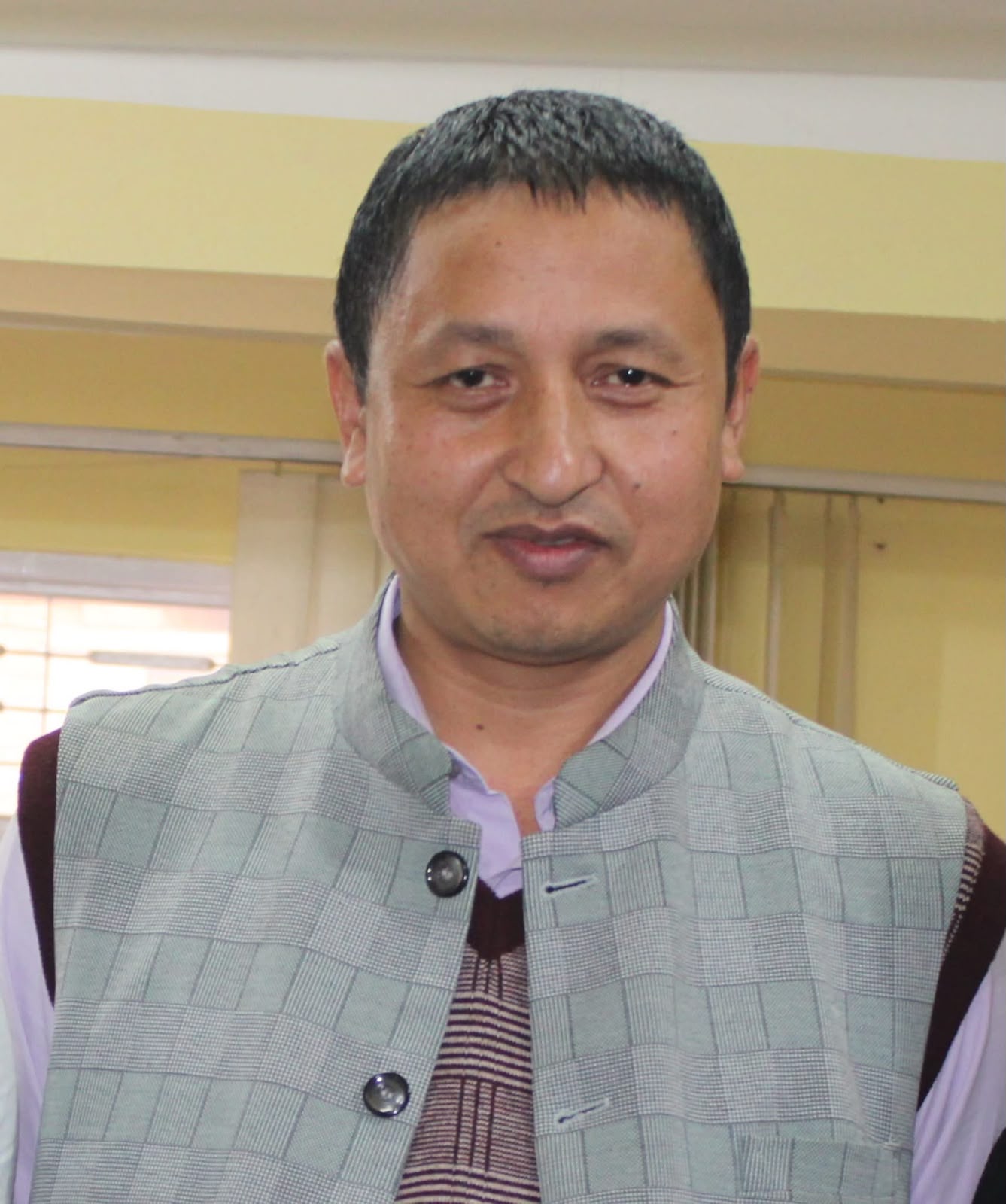
Arjun B BK is a member of Lifelong Learning Mandala, and currently he is pursuing PhD in Development Studies at KU.
Sagun Tripathi is currently pursuing a Master of Education (M.Ed.) in Mathematics at TU.
Arbin Urao has a Master of Science (MSC) in Physics from Amrit Science College, TU.



![Yosin pole raised as Indrajatra festival begins in Kathmandu [In Pictures]](https://en.himalpress.com/wp-content/uploads/2026/09/Indrajatra-5-600x300.jpg)








Hats off. Very nice to read it as an ELT teacher. Thank you so much for publishing your narratives through it. Keep going ahead.
Pedagogical thoughtfulness, pedagogical tact, pedagogical sensitivity and critical pedagogy are all seem to blend in your approach to understanding learners’ (students, parents, educational managers and other interlocutors) lived context and remaining mindful to engage in what could be an authentic teaching. Your teaching is indeed holistic and responsive to the call for a genuine pedagogy. Kudos to your remarkable commitment to critical learning and teaching.🙏🏽