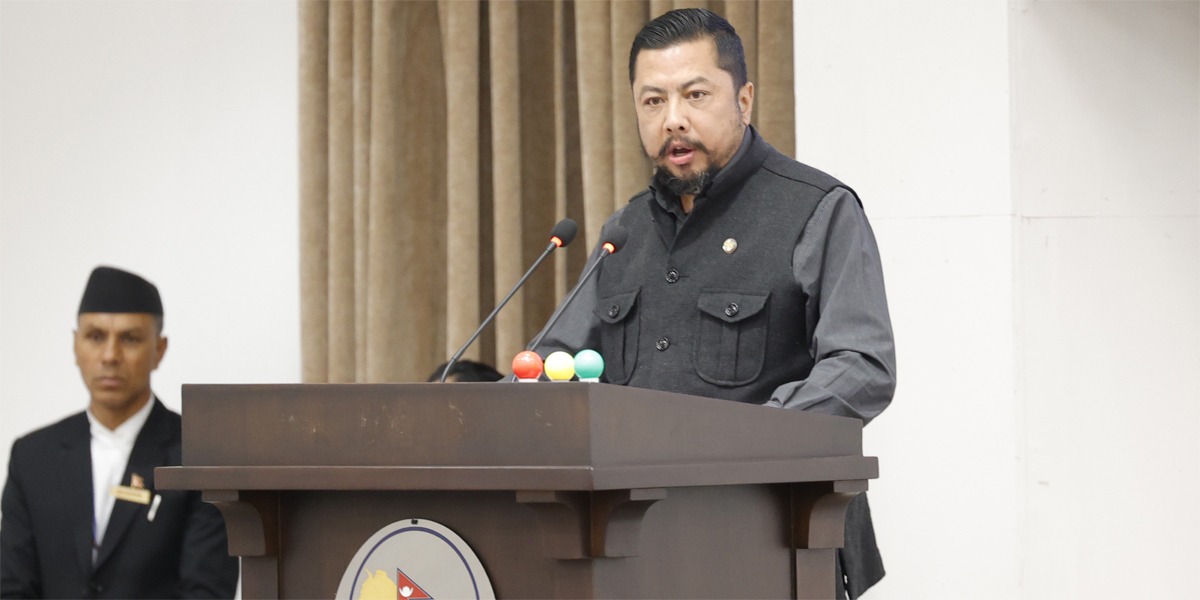
KATHMANDU: The government led by Balendra Shah, built on public disillusionment with traditional parties and the hopes of Gen Z, now faces not only internal challenges but also a diplomatic trial. Maintaining balanced relations with neighboring and global powers will become one of the key challenges of the new government. The tenure of the new Minister for Foreign Affairs, Shishir Khanal, will be a test of whether Nepal’s foreign policy rises to a new level or remains trapped in old dysfunctions, as in the past.
The rise of Balen, as he is popularly known, as prime minister from the Rastriya Swatantra Party (RSP), is the outcome of deep dissatisfaction among Nepal’s youth and urban middle class with traditional political parties. Early indications suggest that he is inclined towards pragmatic diplomacy centred on national interest. Although Balen performed well as Kathmandu mayor, there is a significant gap between local governance and the complexities of national administration. While the Balen government has the potential to steer Nepal from instability toward opportunity, a strong foundation in foreign policy is essential to realize that potential. This is why the role of intellectual figures like Khanal will be decisive.
India is closely observing recent political changes in Nepal. Editorial coverage in publications such as The Hindu, Hindustan Times, and The Indian Express suggests that the southern neighbor is more concerned about the impact of frequent government changes on long-term policymaking and the implications of Nepal’s ties with China for its security.
China, on the other hand, has maintained a quiet but effective engagement. Some Chinese leaders are reportedly working to bring together communist forces, particularly attempting to unite the CPN-UML and the Nepali Communist Party (NCP). Through infrastructure projects like the Belt and Road Initiative (BRI), China views Nepal as a gateway to South Asia and seeks stability and neutrality from the Balen administration.
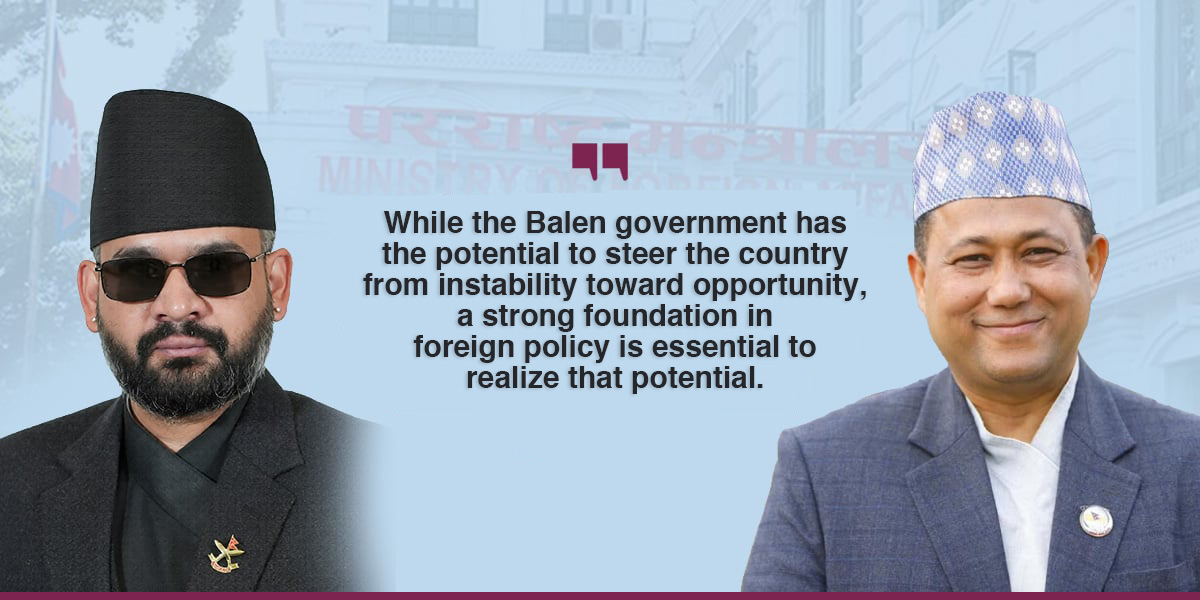
While the Balen government has the potential to steer Nepal from instability toward opportunity, a strong foundation in foreign policy is essential to realize that potential.
The United States sees Nepal as a strategic location. Its visible assistance could expand if the government shows interest and delivers results on time. The US has signaled that the Balen government should prioritize development diplomacy.
These external perspectives will put Nepal’s foreign policy to the test of balance or alignment. This scrutiny from global powers also offers Foreign Minister Khanal an opportunity to demonstrate the art of balanced diplomacy. If successful, Nepal could gain new respect on the international stage.
Nepal must clearly communicate its position to India while helping China understand why it needs closer relations with India. To maintain balance between China and India, Nepal must also engage with global powers, including the US. It should also maintain its own distinct relations with traditional powers such as Russia and European countries by adopting a policy where relations begin with neighbors but extend globally on varied foundations.
Outdated modes of diplomatic engagement are no longer sufficient in today’s digital age. Meetings and policy discussions with countries where Nepal lacks a physical presence can be conducted virtually. Such practices, however, are rarely observed in the foreign ministry. Nepal has not put much effort into expanding relations through honorary envoys, like other countries are doing successfully. Instead, foreign ministry officials appear more focused on opening embassies that offer opportunities for postings and personal benefits. The ministry is mired more in internal crisis than external challenges. There is an excess of personnel but minimal productivity.
If Nepal has the resources and aspires to be an active player in global politics, it can open embassies all over the world. However, embassies and consulates should not be created merely for consular services. Some embassies have effectively become resting places for retired officials and political workers. The practice of distributing posts along party lines has contributed to this situation.
Over the past 15 years, the government has opened 19 new missions. Currently, more than Rs 6 billion is spent annually on operating 44 missions. Twenty of them are considered largely ineffective. Although the US already has an embassy, a permanent mission, and a consulate in New York, additional consulates have been opened in Dallas and San Francisco without a proper study of their necessity. These five missions in the US alone cost over Rs 1 billion annually, even though Nepal’s trade with the US accounts for less than 2% of the total trade.
Similarly, the embassy in Brazil costs around Rs 70 million annually, while exports to Brazil last year stood at only Rs 36.2 million. This clearly shows a gap between investment and returns. Missions in Canada, South Africa, Oman, and Bahrain in the Gulf, and in European countries such as Spain, Portugal, and Denmark, also warrant review. Even the relevance of the mission in Vienna is being questioned. Two consulates in China and the consulate general in Dubai also appear ineffective. Given the proximity between Abu Dhabi and Dubai, the rationale for maintaining a separate consulate is not clear.
Reallocating resources towards stronger internal departments and think tanks could yield better results than maintaining multiple missions. The concept of “flying ambassadors”, deploying diplomats temporarily on a need basis, could also be explored. Countries like Singapore have demonstrated how limited but effective diplomacy can work. Since ambassadorial appointments are often split between political nominees and bureaucrats in Nepal, with postings sometimes serving as rewards for retired officials. As a result, embassies have underperformed in addressing diaspora issues, promoting economic diplomacy, and boosting tourism.
Khanal’s Diplomatic Test
Khanal, who entered politics through the education reform movement, has a strong academic background. He is a co-founder of Teach For Nepal and served as its CEO from 2012 to 2019. He was also active in the Sarvodaya movement and participated in reconstruction efforts in countries like Sri Lanka and Haiti.
He holds a bachelor’s degree in International Political Economy from the University of Bridgeport and a master’s degree in Public Policy from the University of Wisconsin–Madison. Within the RSP, he has led the international relations and tourism department and is a member of the party’s central secretariat.
After the 2022 elections, Khanal briefly served as Minister for Education, Science, and Technology in the Pushpa Kamal Dahal-led government. A two-time member of the House of Representatives from Kathmandu-6, he has experience in international relations and tourism. However, his direct diplomatic experience is limited.
Managing the complex bureaucracy of the foreign ministry, maintaining balance among global powers, and coordinating effectively with Prime Minister Shah are among Khanal’s main challenges. Since the foreign ministry is often seen as a shadow ministry of the prime minister, a clear understanding between the two is a must. Internal dynamics also complicate matters, as there were instances of individuals close to the prime minister’s secretariat influencing decisions in the past.
Millions of Nepali youth work abroad, particularly in the Gulf, Malaysia, Europe, and the United States. Strong labor diplomacy, therefore, is essential to ensure the safety of workers, wages, healthcare, and legal support. However, this is not happening.
Khanal’s test lies on three fronts: proving personal and institutional capability, strengthening labor diplomacy, and maintaining balanced international relations.
Within days of assuming office, Khanal has raised concerns over more than 2,000 Nepalis in Portugal facing issues related to fake documents. Due to tensions in West Asia, temporary restrictions have been placed on labour migration to Gulf countries, which is certain to hit remittances. The government will come under early pressure if the West Asia crisis escalates further and the need to rescue millions of Nepali workers arises. Khanal has attempted to introduce policies to bring back the skills and investment of the diaspora. His NGO background may help build international networks, though balancing national interest with NGO perspectives can sometimes be difficult.
The government now has a historic opportunity to redefine the country’s foreign policy. However, this opportunity will only bear results if internal issues, such as unnecessary missions, overstaffing, and politicization, are addressed, while also maintaining balance among external powers, including India, China, the United States, and Europe.
Khanal’s test lies on three fronts: proving personal and institutional capability, strengthening labor diplomacy, and maintaining balanced international relations. If he succeeds, Nepal could reach new diplomatic heights; if not, it risks repeating the same old cycle. If he can move beyond rhetoric and focus on implementation—anchored in national interest, equality, and frugality in diplomacy—this could mark the first step towards meaningful reform.
Regulating ad hoc diplomatic meetings, bringing the Foreign Aid Coordination Division under the foreign ministry, and rationalizing embassy responsibilities could be a stepping stone for Khanal. The foreign ministry must not remain limited to passport distribution. By transferring non-diplomatic passport responsibilities to the home ministry and investing in research, strategy, and expertise, it can build a more effective diplomatic system. Otherwise, the old saying, no matter who comes, nothing really changes, will hold true once again.