KATHMANDU: Even as the meetings of the newly formed House of Representatives are underway, the Nepali Congress (NC)—the second-largest party in the lower house—has yet to elect its parliamentary party leader.
The party, which has been entangled in disputes over its general convention and special convention since before the March 5 elections, has not even been able to begin the process of selecting its leader.
In the first meeting of the House of Representatives, Bhishmaraj Angdembe spoke from the rostrum on behalf of the party. However, he had not been formally nominated by the party to address the House.
“The parliamentary party leader has not been selected yet. I coordinated with the party myself to address the House meeting,” Angdembe told Himal Press over the phone.
Other parties represented in the House had already selected their parliamentary leaders and chief whips even before the parliamentary session was convened. The NC had planned to move forward with the process of selecting its parliamentary leader after the new Speaker was elected on Sunday. This was becuse Arjun Narsingh KC, who had ben chairing the parliament meetings as the senior-most lawmaker, was also eyeing the position.
Rastriya Swatantra Party (RSP) lawmaker Dol Prasad Aryal was unanimously elected as the new Speaker on Sunday. However, even by Monday, when the third meeting of Parliament was held, the NC had not initiated the process of selecting its parliamentary leader.
Angdembe, who has been lobbying for the position, said he has no information about when the process will begin. “I don’t know when the process will move forward. I’ve heard that a meeting of office bearers may be held. Perhaps something will come out after that,” he said.
Other NC lawmakers also said that no formal discussions have taken place regarding the selection of the parliamentary leader. While informal discussions are ongoing, nothing concrete has happened formally, according to one lawmaker. “We sit in the parliamentary party office in Singha Durbar and hold informal discussions, but nothing formal has happened,” the lawmaker said. “We also met on Sunday, but no formal decision was made.”
What is causing the delay?
After a weak performance in the March 5 elections, the NC was reduced to the second position in the the lower house. Party President Gagan Thapa, who had been elected through the special convention, faced defeat in Sarlahi. Senior leaders such as Dr Shekhar Koirala and Bimalendra Nidhi also lost.
Most of the those elected under the first-past-the-post (FPTP) system are new faces, while many of the proportional representation (PR) lawmakers are veteran leaders. The party is struggling over whether to choose a new face or an experienced leader as parliamentary party leader.
President Thapa appears numerically weak in his effort to appoint someone close to him as leader. In the party’s post-election internal dynamics, Sher Bahadur Deuba and Dr Shekhar Koirala appear to have joined hands. Their growing proximity has weakened Thapa’s faction in terms of numbers in the lower house.
Deuba faction curently has 15 lawmakers, while the Shekhar faction has seven, and Thapa faction has 16. If the Deuba and Shekhar factions unite, they would have 22 lawmakers. Because of this eqution, the establishment is concerned that its preferred candidate may not be elected parliamentary party leader.
Leaders say Thapa’s faction is likely to move forward with the selection process only after ensuring a favorable numerical balance.
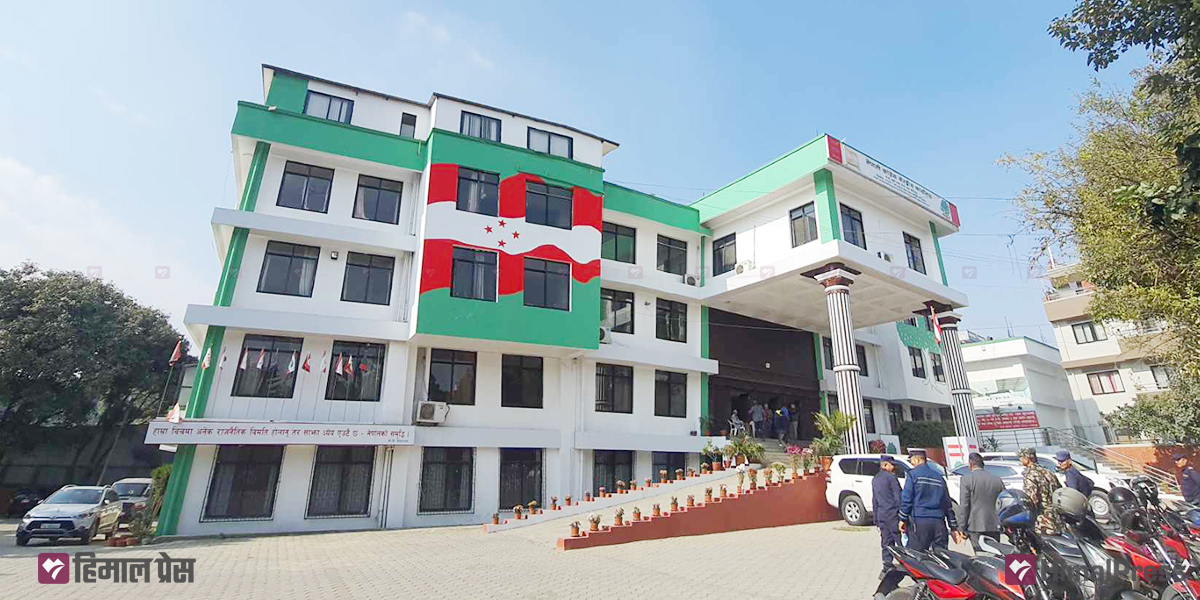
To consolidate support, the establishment has also begun issuing warnings to PR lawmakers about possible disciplinary action. During a recent orientation program held at the party’s central office in Sanepa, top leaders reminded PR lawmakers about the possibility of being recalled.
“You should act in accordance with the party statute. Those who go against it can be recalled,” Vice President Bishwa Prakash Sharma said at the program.
Such warnings have made some PR lawmakers hesitant to openly support either the Deuba or Koirala factions. As a result, only 11 lawmakers attended a recent event organized by former Acting President Purna Bahadur Khadka to congratulate newly-elected members. Two lawmakers from the Shekhar faction reportedly left the event shortly after arriving.
A lawmaker from the Deuba faction said PR lawmakers were effectively warned during the orientation. “They were told the party has the authority to recall them. This fear is preventing many from taking a clear stance,” the lawmaker added.
Candidate selection for the Match 5 elections had also reflected internal divisions. While Deuba submitted closed list of leaders under PR system, Thapa picked candidates FPTP system. This dual authority has further compounded the selection of parliamentary party leader.
Who are the aspirants?
Several leaders from both the establishment and Deuba-aligned factions have staked their claims for the parliamentary party leadership. Among the aspirants are Bhishma Raj Angdembe, Arjun Narsingh KC, Mohan Acharya, and Nischal Rai.
There is also a view within the party that a younger leader should be given the role. Those favoring generational change are promoting Rai as a candidate. KC has publicly claimed that, as the most experienced lawmaker from the party, he deserves the position. Meanwhile, Angdembe and Acharya have also intensified their lobbying efforts.
Thapa, however, is not in a position to support KC, who happens to be his father-in-law, an NC source said. “Thapa is also opposed to Angdembe becoming leader if KC is not selected,” the source aded.
Angdembe is said to be firm in his intent. “The president fears criticism if KC becomes leader. And if not KC, he also doesn’t want Angdembe,” the leader said, adding that a contest between Angdembe and Acharya is most likely.
General Secretary Guru Raj Ghimire said efforts were being made to reach consensus, but if that fails, the process will proceed according to party rules. “There are many aspirants. Our preference is to select the leader through consensus. If that is not possible, we will move forward as per procedure,” Ghimire said.
As per the NC’s parliamentary party statute, lawmakers elect their leader from among themselves, and if there is more than one candidate, the leader is chosen through a secret ballot.
The NC has not been able to select its parliamentary leader unanimously since the 2008 Constituent Assembly election. With factionalism at its peak, there is a high likelihood that the party will once again resort to voting this time.
Ghimire said the process to select the leader will begin soon, possibly from Tuesday, after a meeting of the party’s executive committee forms an election committee.
Factional breakdown
The Thapa (establishment) faction has 16 lawmakers—12 elected under FPTP system and four under the PR system. The Deuba faction has 15 lawmakers (five FPTP and 10 PR), while the Shekhar faction has seven (one FPTP and six PR).
Establishment (Thapa) faction:
Prakash Singh Karki (Solukhumbu), Narendra Kumar Kerung (Panchthar), Santosh Subba (Tehrathum), Nischal Rai (Ilam-1), Mohammad Firdosh Alam (Rautahat-2), Abhishek Pratap Shah (Kapilvastu-3), Mohan Acharya (Rasuwa), Khadga Shahi (Mugu), Basana Thapa (Dailekh-1), Bharat Kumar Swar (Achham-1), Bharat Bahadur Khadka (Doti), and Janak Raj Giri (Bajura), along with Arjun Narsingh KC, Renuka Kaucha, Kali Bahadur Sahakari, and Manmaya BK elected under PR system.
Deuba faction:
Tek Bahadur Gurung (Manang), Sandip Rana (Palpa-1), Jayapati Rokaya (Palpa), Khadka Bahadur Budha (Jajarkot-1), and Bishnu Bahadur Khadka (Surkhet-1), along with Bhishma Raj Aangdembe, Geeta Gurung, Sushila Dhakal Acharya, Ninu Kumari Karn, Sahajan Khatun, Madan Krishna Shrestha, Ganga Laxmi Awal, Pavitra BK, Sita Thapaliya (Urmila), and Harina Devi Kami elected under PR system
Shekhar faction:
Yogesh Gauchan Thakali (Mustang), along with Geeta Kumari Sendang, Rukmini Devi Koirala, Reena KC (Upreti), Dr Pramila Kumari Gachchhadar, Dr Chandra Mohan Yadav, and Rekha Kumari Yadav elected under the PR system.