
Last autumn, as Nepal’s festive season neared, celebrations were dampened by a sudden spike in sugar prices. It wasn’t due to a bad harvest or global supply issues—it was deliberate. Major trading houses, allegedly backed by political figures, hoarded stock to create artificial scarcity. The public paid more while a few powerful conglomerates reaped massive profits. This episode lays bare a deep-seated disease plaguing the corporate landscape of Nepal and its South Asian neighbors: a culture of profit-at-all-costs, built on a foundation of tax evasion, systemic fraud and a cynical misuse of social responsibility.
The investigation exposes the sophisticated—and often illegal—methods used by some of South Asia’s biggest corporate players to extract wealth, not just from consumers, but from the state itself. From manipulating customs duties at dry ports to orchestrating complex VAT scams and PR campaigns disguised as charity, these practices create a parallel economy of deceit. Compared to the stricter regulated environment in Europe and the United States, the gap in accountability is stark. The real is not merely about corporate ethics; it is about nation-building. How can countries like Nepal develop when its most powerful economic actors continue to erode public trust and fiscal stability?
A Masterclass in Malpractice
Corporate malpractice in South Asia begins at the borders. where the first line of state revenue is drawn. A senior customs official, speaking anonymously, described “under-invoicing” as routine. “A container of electronics worth $100,000 might be declared as $30,000,” he said. “The importer—often a major distribution house—pays a fraction of the tax, and the savings are split among insiders. The company’s profits swell—illegally.”
Misclassification is another chapter in their playbook. Luxury textiles are declared as cheap polyester and premium vehicle parts as scrap metal. A 2023 report of the Office of the Auditor General estimated billions in annual revenue losses from such customs fraud. These are not clerical errors; they are deliberate, organized strategies.
Further down the supply chain, the Value Added Tax (VAT) system has been turned into a corporate cash machine. The “fake VAT bill” scam is widespread: companies buy forged invoices from shell firms to inflate costs, lower taxable profits and even claim fraudulent refunds. A raid in Kathmandu uncovered printing presses producing fake VAT bills for dozens of clients—evidence of fraud an industrial scale.
The manipulation does not end with taxes—it hits consumers directly. The sugar-hoarding case is just one example. Similar tactics have been used in pharmaceuticals, construction materials and everyday goods. During crises, like blockades or health emergencies, companies have been accused of engineering shortages to justify huge price hikes. Profit margins of up to 300% on life-saving medicines are not uncommon.
Misuse of CSR Funds
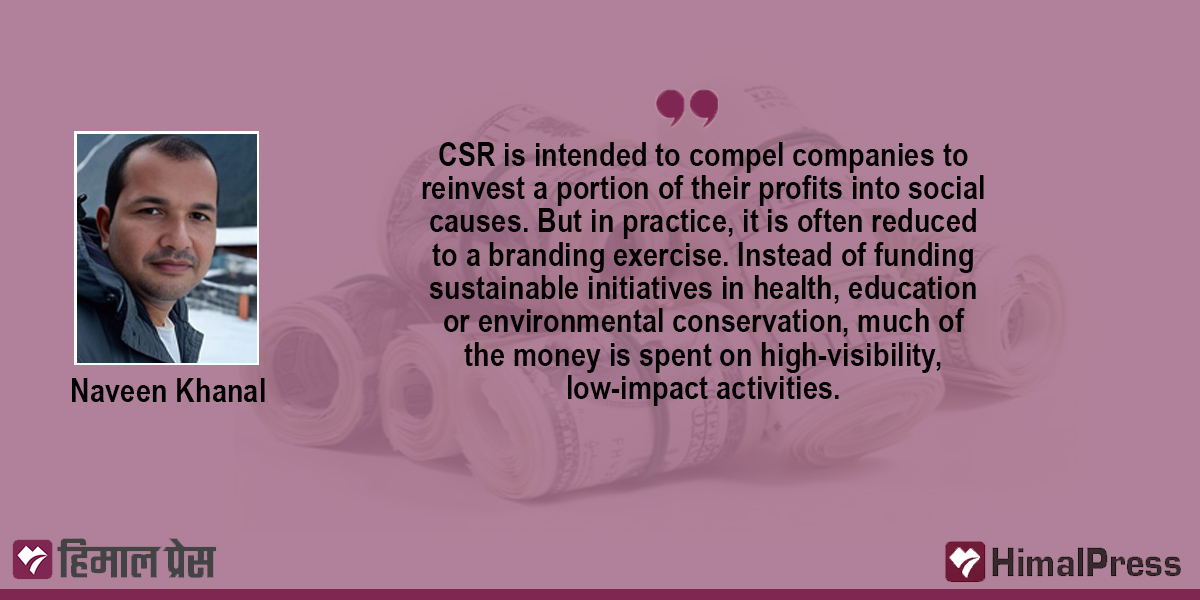
In countries like Nepal and India, CSR is intended to compel companies to reinvest a portion of their profits into social causes. But in practice, it is often reduced to a branding exercise.
Instead of funding sustainable initiatives in health, education or environmental conservation, much of the money is spent on high-visibility, low-impact activities like sponsoring concerts, beauty pageants or marathons. These events generate media buzz but do little to tackle real social issues. Investigations into CSR spending by major South Asian conglomerates reveal that funds are often funneled to NGOs and foundations controlled by company owners or their families, ensuring the money stays within the inner circle.
The lack of independent audits and transparent reporting means there is virtually no accountability. It is philanthropy in name only, used to distract from profit-driven models that undermine social welfare.
A Tale of Two Systems
The corporate culture in the US and Europe may not be flawless, but it operates under a different set or rules and expectations. The difference is not in corporate morality, it is in the system: strong regulators, independent media, empowered consumers and legal frameworks that impose serious penalties for misconduct.
When Volkswagen was caught cheating emissions tests in 2015, it did not just face public outrage. In the US alone, it paid over $30 billion in fines, recalls and legal settlements. In Europe, tech giants like Google and Meta have been hit with multi-billion-dollar fines under the General Data Protection Regulation (GDPR) for anti-trust and data privacy violations. These are not just a cost of doing business; they are existential threats that force companies to take compliance seriously.
Genuine CSR in this context is often integrated into the core business strategy. Patagonia, the outdoor apparel company, famously commits 1% of its total sales to environmental causes and has built its entire brand on sustainability. Microsoft has pledged to become carbon negative by 2030. These initiatives are long-term, measurable, and subject to intense public and investor scrutiny. Whistleblower protection laws are stronger, encouraging insiders to expose wrongdoing without fear of retribution. This combination of regulatory teeth and social pressure creates a powerful incentive for corporations to behave responsibly.
Why South Asia Lags
South Asia’s failure to hold such companies accountable stems from deep systemic flaws. The most significant is regulatory capture—where the line between business and politics vanishes. Politicians often have financial stakes in the companies they are meant to regulate or rely on corporate funding for their campaigns. This unholy alliance ensures enforcement agencies, such as tax offices, anti-corruption bodies and customs remain weak, underfunded and politically neutered.
Investigative journalism, a key check in Western democracies, is also compromised. In South Asia, many media outlets are owned by the same conglomerates they should be exposing. Self-censorship is common, while independent journalists face threats, lawsuits and advertising revenue withdrawals.
The social and economic cost of unchecked corporate power is staggering. The region loses tens of billions of dollars annually in tax evasion and illicit financial flows, according to the South Asia Tax Justice Network. This tax gap affects public services because each evaded dollar is one not spent on hospitals, schools or infrastructure.
It fuels inequality, concentrating wealth among elites while ordinary citizens face rising costs, poor services and slow development. Worse, it breeds deep public distrust in both government and business by eroding democratic institutions and national morale.
The Path Forward
Fixing this broken system requires bold, structural reforms. Dr Anjali Sharma, a New Delhi-based governance expert, has outlined three remedies for this. “First, we need to sever the political-corporate nexus through radical campaign finance reform and stricter conflict-of-interest laws for public officials,” she insists. “Second, tax and customs agencies must be empowered with autonomy, technology, and forensic auditing capabilities. Third, CSR laws must be reformed to mandate transparency, independent third-party audits, and a focus on measurable, long-term community impact, not PR.”
But laws alone won’t suffice. Civil society, media and consumers must apply sustained pressure. Public outrage, when organized, can force even the most powerful actors to change.
Conclusion
Companies are more than a profit engine; they are a social entity licensed by the society they serve. Its purpose cannot be limited to maximizing shareholder value at the expense of all other stakeholders. The prevailing corporate culture in Nepal and much of South Asia is not just unethical; it is unsustainable. It is building private wealth atop public decay.
The time has come to redefine the corporate contract. Businesses must be judged not just by their profit margins, but by the taxes they pay, the dignity with which they treat their workers, the health of the environment they operate in, and their genuine contribution to the nation’s progress. As Keshav Adhikari, a former auditor general of Nepal, put it, “A nation’s wealth is not in the vaults of its billionaires, but in the well-being of its people.”
South Asia deserves a corporate culture that understands this fundamental truth—one that builds nations, not just empires.