
 Photo Courtesy: Umesh Budhathoki
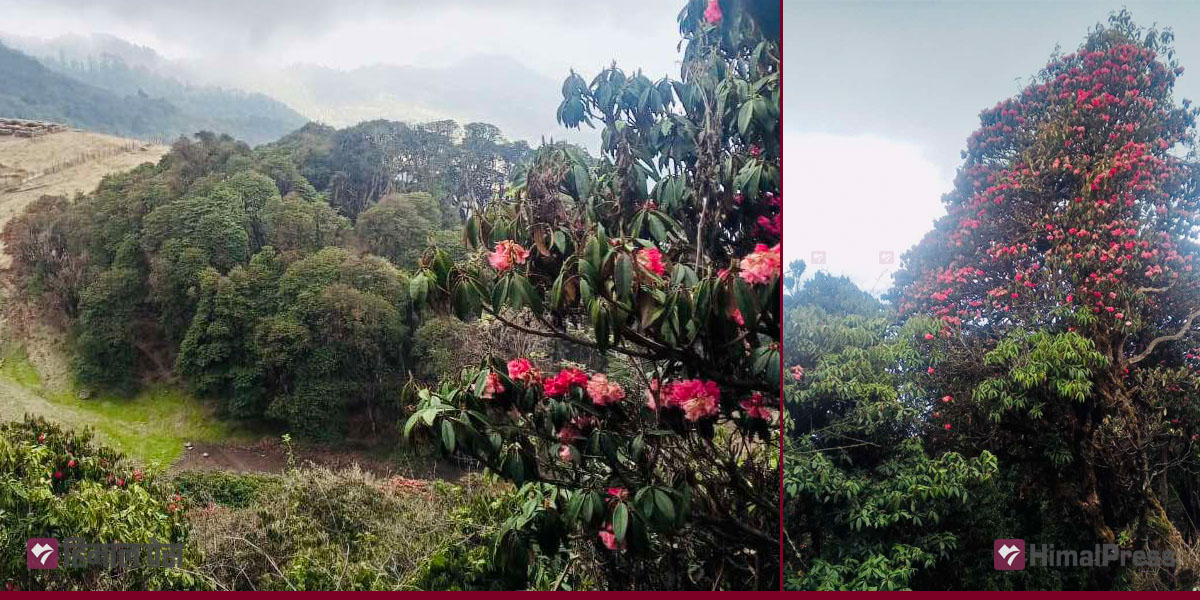
ITAHARI: This year, the Tinjure-Milke-Jaljale (TMJ) region, often known as Nepal’s ‘rhododendron capital’, has yet to see rhododendrons bloom.
Home to 28 of the 32 rhododendron species found in Nepal, TMJ attracts domestic and international tourists eager to witness its vibrant floral displays. However, the absence of blooms this year has left visitors disappointed.
Koshi Province had planned a grand ceremony in TMJ on April 9 for the official launch of the Koshi Tourism Year. The ceremony was scheduled to be inaugurated by Prime Minister Pushpa Kamal Dahal. However, the ceremony was postponed due to a delay in rhododendron blooming. Some even made sarcastic comments stating that the provincial government was sprinkling water from fire engines to make rhododendrons bloom.
Deputy Prime Minister and Minister for Urban Development, Prakash Man Singh Shrestha, inaugurated the event in Oli’s absence.
Local tourism entrepreneurs lament that visitors coming to TMJ to see the rhododendrons are leaving disappointed. Umesh Budhathoki, a hotelier from Panchpokhari, Laligurans Municipality-7, said the rhododendrons barely bloomed this season. “Rhododendrons bloomed in some trees, but the flowers were very few compared to last year,” Budhathoki said.
He attributed the sparse blooming to tourists breaking branches – a practice that damages the plants. “This year, there was no snowfall, which also affected the flowering process. But the bigger issue is the tendency of people to snap branches. If 1,000 visitors each break one branch daily, imagine the damage,” Budhathoki explained.
According to Budhathoki, rhododendrons, unlike other plants, do not bloom from broken branches. “If a branch is snapped, the plant gradually dries up,” he said. Budhathoki warned that the tendency of snapping branches is causing rhododendron trees to die out, which is threatening the region’s ecological and tourism value.
Typically, rhododendrons at elevations below 2,500 meters start blooming from mid-January and continue through February to April. Above 2,500 meters, blooms start after mid-March, and some species, like the white rhododendrons, flower into early May. While 28 rhododendron species grow in TMJ, only red rhododendron, which is also the national flower, is widely recognized by visitors.
“This year, rhododendron didn’t bloom significantly. People only know the red rhododendron and ignore other species. About 12 to 14 species bloom from May to July, but the lack of red rhododendron has led to a reduction in tourist numbers by as much as 75%,” Budhathoki said.
Budhathoki urged the government to implement policies to control the growing practice of snapping branches. “If this isn’t controlled, rhododendron could vanish. We need a clear policy to protect existing plants rather than just planting new ones,” he said. “We are failing to save what we have.”
Rhododendron expert and biodiversity researcher Kamal Maden also said that rhododendron may not bloom in snapped branches for years. “It is not that rhododendrons have not bloomed. However, flowering has drastically reduced in the Tinjure area,” he said. “Dry soil, lack of rainfall and constant sunlight from morning to evening affected the flowering pattern in the RR Garden area.”
Maden added that forests in TMJ lack ground-layer vegetation due to excessive clearing of shrubs and leaf litter by the locals to prepare manure. “Leaf litter retains moisture for plants. The forest has only old trees, with no middle-layer growth, which has disrupted the ecosystem,” he said. He also said the government should bring a policy to control branch-breaking and protect the region’s biodiversity.
Arjun Mabohang, mayor of Laligurans Municipality in Tehrathum, disputed claims that rhododendrons didn’t bloom at all this season. “It is true that the rhododendrons didn’t blanket the hills like last year. But we can see flowers in the hills,” he said. Mabohang attributed the reduced blooming to biodiversity loss and forest encroachment. “People cut wood, pick flowers, and clear small plants while sweeping leaf litter. We have not been able to control encroachment,” he added.
He said that conservation efforts have been hampered by legal constraints as forests fall under federal jurisdiction. “If municipalities had authority over forests, we could protect them better. Current forest policies limit our role,” he added.
As the provincial government celebrates Koshi Tourism Year, experts have criticized the government for neglecting conservation. They say that all three tiers of government have failed to prioritize forest and rhododendron protection. “Although we have three tiers of government, none treat forests as a priority. Even forest offices show little concern, only acting when fires break out,” Maden said. He called for coordinated efforts to project TMJ’s ecological heritage.