
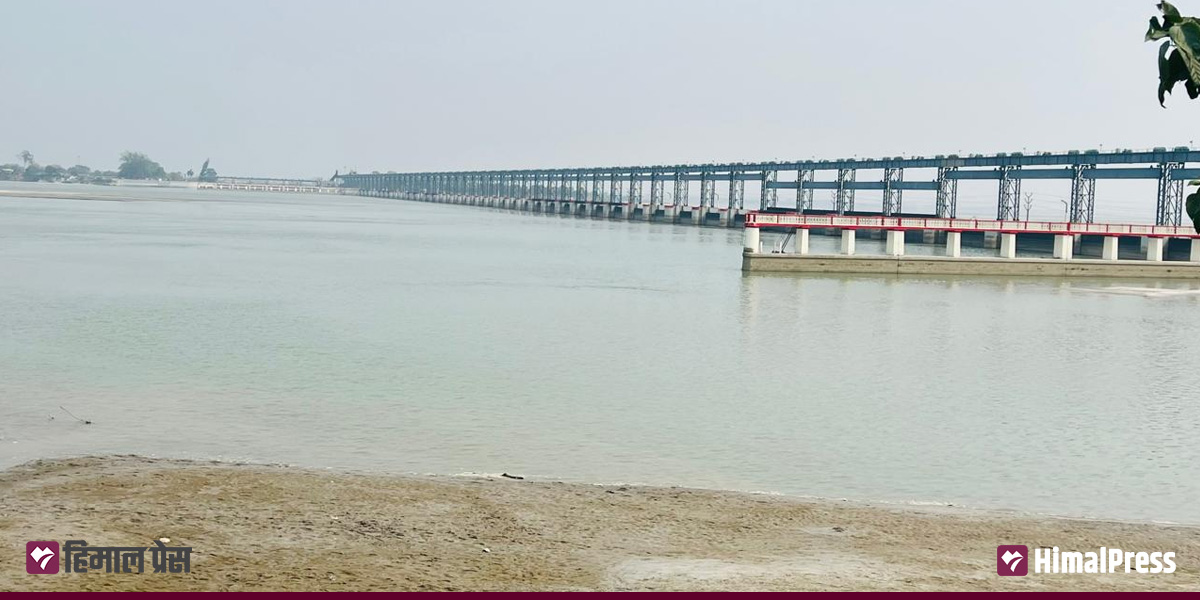
 This undated photo shows Koshi Barrage on Saptakoshi River. Photo: Bibek Bibash Regmi/Himal Press
ITAHARI: The Saptakoshi, Nepal’s largest sediment-carrying river, has long been both a blessing and a curse for people living along its banks.
Flowing through Sunsari, Udaypur and Saptari districts in eastern Nepal, the river carries vast amounts of sediment that gradually raise its bed, increasing the risk of flooding. During the monsoon, uncontrolled floodwaters often inundate settlements, causing significant damage to life and property.
Local residents complain that the government’s attention to the river comes only during crises, such as floods or when communities are submerged. At other times, they say, their concerns are largely ignored.
A 2009 study conducted by ICIMOD states that Saptakoshi transports over 100 million tons of sediment, including sand, gravel and stones, annually, which accumulates beneath the water surface. This buildup elevates the riverbed and increases the likelihood of overflow into nearby settlements.
Local activist Umesh Mandal said that the issue only garners attention during the monsoon. “Riverbed naturally rises if sediment is not removed periodically. When water flows at a higher level, there is always the risk of flooding,” he explained.
Since 2018, provincial and local governments have imposed strict regulations on sand excavation due to environmental concerns. While well-intentioned, Mandal said that these efforts lack a scientific and strategic approach.
He also criticized the government for failing to implement short- or long-term plans to protect riverside communities. According to Mandal, the Nepal–India Koshi Agreement has further complicated the situation by imposing limitations that leave these communities vulnerable.
Rabin Ghimire, a local activist and Saptakoshi expert, agreed with Mandal. “The real problem is that the river’s resources remain unutilized,” he said. “The Saptakoshi could be a source of income for the local community, but the lack of initiative from the government has kept it untapped.”
Under the Koshi Agreement, Nepal must coordinate with India for any activities within 32 kilometers north of the Koshi Barrage on the Nepal-India border. This area stretches up to Shukrabare (formerly Mahendranagar), beyond which Nepal can act independently. Still, Ghimire argued, the government has not shown the will to make use of this leeway.
“In 1967, the Saptakoshi carried 900,000 cusecs of water without much harm. Today, even 500,000 cusecs flood settlements because the riverbed has risen significantly,” Ghimire told Himal Press.
He added that managed sand extraction could both deepen the riverbed and create economic opportunities for locals. “The sediment often hides timber and other usable materials. Removing it during the dry season would help the river flow more naturally and reduce flood risks,” he added.
The Saptakoshi is fed by seven major rivers—Sunkoshi, Dudhkoshi, Arun, Tamor, Tamakoshi Indrawati and Likhu—which originate in the Himalayas and carry heavy sediment loads.
The Koshi River management needs a long-term strategy. While the barrage and embankments were built with Indian investment, the lack of ongoing bilateral coordination on maintenance and risk mitigation has compounded woes for the local people.
Every year, the Saptakoshi floods hundreds of settlements, destroys crops and forces families to live in fear. Experts and locals alike call for coordinated action between all three levels of the governments in Nepal, and India to manage sediment, reduce flood risk and unlock sustainable use of resources.