 Himal Press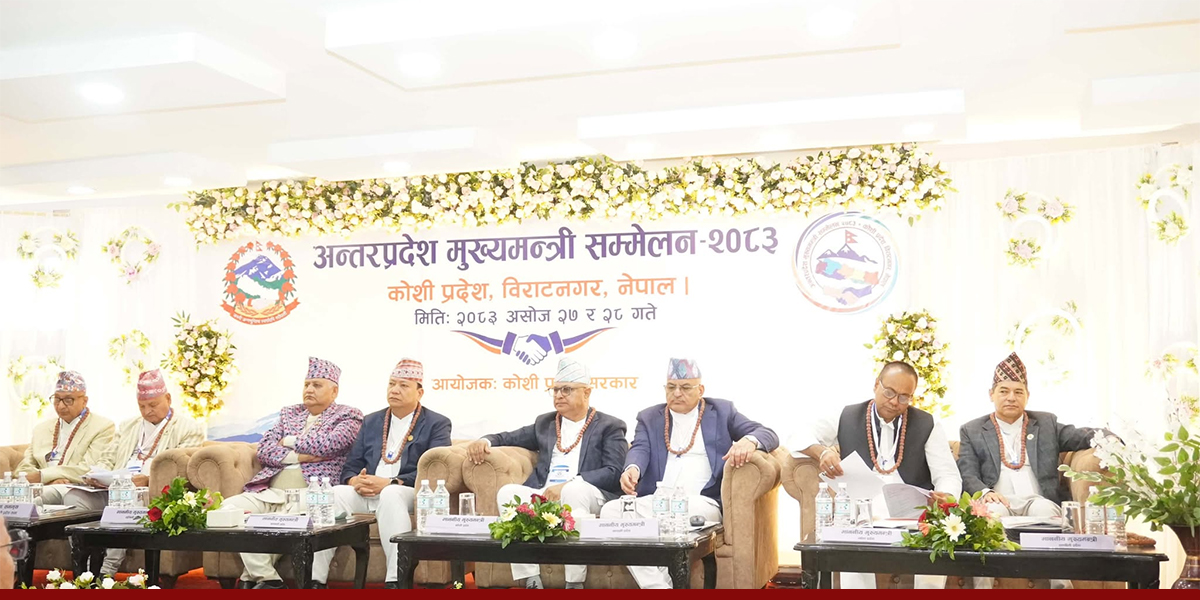
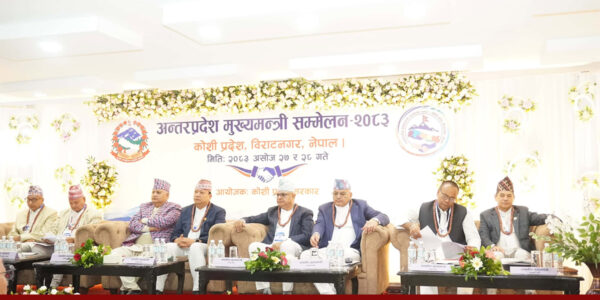
ITAHARI: Chief ministers of seven provinces have called for effective implementation of federalism, the transfer of powers to provincial governments, timely lawmaking, and greater cooperation and coordination among the three tiers of government.
Speaking at an interprovincial chief ministers’ conference that began in Biratnagar on Tuesday, they said provincial governments had been unable to perform effectively because they lacked adequate authority.
Karnali Province Chief Minister Mangal Bahadur Shahi said the achievements of federalism must be protected and democracy further strengthened. Stating that some public expectations have not been met, he said attempts were being made to create misconceptions by exploiting the situation. He emphasized the need to counter such misconceptions with facts and move forward on the path to prosperity.
Shahi said there was still a lack of clarity over the exercise of powers granted to provinces by the constitution. Stating that delays in enacting laws have created administrative and financial problems, he urged provincial governments to identify their respective strengths and work together through coordination and cooperation to achieve prosperity.
Likewise, Lumbini Chief Minister Chet Narayan Acharya accused the federal government of delaying the transfer of powers constitutionally assigned to provincial governments. He said the federal government had been neglecting the issue.
Acharya also said unnecessary obstacles were being created in the process of enacting certain laws.
“Instead of strengthening administrative structure, efforts are being made to weaken it. Attempts are being made to restrict fiscal transfers,” he said. “There is a need for policies that ensure the transfer of financial resources to provinces in accordance with the constitution.”
Gandaki Chief Minister Surendra Raj Pandey said political parties that led previous governments had failed to strengthen federalism.
“Sometimes, it makes me wonder whether federalism was introduced merely to write the constitution and suppress the revolt at that time. Otherwise, why have provinces been left so powerless?” Pandey questioned.
Stating that provincial structures were under constant attack, Pandey said provincial governments had lower administrative expenditures than other tiers of government but were still branded as a white elephant.
“Provincial governments spend far less than other levels of government, yet they are being targeted as if they have done nothing. They are criticised for not working or moving fast enough. But the federal government has tied their hands and feet. Can anyone run when their hands and feet are tied?” he asked.
Pandey said provincial governments would enact laws on their own initiative and move forward if the federal government failed to introduce the necessary legislation.
Taking a swipe at the federal government’s administrative practices, Pandey said provincial governments were not adequately informed about the transfer and posting of secretaries. “We do not even know when a secretary will arrive, where someone will be transferred or when they will leave. How can administrative federalism be strengthened under such circumstances?” he asked.
Bagmati Chief Minister Kiran Thapa said all provinces should adopt a common position and policy on climate change and its consequences. He said a strong fund involving the provinces was needed to minimize losses caused by climate change.
Thapa stressed the need to remove legal complications and make cooperation and coordination among federal, provincial and local governments more effective. He said provinces should unite in addressing climate change issues.
Madhesh Chief Minister Krishna Prasad Yadav said provinces should advance development and prosperity by working together and building a common understanding. He called for prioritizing interprovincial partnerships and identifying opportunities for joint investment.
Yadav said tourism could be promoted by developing religious tourism circuits linking different provinces. He also stressed the need to strengthen partnerships among federal, provincial and local governments.
Koshi Chief Minister Hikmat Kumar Karki said provincial governments should focus on delivering results within their areas of authority rather than merely voicing grievances. He said the complexities surrounding the implementation of federalism would be assessed and the findings presented to the prime minister for discussion.
“The conference is not intended to criticize the federal government but to discuss common provincial concerns, mutual interests and cooperation,” he said. “Transfer of powers to provinces was also delayed when my own party was leading the federal government. I have no complaints about the current government which has been in office for only four to five months.”
Karki also stressed the need for all provinces to develop a common position on climate change. “Likewise, drug abuse is a serious problem in all seven provinces. Young people must be protected from substance abuse and encouraged to participate in social transformation,” he added.
The conference, organised by the Koshi Province Government, will continue until Wednesday. Experts will present working papers on various issues in the presence of provincial chief ministers. According to organizers, conclusions drawn from the discussions would be submitted to the federal government.
The chief ministers are also scheduled to hold discussions with industrialists and businesspeople during the conference. On the final day, they will visit tourist destinations in Koshi Province as part of efforts to promote tourism in the province.