 Himal Press
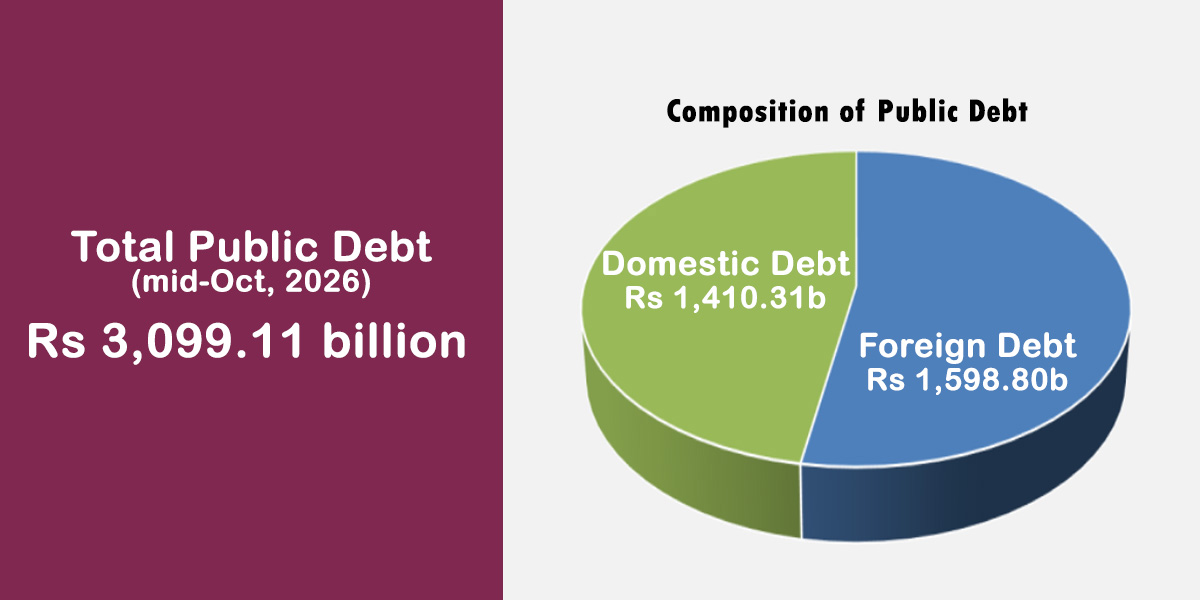
KATHMANDU: Nepal’s total public debt has more than doubled over the past seven years, surpassing the Rs 3,000 billion threshold in mid-October.
According to the latest report from the Public Debt Management Office (PDMO), the total public debt rose from Rs 2,981.7 billion at the start of the current fiscal year 2026/27 in mid-July to Rs 3,009.11 billion by mid-October.
The debt stock now stands at 45.59% of the country’s Gross Domestic Product (GDP), up from 38.05% at the end of 2019/20 when total public debt was approximately Rs 1,433 billion. Over this seven-year period, the debt stock grew by roughly 110% in absolute terms, while its share of GDP expanded by 7.54 percentage points.
External debt accounted for Rs 1,598.80 billion (53.13%) of the total outstanding debt in mid-October, while domestic debt made up the remaining Rs 1,410.31 billion (46.87%.)
For the current fiscal year, the government has set a target of mobilizing Rs 658.28 billion in public debt. It successfully raised Rs 123.32 billion by mid-October, achieving 18.73% of its annual target. Domestic borrowing reached 24.39% of its annual target, whereas external borrowing stood at just 9.39%. Consequently, domestic debt accounted for 81.09% of all new borrowing during the review period, with external debt contributing 18.91%.
Meanwhile, the government spent Rs 98.87 billion on debt servicing during the first quarter of the fiscal year. This is equivalent to 23.66% of the Rs 417.88 billion allocated for debt servicing in the current fiscal year.
Debt-servicing expenditure during the period amounted to 1.50% of GDP.
Notably, the funds set aside for debt servicing this year are nearly equivalent to the country’s entire capital budget of Rs 431.1 billion. This means the public debt servicing cost now consumes almost as much financial capacity as the government’s budget for development works and public infrastructure.
Rising debt burden
The persistent rise in public debt has been driven by post-2015 earthquake reconstruction, emergency spending during the COVID-19 pandemic and continuously expanding government expenditures.
Debt stock expanded from Rs 1,738 billion in 2020/21 to Rs 2,013 billion in 2021/22, reaching Rs 2,295 billion in 2022/23, Rs 2,434 billion in 2023/24, Rs 2,669 billion in 2024/25 and Rs 2,975 billion in 2025/26.
The debt-to-GDP ratio has followed a similar upward trajectory, climbing from 39.9% in 2019/20 to 41.2% in 2022/23, 43.71% in 2024/25 and 45.07% in 2025/26 before reaching its current high.
Governments regularly borrow to bridge the gap between revenue and expenditure. When debt finances productive infrastructure projects that expand economic activity, it enhances the government’s repayment capacity. However, borrowing that fails to generate sufficient economic returns risks increasing debt-servicing pressures and limiting resources available for development spending.