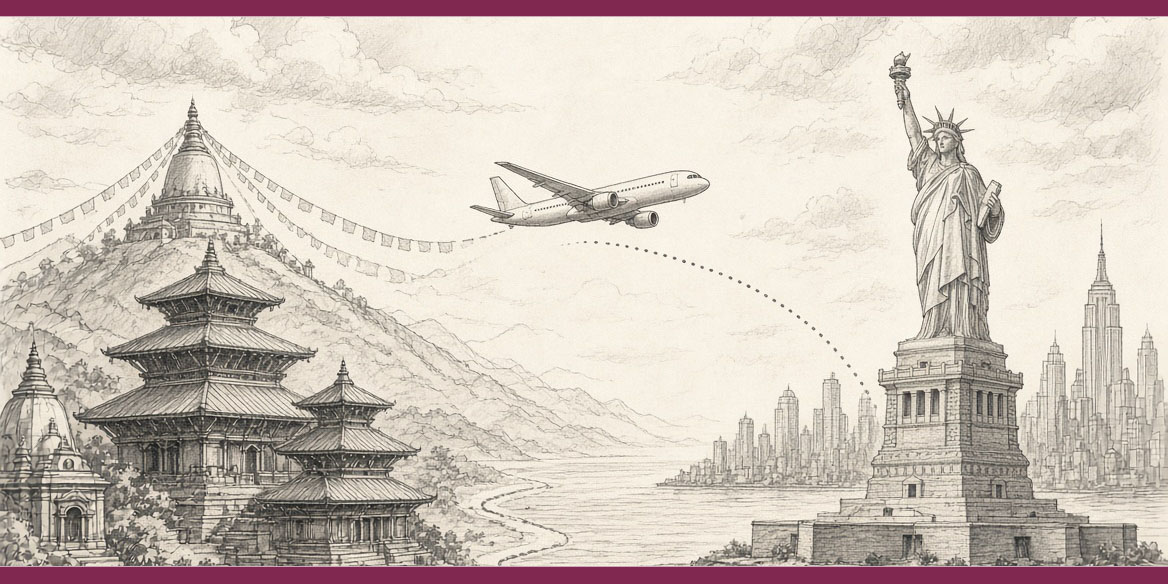
 American dream
NEW YORK: Lumbini Kumar (name changed) served in the Nepal Army for 22 years. During his time with the army, he worked in different parts of the country and was also deployed in two UN peacekeeping missions. When he retired, he returned to his home district in Lumbini province. He had a pension, a small business and farmland. He just wanted to spend the rest of his life in his village.
As someone who retired at the young age of 40, Lumbini Kumar soon started receiving advice from neighbors, friends and relatives. They suggested that he go for foreign employment, as staying in the village at such a young age was not a good decision.
During those days, young people from his village were leaving for the United States in droves. Many were taking risky, irregular routes to get there. Some had mortgaged homes and land, while others had borrowed heavily.
Eventually, he followed the same path. Lumbini Kumar is now in New York. He has been working day and night to repay the debt he accumulated to reach the United States. The military habit of always being ready has stayed with him. The difference is that he is no longer preparing to serve his country; he is preparing to pay his creditors.
“In the army, I was told to always be ready,” he said. “Here, I am always in a hurry to pay the lender.”
It has been about a year since Lumbini Kumar arrived in the US. He said the journey to the United States took three months and cost him nearly Rs 10 million. About Rs 4 million came from his own savings and the rest was borrowed.
Lumbini Kumar still has about Rs 8.5 million in debt. Interest rates on his debt range from 15% to 22%. He says he sends as much as Rs 500,000 a month to Nepal.
His immediate goal is to clear his debt, while his larger goal is to save more than Rs 10 million and return home. However, Lumbini Kumar says he would bring his family to the US if he can obtain legal status.
“I will return if I fail to get permanent residency (PR) in the US,” he said. “But if I succeed in getting PR, I plan to bring my family here.”
Lumbini Kumar is not alone.
Two other Nepalis this scribe met in New York came from different parts of Nepal and different professions. One is Bijauri (name changed), a former Nepal Police officer, and the other is a college graduate named Khairahani (name changed) who once taught at a village school. All three stay in the same place in New York. While their reasons and motives for coming to the United States were different, their daily life in New York is similar.
They live together and leave for work early in the morning. All of them work in three shifts, and their target is to earn an average of $300 a day and about $2,000 a week. A major chunk of their income, however, is consumed by rent, food, transportation, other expenses and debt payments. Still, they hope to repay their debts, educate their children, fight their immigration cases and return to Nepal after three or four years with savings of Rs 10-15 million.
The work leaves little time for anything else. They often take meals between jobs. Going home in the middle of the day is less a break than a brief chance to prepare for the next shift. For people living this way, the American dream can look less like leisure and more like a race against time.
Jackson Heights, a neighborhood in Queens, is a familiar gathering place for Nepalis in New York. They meet friends, exchange news from home and talk about life in the United States.
Among the questions newcomers sometimes hear is a curious one: “Did you come from above or below?”
“Above” generally means entering the United States legally by air. “Below” refers to an irregular and often dangerous journey through several countries before reaching the US-Mexico border. There are different routes to get to the US-Mexico border and they are known by names such as the Cuban route, donkey route or “black route.” The journey can involve planes, boats, vehicles and long stretches on foot. Travelers cross multiple countries, encounter different languages and rely on different intermediaries. Such journeys can take months, or even years.
People spend anywhere between Rs 4.5 million and Rs 13 million on such journeys.
Lumbini Kumar, who spent nearly Rs 10 million to get to the US, said he found it easier to borrow money for an overseas journey than to secure investment for a business at home.
“People are willing to invest heavily in someone going abroad even when they do not know whether that person will reach the US or find work there,” he said.
The second journey begins after arrival
For most of the irregular migrants, reaching the United States is only the beginning of another uncertain journey — the effort to establish a legal status.
According to Lumbini Kumar, some Nepalis obtain documents from Nepal claiming that they are members of political parties. They collect recommendations and certificates from the ward and other government offices.
He claimed that the Nepali Congress (NC) and Rastriya Prajatantra Party (RPP) are quite generous in issuing recommendations and related documents compared to other parties like the CPN-UML or the then CPN (Maoist Center). Since Americans tend to trust democrats or right-wingers more than communists, even left followers can sometimes be found obtaining such documents by presenting themselves as NC supporters, he said.
He said people spend up to Rs 200,000 to prepare such documents.
According to him, Nepalis have organizations and networks in various US states. Some maintain contacts in the names of political parties and help prepare documents. “When political leaders visit the US, people like us not only provide accommodation, food and shopping, but also collect money and give them some money when they leave,” Lumbini Kumar said. “What else can we do? We need their support and cooperation.”
He said some people do not want to provide such assistance, but those who, like him, came through unofficial channels often help out of fear that they could face problems.
This raises a serious question: What should be the role of Nepali organizations abroad? Should they work to protect the rights of Nepali migrants and strengthen social ties, or should they create networks of personal interests linked to individual immigration problems?
Very few such organizations are properly run. While most of these organizations are formed along political lines for similar purposes, many are not even formally registered and operate as loose forums.
Not every American journey looks the same
The experiences of Nepalis who arrive through irregular routes vary widely.
Shanti Suraksha Nepali (name changed), who appears to be of postgraduate age, also reached the US through an irregular route. However, she now appears to be living a relatively comfortable life after marrying a professor who is a US citizen.
Nepalis say she helps people who entered through illegal routes with paperwork and other arrangements. She takes them to lawyers, arranges the necessary documents and charges them for these services.
Nepalis who arrived in the US through the Diversity Visa program have a relatively comfortable life in the US. Those who pursue higher education in the US and obtain H-1B visas are also doing well. Many of them eventually receive offers of permanent residency or citizenship. Students, meanwhile, often extend their visas and later obtain green cards through various means. While their situation is not particularly comfortable, they can settle down once they obtain green cards and eventually apply for passports.
Some are working day and night under heavy debt. Others have built different lives through marriage or other opportunities. Some are waiting for legal processes to run their course, while others are planning to return home. Even people who reached the US through the same route can have very different destinations and experiences.
However, the stories of the three Nepalis ultimately come back to the same issues—work and debt. With the new government in place, however, there appears to be renewed hope that things might improve and that they may be able to build a life in Nepal.
This was also evident in conversations among Nepalis who came to catch a glimpse of Prime Minister Balendra Shah at his hotel when he arrived in New York to attend the UN General Assembly. “He looks like someone who might actually do something,” they said. “If he does, we should stop living a life of constant struggle and build a comfortable life in Nepal.”
Another person, however, looked a bit pessimistic. “People said the same thing after the 2006 movement when the Maoists joined the political mainstream. Those experienced old-timers couldn’t deliver. Let’s see how these inexperienced folks perform,” he said.
Never Ending Journey
Lumbini Kumar, Bijauri and Khairahani may be in the US, but their ordeal has not ended.
All three have morning deliveries, an afternoon shift at a store and an evening job at a restaurant. On the other hand, there is uncertainty over their immigration paperwork, court hearings and legal fees, as well as pressure from family and debt back home in Nepal. And there is always the fear of being arrested at any moment.
There is no data about the number of Nepalis who entered the US through irregular routes. But Nepalis in Jackson Heights estimate that the number could exceed 100,000.
New York and California are the preferred destinations for many of these people because these states offer more favorable conditions for pursuing legal battles.
They believe people from various parts of Nepal are involved in the networks facilitating such journeys. They allege that the networks are connected to people who have retired from the police and administration, worked in the foreign affairs sector, or are involved in business. Although complaints have been filed against such individuals and networks, there has not been sufficient investigation against them.
The risks associated with the dream of going abroad are not limited to routes to the United States. Cases involving Nepalis taken to Cambodia for forced labor in online scam operations, recruited in the name of military service in Russia and Ukraine, and lured to African countries with promises of employment also highlight these dangers. The situation of those heading to Europe is similar.
These cases are not all of the same nature. However, the state needs to seriously investigate networks that lure people into risky journeys with promises of jobs and a better future. The silence of the state machinery on this issue is itself puzzling.
For those who have secured their documents and equipped themselves through education and experience, however, the US has indeed become a land of opportunity—and a land of dreams. I met many Nepalis who were working hard and investing in new ventures.
When will they return?
For Lumbini Kumar, the answer is tied to a number.
He misses his wife, son, daughter and elderly mother. He says he plans to work for another two years, repay his debt and return to Nepal.
He once had another option: stay in his village, work his land, run a small business and live on his pension.
Now that option is buried beneath debt.
“I am almost there,” he said. “I will save some money and then go.”
His story reflects a broader reality among the Nepalis that this scribe talked to. Going to America was the beginning of their journey, not the end.
They left Nepal carrying expectations of higher earnings, security and a better future. Some arrived after borrowing millions of rupees and taking dangerous routes. Although they found work in the US, they are dealing with long hours, debt, legal uncertainty and separation from their families.
In 2025 alone, around 470 Nepalis were deported, the highest number in a single year. According to the Nepali mission in the US, more than 700 have been deported since January 2025. Removal orders issued by immigration courts have also risen sharply.
With the chances of successfully entering and staying in the United States declining, the number of Nepalis taking the illegal route to reach the US seems to have declined a bit. But this does not mean Nepalis have stopped trying to reach the United States.
The US may represent opportunity for many Nepalis. But for those who arrive heavily indebted and without secure immigration status, reaching the United States can mark the start of another struggle measured not by miles traveled, but by hours worked, dollars earned and debts still to be paid.