 Himal Press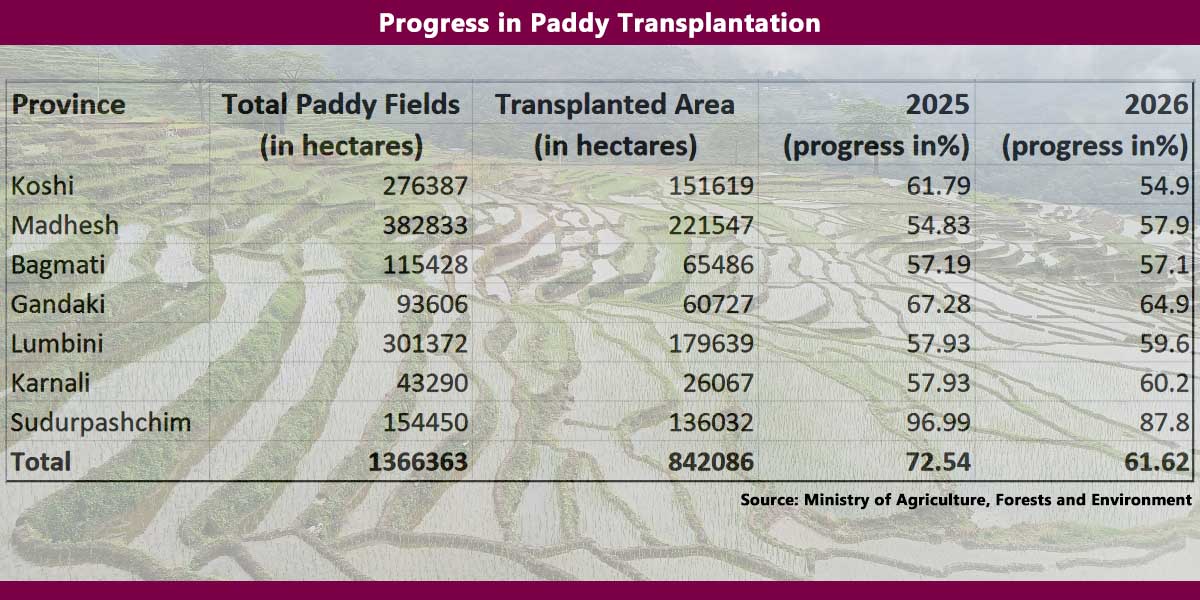
KATHMANDU: Paddy transplantation is gradually picking pace across the country following improved monsoon rainfall. However, the overall progress lags behind last year’s level, the latest data from the Ministry of Agriculture, Forest and Environment show.
As of July 16, paddy had been transplanted on 842,086 hectares, or 61.62% of the country’s total 1.37 million hectares of paddy fields. The progress in paddy transplantation had reached 72.54% on July 20 last year. This means progress this year is 10.92 percentage points behind compared to last year.
Among the provinces, Sudurpashchim has recorded the highest transplantation rate at 87.8%, although it remains below last year’s 96.99%. Gandaki is next with a transplantation progress of 64.9%, down from 67.28% a year ago. Likewise, in Karnali, transplantation has reached 60.2%, up from 57.93% last year, while Lumbini has completed 59.6% of transplantation, compared with 57.93% at the same time last year. Madhesh, the country’s largest rice-producing province, has also outperformed last year’s pace, with progress reaching 57.9%, up from 54.83% at the same time last year.
Bagmati has completed transplantation on 57.1% of paddy fields in the province, almost unchanged from 57.19% a year earlier, while Koshi has reported 54.9% progress, down from last year’s 61.79%.
The latest data show that three provinces—Madhesh, Lumbini and Karnali—have surpassed last year’s transplantation progress, while Koshi, Bagmati, Gandaki and Sudurpashchim remain behind.
Paddy contributes around 15% to agricultural GDP and 5% to total GDP. Total paddy production stood at 5.7 million tons in 2025/26.