 Himal Press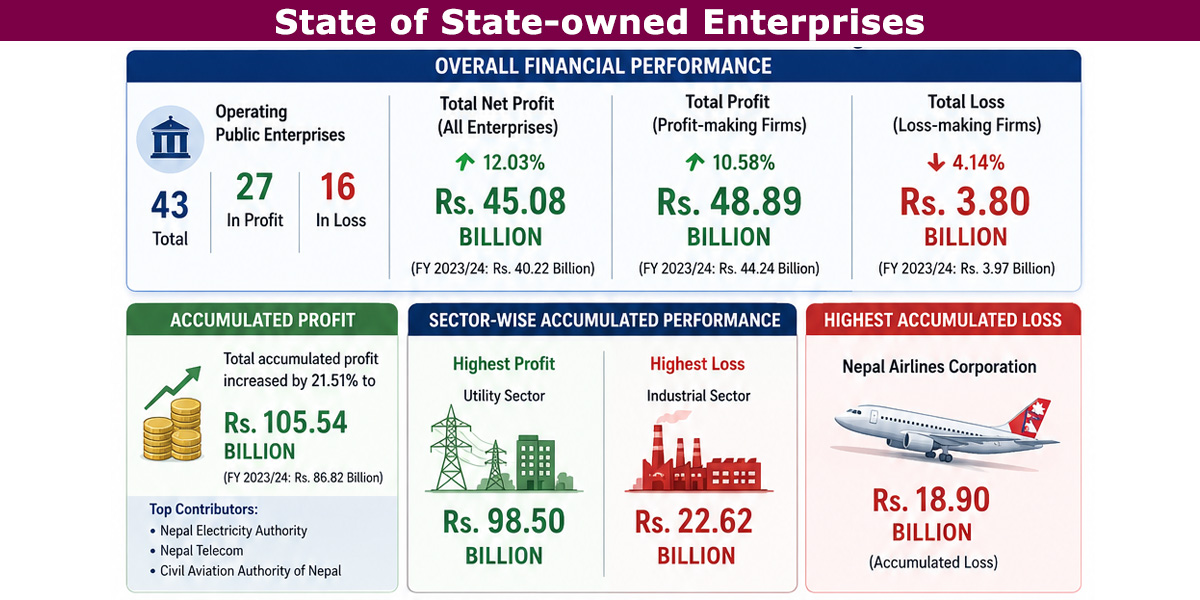
KATHMANDU: Out of 45 public enterprises in the country, only 27 ended the fiscal year 2024/25 in profit, while 16 posted losses and two have already closed, according to the latest situation report of public enterprises made public by the Ministry of Finance on Wednesday.
According to the report, although combined net profits of PEs rose by 12.03% compared to the previous fiscal year, deep-running structural and managerial weaknesses have continued to affect these entities.
The combined net profit of PEs reached Rs 45.08 billion during the review year. Profit-making enterprises collectively earned Rs 48.89 billion, up 10.58% from the previous fiscal year, while total losses of loss-making enterprises narrowed by 4.14% to Rs 3.80 billion.
While the figures suggest that state-owned enterprises have regained some financial momentum after years of instability, the overall picture is uneven as profits are concentrated in only a handful of large institutions.
The report shows that the accumulated profits of public enterprises surged by 21.51% to Rs 105.54 billion. The largest contributors were the Nepal Electricity Authority (NEA), Nepal Telecom (NT) and the Civil Aviation Authority of Nepal (CAAN).
Sector-wise, utilities emerged as the strongest performer, posting accumulated profits of Rs 98.50 billion. In contrast, the industrial sector recorded the highest accumulated losses at Rs 22.62 billion.
Nepal Airlines Corporation (NAC) is the most financially troubled institution among PEs. According to the report, the national flag carrier alone accounted for accumulated losses of Rs 18.90 billion. It also has the highest negative net worth, at Rs 7.93 billion.
Although the government continues to inject significant resources into state-owned enterprises, dividend returns have remained modest. The government received Rs 8.37 billion in dividends from PEs in the review year, slightly lower than the Rs 8.83 billion received a year earlier. The dividend return on total government equity investment stood at just 2.3%.
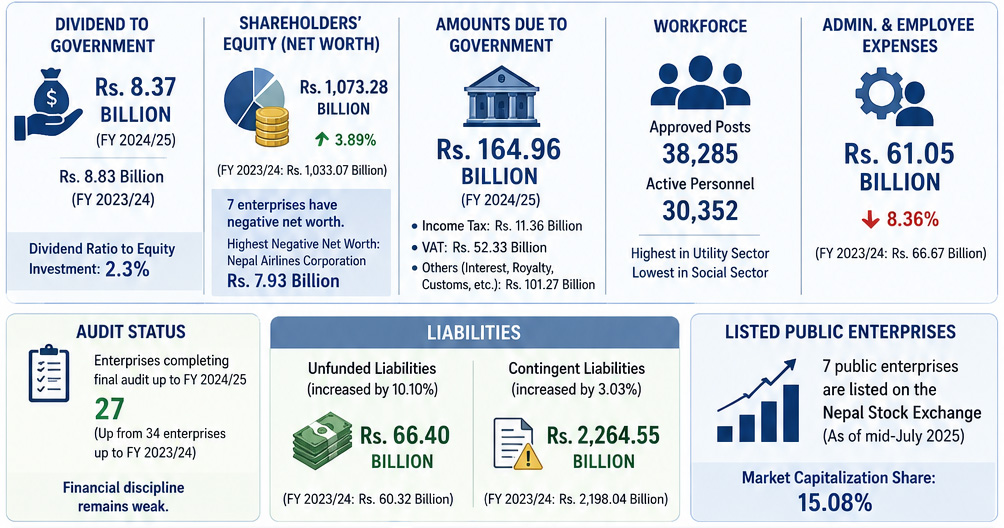
The net work of PEs rose by 3.89% to Rs 1,073 billion in the review year. However, seven of these enterprises are operating with a negative net worth.
The report also points to growing fiscal risks associated with public enterprises. Unfunded liabilities increased by 10.10% to Rs 66.40 billion, while contingent liabilities climbed to Rs 2,264 billion.
Despite their financial performance, PEs are one of the major sources of revenue for the government. According to the report, the government is due to receive Rs 164.96 billion under various headings from these enterprises. This includes Rs 11.36 billion in income tax and Rs 52.33 billion in value-added tax (VAT).
PEs are also among the largest job providers in the country. According to the report, these 45 PEs have 38,285 approved postins. They currently employ 30,352 workers, including permanent, contract and daily-wage staff.
Meanwhile, administrative and employee expenses of PEs fell by 8.36% to Rs 61.05 billion in the review year.
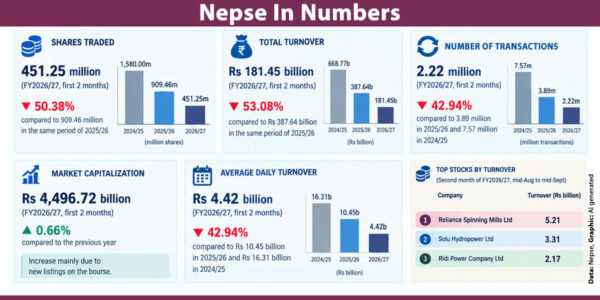
Seven PEs are currently listed on the Nepal Stock Exchange, accounting for 15.08% of the market’s total capitalization.
The report warns that many public enterprises are struggling with unclear objectives, weak competitiveness, operational inefficiency and poor management. Stating that the sector is facing both operational and financial crises, the report has recommended that the government bring an immediate reform program covering policy, structural and managerial changes.
Likewise, it has urged the government to reassess the scope of state involvement in enterprises and gradually divest investments from sectors where public ownership is no longer necessary.