 Himal Press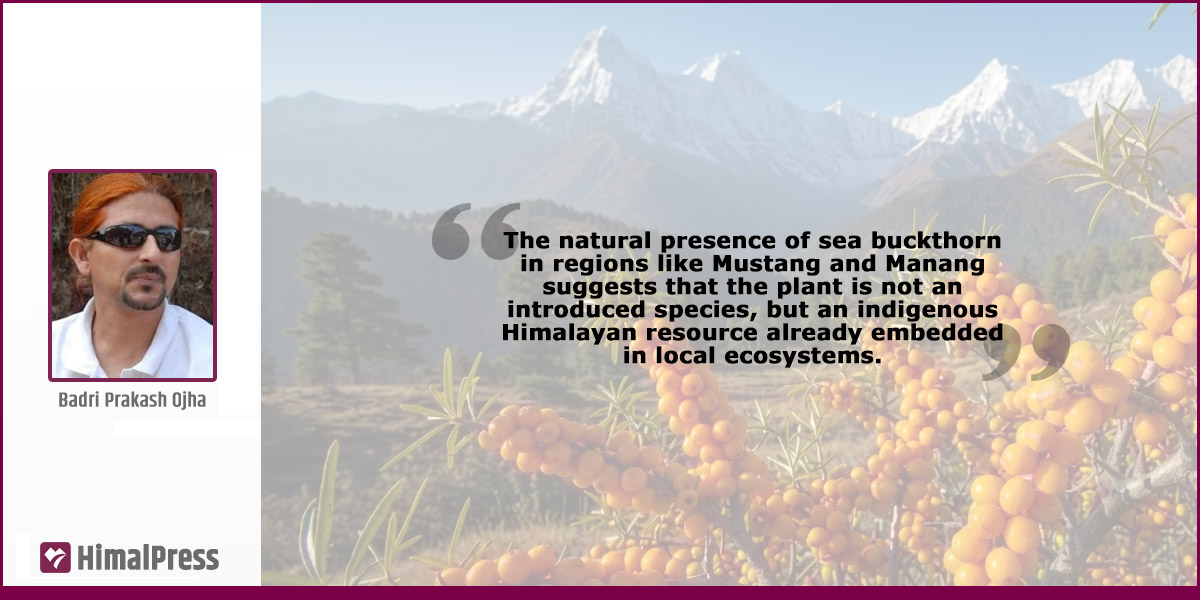
Sea buckthorn, locally known as dale chuk, is a hardy, thorny shrub native to the cold and dry mountain regions of Eurasia and the Himalayas, including Nepal’s high-altitude landscapes. In districts such as Manang and Mustang, it grows naturally in the wild, enduring rocky terrain, extreme cold, and thin air at high altitude.
The plant produces bright orange berries that are exceptionally rich in vitamin C, antioxidants, flavonoids, and omega fatty acids. In recent years, these naturally growing berries have already begun supporting small-scale juice production in Manang and Mustang—an early sign of the plant’s untapped economic potential in Nepal.
Long before sea buckthorn appeared in scientific journals and global health markets, it was already a part of Himalayan life. For centuries, communities across Nepal’s high hills and trans-Himalayan valleys recognized its resilience and value, using its berries and oil extracted from it for traditional remedies, nutrition, and household needs. Today, modern science is rediscovering what local communities have long known. Researchers now describe sea buckthorn as one of the world’s most nutrient-dense medicinal shrubs. Its berries contain a rare combination of bioactive compounds, including omega-7 fatty acids, carotenoids, polyphenols, and plant sterols, which have attracted growing interest in nutrition, dermatology, and pharmacology.
Scientific studies suggest that plants may support skin repair, reduce inflammation, improve cardiovascular health, and help regulate metabolism. However, much of the research remains experimental or in early clinical stages.
Unlike many conventional crops that require irrigation, fertile soil, and stable weather, sea buckthorn thrives in marginal land.
What makes sea buckthorn especially important for Nepal is not only its medicinal value, but also its remarkable adaptation to Himalayan ecology. Unlike many conventional crops that require irrigation, fertile soil, and stable weather, sea buckthorn thrives in marginal land. It can survive frost, drought, strong winds, and nutrient-poor soil. Its deep root system also helps stabilize slopes, reduce soil erosion, and improve soil fertility through nitrogen fixation. This makes the plant both an ecological protector and a potential agricultural asset.
Across the Himalayas, countries such as China, Mongolia, and India have already begun large-scale cultivation and industrial use of sea buckthorn. The plant is now processed into juices, herbal supplements, cosmetics, and pharmaceutical products. In Ladakh, India, for example, government-supported programs have helped build value chains connecting mountain farmers to national and international markets.
Nepal holds a similar geographical advantage. The natural presence of sea buckthorn in regions like Mustang and Manang suggests that it is not an introduced species, but an indigenous Himalayan resource already embedded in local ecosystems. The small-scale juice production emerging in these districts is a promising early step, though it remains limited by infrastructure, investment, and market access.
Value-added industries such as juice production, nutraceuticals, skincare products, and herbal exports could generate sustainable income while helping preserve fragile mountain ecosystems.
The broader opportunity lies in reimagining Himalayan agriculture. As climate change has started to affect traditional farming in mountain regions, crops like sea buckthorn offer a rare combination of resilience and profitability. It can grow where other crops fail, while providing high-value products that can connect remote communities to wider markets.
A structured approach involving community cooperatives, local processing units, research institutions, and provincial government support could transform sea buckthorn from a wild shrub into a key driver of high-altitude rural development. Value-added industries such as juice production, nutraceuticals, skincare products, and herbal exports could generate sustainable income while helping preserve fragile mountain ecosystems. At the same time, greater scientific collaboration within Nepal could deepen understanding of the plant’s nutritional and medicinal properties, paving the way for standardized products and stronger assurance systems for global markets. Ultimately, sea buckthorn represents more than just a plant. It reflects the resilience of the Himalayas themselves — surviving harsh conditions, protecting fragile landscapes, and quietly sustaining life.
For Nepal’s upper Himalayan districts, particularly Manang, Mustang, Dolpa and Solukhumbu, where the plant already grows naturally and is already being used for juice production, sea buckthorn offers a powerful reminder: development does not always require new introductions; sometimes it begins with recognizing the value of what mountains have provided all along.









![Yosin pole raised as Indrajatra festival begins in Kathmandu [In Pictures]](https://en.himalpress.com/wp-content/uploads/2026/09/Indrajatra-5-600x300.jpg)