
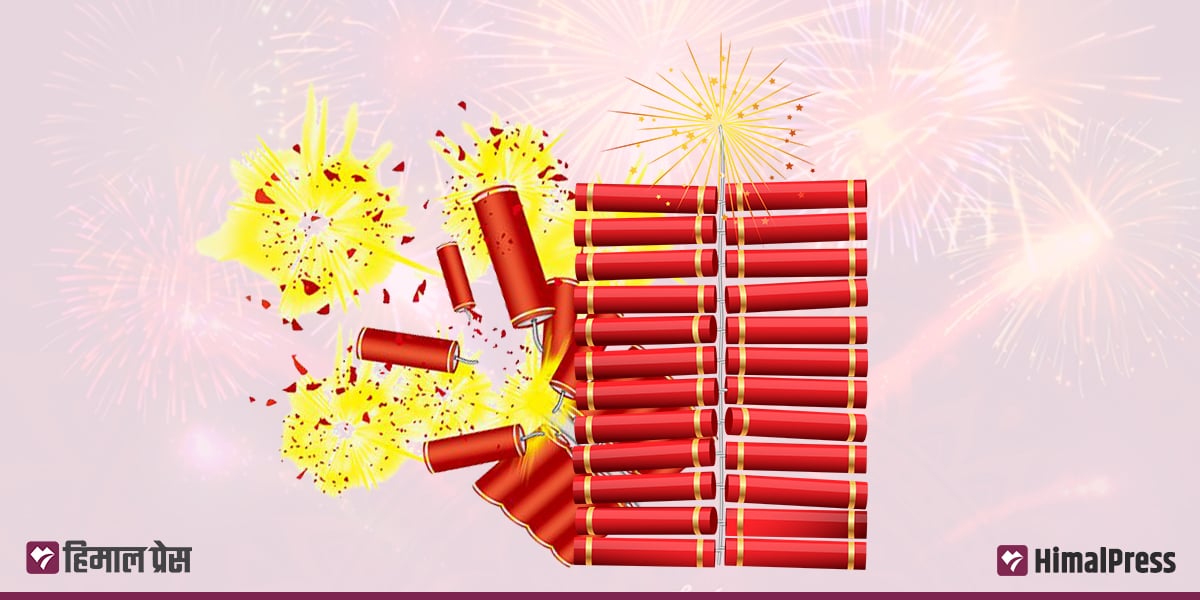
ITAHARI: The festival of lights and flowers, Tihar, is in full swing, bringing joy and color to homes across the country since Monday. But along with the celebration, there is also fear — the fear of firecracker-related fires.
Doctors warn that the loud explosions terrorizing towns not only disturb peace but also affect patients, elderly people, and children. The deafening noise has heightened anxiety in major towns across Koshi Province, including Dharan, Inaruwa, Itahari, Biratnagar, Sundar Haraicha, Urlabari, Belbari, Damak, Birtamod, Gaurigunj, Gaighat and Beltar.
Locals and officials say most of the firecrackers are smuggled into Nepal from India through open and weakly monitored borders in Sunsari, Morang and Jhapa districts.
In past years, Sangeet Chowk in Itahari used to turn into a lively hub of lights, as businesses decorated the market collectively to promote tourism. The area, however, has remained dark this year. Following the Gen Z protests on September 8 and 9, both municipal fire engines were torched by the protesters. The fears of fire hazards led the organizers to go against lighting this year.
Raju KC, general secretary of Sangeet Sadhana Pratisthan Nepal and the planner behind Sangeet Chowk’s decorations, said lighting was avoided this year due to the risk of fire. “Sangeet Chowk and Tihar complement each other, but with no fire engines available, it’s too risky,” he told Himal Press. “We had aimed to attract around 90,000 visitors every day during Tihar, but safety comes first.”
Before the festival, district administrations of Sunsari, Morang, and Jhapa issued notices banning firecrackers and all illegal gambling activities such as lotteries and dice. They also prohibited the sale, transport, or distribution of firecrackers. Despite these warnings, loud firecrackers continue to explode across urban centers.
Though officials have called for a peaceful celebration, urging the public to refrain from gambling, fireworks and public drinking, the appeal appears to have been largely ignored.
Police say most firecrackers are imported from India, particularly through Bhantabari (Sunsari), Jogbani (Morang), Kakarbhitta and Bhadrapur (Jhapa) and Pashupatinagar (Ilam) — all open border points. Sunsari alone shares a 62-kilometer open border with India, connecting through the Koshi Barrage area to Bihar’s Supaul and Araria districts.
Security officials admit that after the Gen Z movement in early September, their focus has shifted to domestic stability. “Since security personnel were preoccupied with internal management, this momentarily weakened border surveillance,” one security officer said.
Currently, Indian firecrackers are openly sold in border markets and towns like Itahari and Biratnagar.
According to DIG Ishwar Karki of the Koshi Province Police Office, firecracker imports have economic and health consequences. “Every Tihar, millions of rupees flow out of Nepal for firecrackers,” he said. “They serve no real purpose; they drain money, damage health and pollute the environment.”
Although police have confiscated firecrackers worth Rs 1.835 million from Sunsari, Morang and Jhapa so far, firecracker use has not stopped.
Health professionals say chemicals like aluminum nitrate, sulfur dioxide, lead and gunpowder used in firecrackers are more toxic than industrial pollutants. Dr Roshan Khadka of Koshi Hospital cautioned that the noise and smoke from fireworks can lead to miscarriage in pregnant women and affect children’s blood and nerves.
He added that children playing with firecrackers without washing their hands risk long-term chemical exposure and chronic illness.