

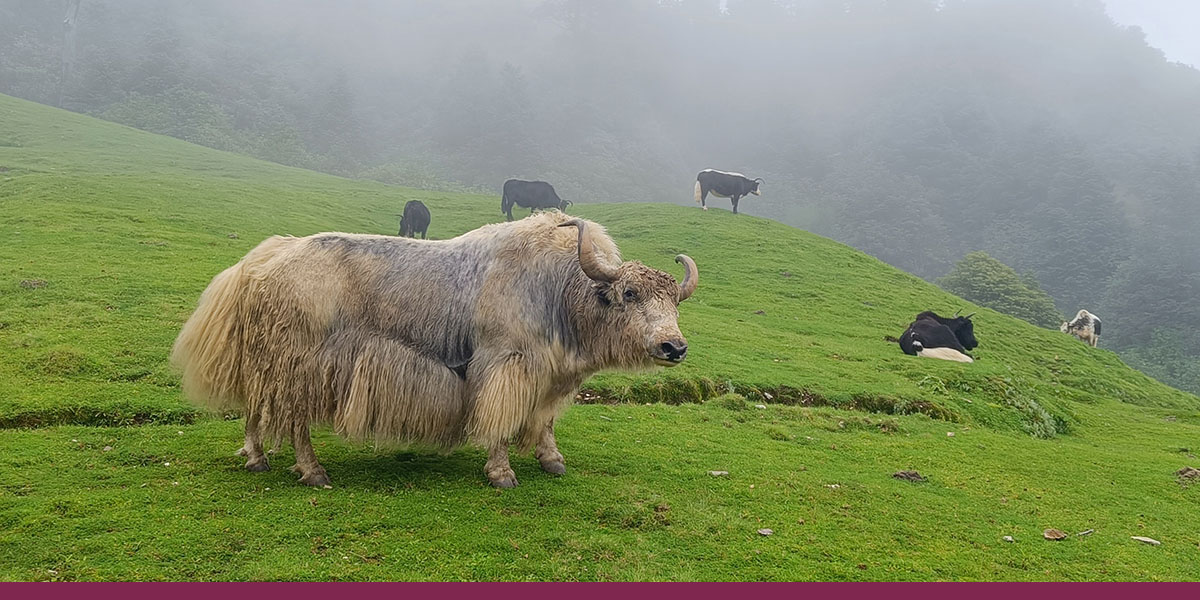
 Yaks grazing in Kalinchok of Dolakha (File Photo)
KATHMANDU: The population of yaks, one of the important domesticated animals in the Himalayan region of Nepal, is declining with each passing year. The government has yet to formulate any policy or plan for the conservation of these mountain bovines, leading to a decline in the number of farmers engaged in farming.
No specific programs have been implemented for the preservation and promotion of yak farming. However, officials of the Ministry of Agriculture and Livestock Development have said that they are working on conserving mountain livestock like yaks, sheep and mountain goats (chyangra).
The government began observing “National Yak Day” for the first time this year. A special event was organized in Kathmandu on April 20, where Minister for Agriculture and Livestock Development, Ramnath Adhikari, announced plans to introduce special initiatives to protect and promote commercial farming yaks, which are integral to Himalayan livelihoods.
Yak farming plays a vital role in the income, food security, nutrition and environmental balance of Himalayan communities. Minister Adhikari revealed that the upcoming budget will include provisions for yak conservation. “We are also making the local governments responsible for these efforts,” he said. “Concerted efforts from all stakeholders are essential for the conservation and promotion of yak farming. All three tiers of government must collaborate on a joint plan to protect biodiversity and empower Himalayan communities.”
Dawa Sangbu Sherpa, president of the Nepal Yak Farmers Federation, said yak farmers were suffering from geographical difficulties, migration, lack of grazing land and breeding issues. “Attacks by wild animals, a declining number of farmers and climate change are reducing yak numbers in the Himalayan region. Although the government provides minimal funds through local governments, this has failed to make any impact on yak farming,” Sherpa said. He demanded specific programs for preserving pure yak breeds and genetic improvement.
Yak population in Nepal, which was around 200,000 in the 1960s, has dwindled to approximately 54,000, according to the federation.
The recent Agriculture and Livestock Diary confirms this decline, stating that the number of yaks declined by over 12,000 between the 2020/21 and 2022/23 fiscal years. According to the Department of Livestock Services, there were 65,406 yaks in 2020/21, but the number dropped to 62,561 in 2021/22 and further to 53,195 in 2022/23.
Yaks are included in the protected wildlife list under the National Parks and Wildlife Conservation Act, 1973.
Agricultural experts accuse the government of failing to allocate a budget for yak and chauri conservation. Former Agriculture Secretary and agricultural expert Rajendra Bhari said all three tiers of government should prioritize breeding and genetic improvement of this mountain bovine. “Given the declining numbers, immediate conservation plans are necessary. Concrete programs, including establishing yak resource centers and production hubs, must be introduced,” he added.
Yak farmers see significant export potential for products made from yak hide and tails. The world-famous yak cheese, which is rich in omega-3 fatty acids, is produced only in Nepal. Chhurpi (hardened cheese), yogurt and other dairy products from yak milk are key income sources for Himalayan farmers.
Since yaks are also a symbol of Himalayan civilization, their conservation could create jobs and promote tourism, say experts.